



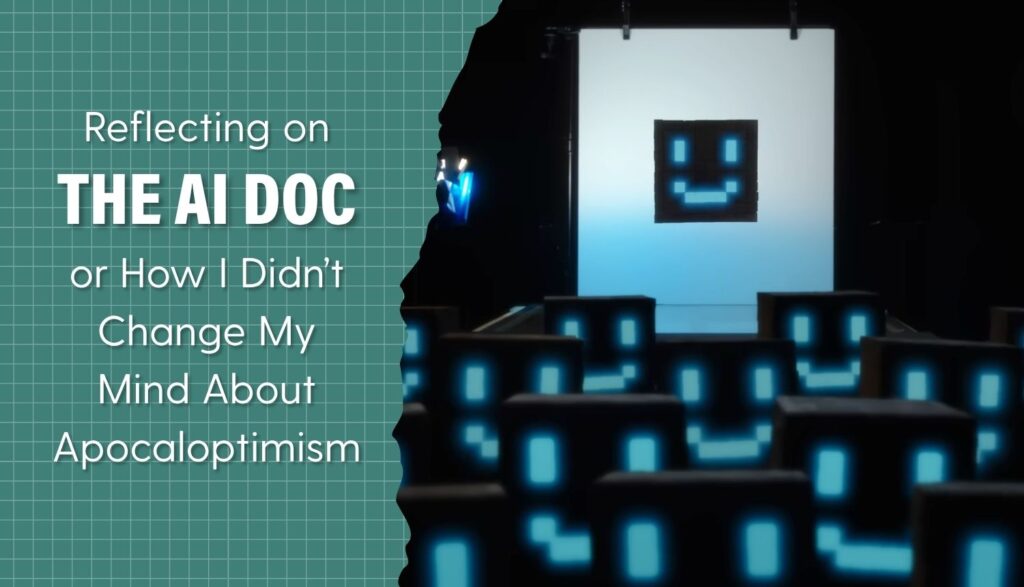
A couple of weeks ago, I got to attend a screening of The AI Doc. The documentary, subtitled “How I Became an Apocaloptimist,” was created by the filmmakers behind 2022’s Oscar-winning Everything Everywhere All at Once and Navalny. It aims to inform the public about artificial intelligence: What AI is, why it’s good, why it’s bad and what we as consumers need to know about it.
Co-director Daniel Roher interviews experts in the industry, both those who love AI and all its potential and those who fear it and what it could mean for the future of humanity. As Roher hears from those who embrace AI, he sees the possibilities that the technology offers: AI—that is, the possible future of AI, which would make the AI we see now almost infantile—could help us cure diseases, predict natural disasters, solve global hunger, etc. But discussions with AI doomsdayers puts Roher on edge. Like them, he begins to wonder if the machines, devoid of empathy and logical to a fault, will take a page from Spock’s book: “The needs of the many outweigh the needs of the few.” Or, potentially, the needs of AI outweigh the needs of us.
Roher’s anxiety and anticipation stem from the fact that, as he’s filming, his wife is expecting their first child. He wonders if AI will make the world better or worse for his son. Leaders of prominent AI companies, including OpenAI CEO Sam Altman and Anthropic president Daniela Amodei, reassure Roher that there’s never been a better time to have children. They say they’re excited about all that AI has to offer the next generation.
But they also recognize how AI might be misused. When asked why AI companies can’t just pause development until proper safety precautions can be established, Altman and Amodei point out that the technology has already come too far. People with ill intentions already have access to everything they need to cause potentially catastrophic events: The only way to combat those bad actors is to stay a few steps ahead of them.
When Roher hears that, he worries there may not be a world for his son to grow up in at all.
As I watched the film, none of this surprised me. In my role at Plugged In, I’ve read and written quite a bit about AI. My personal take is that AI isn’t good or evil. It doesn’t have consciousness, and it certainly doesn’t care about me. Rather, like the atomic bomb, it’s a powerful piece of technology—perhaps, given its near-limitless applications, the most powerful piece of technology that humans have ever created—that can be programmed and manipulated by people. And just like the bomb, we don’t know how people will use this technology.
But we can’t control the people who would misuse AI any more than we can control people who would use a bomb. We can set up safeguards and try to make it harder for bad things to happen, but at the end of the day, we are not in control.
Roher’s parents—two people who are decidedly not AI-savvy—tell him not to think about it too much. “You can only control what you control,” his dad sagely counsels.
If that sounds familiar, allow me to guide you to the book of Matthew, which was written nearly two thousand years before AI was even a twinkle in Alan Turing’s (the mathematician who laid the foundation for AI in the 1950s) eye:
“Therefore I tell you, do not be anxious about your life, what you will eat or what you will drink, nor about your body, what you will put on. Is not life more than food, and the body more than clothing? Look at the birds of the air: they neither sow nor reap nor gather into barns, and yet your heavenly Father feeds them. Are you not of more value than they? And which of you by being anxious can add a single hour to his span of life? And why are you anxious about clothing? Consider the lilies of the field, how they grow: they neither toil nor spin, yet I tell you, even Solomon in all his glory was not arrayed like one of these. But if God so clothes the grass of the field, which today is alive and tomorrow is thrown into the oven, will he not much more clothe you, O you of little faith? Therefore do not be anxious, saying, ‘What shall we eat?’ or ‘What shall we drink?’ or ‘What shall we wear?’ For the Gentiles seek after all these things, and your heavenly Father knows that you need them all. But seek first the kingdom of God and his righteousness, and all these things will be added to you. Therefore do not be anxious about tomorrow, for tomorrow will be anxious for itself. Sufficient for the day is its own trouble.”
Matthew 6:25-34 ESV
We are not in control. God is. So no matter how far AI takes us—whether it helps us find a cure for cancer or whether it results in something even worse—we should not be afraid. God will still be in control. None of this surprises Him. He knows what human beings are capable of. And He certainly knows what the machines we create are capable of.
So the next time you’re hovering between the pessimism of the AI apocalypse and the optimism of a Star Trek-esque future, I encourage you to repeat the words of the Apostle Paul as recorded in Romans 8:28: And we know that for those who love God all things work together for good, for those who are called according to his purpose.

Recent Comments