
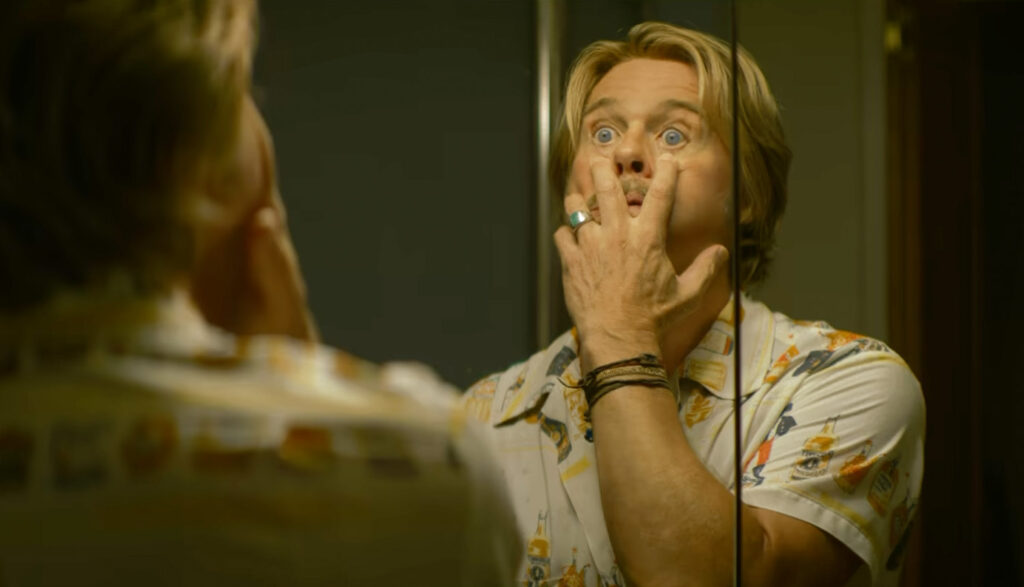
In Netflix’s The Further Mis-Adventures of Cliff Booth, the one-time Hollywood stunt double has a new side hustle: that of a hit man. This film is filled with sex, drugs, bloody violence (including two murders of children) and loads of profanity. But Quentin Tarantino wrote the script, so that just stands to reason.
Cliff Booth has had an eventful few years since he and his Hollywood pal Rick Dalton saved a certain Sharon Tate from a murderous gang of cultists. (The incident was chronicled, of course, in Once Upon a Time … in Hollywood.)
It’s 1977 now, and Cliff’s not serving as Rick’s stuntman anymore—not since Rick, um, literally outgrew him. But Cliff has served drinks as a bartender at some of the most unusual establishments in the greater Los Angeles metropolitan area. He’s competed in countless demolition derbies. He performs in the occasional porn flick. He cares for his cantankerous pops and his equally cantankerous cat.
Oh yeah, and he’s become something of a low-key hit man.
He doesn’t kill for just anyone, mind you. Just his friends. And it’s not like he relishes the work. Still, a gig’s a gig, and the occasional murder keeps his dad in beer and the cat in—well, whatever that cat eats.
But bartending and hit-manning can be unreliable work. Cliff would sure like another steady gig in Hollywood, just like he had … once upon a time.
And it looks like more Hollywood work might be heading his way. A rising star, —tough-guy TV icon Charlie Peters—wants to talk with Cliff about … something.
Is it stunt work? Probably not. Charlie does most of his own stunts. Is it advice about how to be a tougher tough guy on camera? Yeah, Cliff knows a thing or two about that, but he doesn’t like to brag. What could it be?
Cliff doesn’t rightly know. But he’d like to find out.
Maybe it’s because Cliff’s agent, Karen Crosby, is a beautiful, icy blonde with legs that go to Greenland. Maybe it’s because Charlie’s wife is Toni Peters, one of Cliff’s many (many) old flames. Or maybe Cliff’s just curious. A guy like Charlie doesn’t just call any old goat. Not without a good, and potentially lucrative, reason.
It wouldn’t have anything to do with those Filipino brothers who tote around an axe called Esmerelda and have a knack for killing people, would it?
Nah. Couldn’t be.
Cliff is a man of honor. Granted, it’s a perverted sense of honor, but still, he has standards.
When a woman wants to sleep with Cliff after an energetic night out, he tells her to go home. “I don’t want you to regret this tomorrow because you were horny,” he says—and then kicks himself for letting the opportunity sail by. He won’t take on those Filipino gangsters—the Verdusco brothers—for money. But when they kneecap one of Cliff’s favorite actors in the middle of Hollywood? That’s where he draws the line. “I cannot abide this kind of behavior,” he says.
And while we can argue that Cliff should’ve talked to the woman about the sanctity of marriage, or that he could’ve simply called the police regarding Verduscos, we cannot quibble with the tenderness with which he treats his father or the care he gives his dad’s very annoying cat.
We hear a line from a movie that includes the phrase, “I’m gonna tell you like the good Lord told John.” When someone asks why someone else partakes in a particular vice, he’s told, “It beats church.” When Cliff expresses regret over not sleeping with a willing participant, he says, “You were on God’s highway, and all the lights were green.”
We hear a reference to bad karma.
Cliff Booth occasionally moonlights as a porn actor—mostly in supporting roles, he says. But when a married woman (who apparently watches Cliff’s adult movies with her husband) recognizes him and compliments him on his “performance,” it’s clear he’s not just a character actor. Indeed, a quick flashback of one of his scenes shows him graphically having sex with his co-star (though no genitals are shown).
Dozens of women ogle Cliff during one of his bartending gigs, too, and he admits to Karen Crosby (Charlie’s agent) that he’s had affairs with loads of people. The only type of woman who’s yet to land on his list is a little person. He did, in fact, have an affair with Toni (Charlie’s wife) more than a decade previously—though Cliff says that no one should hold that against him because everyone was sleeping with everyone back then. Toni later tells Cliff that she met Charlie when she and Cliff were together. In fact, Toni was cheating on Cliff with Charlie.
All that is in the not-so-distant past here, though. Cliff is only interested in Karen, now. But he doesn’t want to sleep with her—or, at least, not at first. No, Cliff wants Karen to hit him. And Karen, sexually speaking, is interested in the hitting. She slaps Cliff hard across the face several times, satisfying the sadomasochistic desires of them both for a while.
Cliff and a woman make out in a tavern corridor, groping each other in various regions. They end their would-be lovemaking when they notice a child eyeing them.
A movie-within-the-movie depicts two characters talking in a strip club, where topless dancers in thongs writhe and bend over. The topic of conversation? How difficult it is to have meaningful sex with sex workers—and the drudgery and difficulty entailed in satisfying those women. (It’s not the only strip joint we see in Cliff Booth’s litany of movies.) The conversation is outrageously graphic.
Cliff meets with a young, effeminate man named Joey who slept with a famous, married, male director and robbed his house (taking the man’s Oscar award). Joey and his much-older boss hope to sell all the stuff back to the director (using Cliff as a go-between), and we hear some lurid conversation as to how Joey’s encounter with the director went. Later that evening—in a scheme to get Joey to leave town—Cliff threatens to frame Joey and tell legal authorities that the two of them (Cliff and Joey) were lovers.
When Cliff meets with the director to give him back his stuff, they talk about the director’s preferred sexual positions and his inability, under certain circumstances, to achieve an erection.
We see pictures of a married man surrounded by bare-breasted women. He appears to receive oral sex from a woman at one juncture in the film. Women engage in mud-wrestling—sometimes wearing barely there bikinis and, perhaps, topless. Women wear revealing outfits. We hear a reference or two to masturbation.
The Verdusco brothers kill a family of four in cold, quick blood. Searching for a wife and mother, they first shoot both of the woman’s twin boys in the head, leaving Rorschach-like splotches of blood on the white walls. They face off against the husband and hack him to death with an axe. When they find the woman, the brothers grab her hands and feet and fling her through a window, where she crashes to the concrete below. (We briefly see her body.) They later attack an actor in the street, sickeningly breaking both his arm and leg before driving away.
Two other men are shot to death. Someone is set on fire. A character loses a finger, while another bleeds to death in the middle of a blazing inferno.
We hear about Cliff’s service in the Philippines during World War II, where he allegedly killed 47 Japanese soldiers in close combat (not including those he killed with bombs or grenades). He describes how he’d kill people with knives—how familiar he is with the sensation—and when someone begs Cliff to tell him what killing someone feels like, Cliff advises him to kill a pig first. The man eventually does just that, and Cliff finds him covered in blood and weeping, the pig’s bloody carcass laying several feet away.
Charlie brags about killing countless guys in the movies, and we see several of those fictional deaths. (Other fictional, onscreen killings are depicted, too.) Someone recounts (and we see onscreen) a supposed incident involving Charlie, where he loaded a live round into his gun in order to get a more authentic performance from his co-star. It sounds as though he has a sadistic, nihilistic streak running through him. He expresses huge enthusiasm for his next project, where he’ll be choking the life out of a young woman as he stares into her eyes. (“Real sexual terror,” he says.)
Cliff drives a car in a demolition derby event, and he eventually crashes. After a few seconds, he climbs out of his wrecked vehicle with his thumb up, apparently to reassure the uncaring crowd that he’s just fine. Dozens of fish apparently die when their tank breaks. Women wrestle in mud to entertain bar patrons. In a violent movie, several characters lie dead or seriously injured after a shootout; the movie ends with one person pointing a gun at another and repeating a soon-to-be classic (and obscene) catchphrase. A character is threatened with a gun.
[Spoiler Warning] We learn that Charlie hired those Filipino gangsters to kill his wife—a contract he deeply regrets now. It’s at least one reason why they’re in town, to fulfill that contract.
At least 140 f-words, 50 s-words and one use of the c-word. We also hear multiple uses of the n-word, “a–,” “b–ch,” “b–tard,” “d–n,” “h—,” “c–ks–ker,” “f-ggot” and “pr–k.” God’s name is misused at least 10 times, most of those with the word “d–n.” Jesus’ name is abused twice, once with an f-word spliced in the midst of it. In this 1977 setting, someone refers to a little person by a term that is now considered offensive.
Among all his many other dubious talents, Cliff Booth is a talented mixologist. He’s particularly skilled at crafting margaritas, and a hefty scene is dedicated to him mixing and serving those drinks to an appreciative audience. He asks a couple of patrons if they’d like shots (to which they hurriedly agree). We’re more likely to see Cliff himself drinking cheap beer—a beverage that his father enjoys, too.
Elsewhere, characters drink wine and whiskey. Several characters smoke—sometimes cigarettes, sometimes what appears to be marijuana. Several scenes take place in bars and nightclubs. We hear references to all manner of drugs.
After Cliff kills someone, he stuffs the body into the trunk of a stolen car, drives that car to a rough neighborhood in greater L.A. and abandons it there. When Cliff’s unwilling accomplice asks why, Cliff tells him that the car will surely be stolen, and then the body will be the thieves’ problem.
Cliff urinates in a bathroom. A client gives Clint $15,000 to give to a couple of would-be extortionists and make the problem go away. When Clint makes that problem go away with a bullet or two, he keeps the $15,000 and allows his client to assume he paid off the extortionists as planned.
As I was writing this critique of The Further Mis-Adventures of Cliff Booth—wading through page after page of content concerns to piece together this vaguely coherent review—my wife came by and said, “Why don’t you just say it’s Quentin Tarantino? Do they need to know anything else?”
She has a point.
Ironically, The Further Mis-Adventures of Cliff Booth is not a Tarantino flick. David Fincher, who directed scads of award-winning movies such as Fight Club, The Curious Case of Benjamin Button and The Social Network, was the guy in the director’s chair this time around.
But let’s not kid ourselves: Tarantino’s fingerprints are all over this. He wrote the thing. The character Cliff Booth first appeared in Tarantino’s own Once Upon a Time … in Hollywood. And I half suspect that, even if Fincher is the director on record, Tarantino was somewhere just off camera, screaming, “More blood! More profanity! More everything!”
Make no mistake, Tarantino is a talented moviemaker. But alongside his ability to craft compelling dialogue and create a mesmerizing setting, most of Tarantino’s flicks feel like they have the soul of a middle schooler who thinks the height of wit is scrawling four-letter words on a bathroom stall. He makes movies for 13-year-old boys that 13-year-old boys should never, ever see.
I know a few Tarantino fans, and the man’s skills are not lost on me. But nor do they hold any particular attraction. I see Tarantino’s talents and can’t help but think that, more often than not, he squanders them in his puerile pursuit of excess and shock.
The Further Mis-Adventures of Cliff Booth, despite having two legendary directors at its core, is perhaps the most disappointing exercise yet. It’s as if someone wanted to make a movie about the old Dos Equis spokesman (“The most interesting man in the world”) and turn it into an NSFW farce. All the movie’s unquestioned style, top-notch dialogue and smarmy charm can’t hide its vacuous core. If Tarantino was a chef, he’d insist on slathering the filet mignon in Cheeto dust. If he was a painter, his Sistine Chapel would be coated in glitter and obscene graffiti.
The Further Mis-Adventures of Cliff Booth is a misadventure itself into the squalid realms of sex, violence and unremitting language concerns. And perhaps my discerning wife ultimately did say it best: It’s Tarantino. Do you need to know anything else?

Paul Asay has been part of the Plugged In staff since 2007, watching and reviewing roughly 15 quintillion movies and television shows. He’s written for a number of other publications, too, including Time, The Washington Post and Christianity Today. The author of several books, Paul loves to find spirituality in unexpected places, including popular entertainment, and he loves all things superhero. His vices include James Bond films, Mountain Dew and terrible B-grade movies. He’s married, has two children and a neurotic dog, runs marathons on occasion and hopes to someday own his own tuxedo. Feel free to follow him on Twitter @AsayPaul.