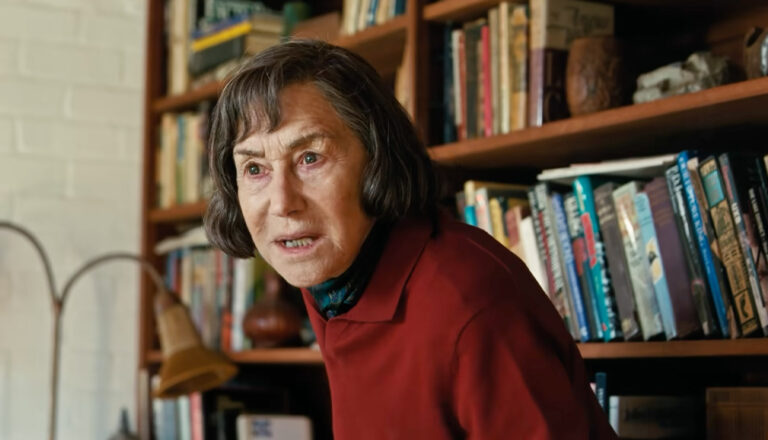

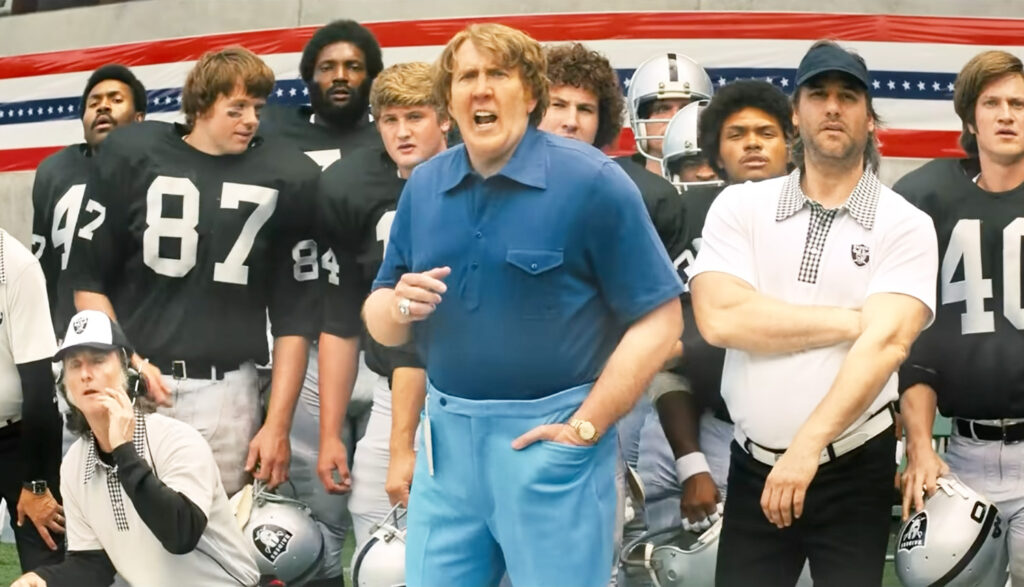
Madden draws up the plays of John Madden’s life in broad, semi-comical brushstrokes. Sometimes it works. And there are some nice statements made about friendship and marriage. But most of the quirky humor is tackled flat and the script is excessively profane.
John Madden’s life as a coach—struggling in the football trenches alongside Raiders team owner and friend Al Davis—has been incredibly successful. It’s also been something that has eaten up his life, stretched his marriage to the breaking point and left him with a bleeding ulcer.
You see, Madden’s football-obsessed mind can’t stop. He’s always devising and whiteboarding new plays, better defenses, flawless schemes. And he has a notebook full of it all that’s thick enough to choke a hungry elephant. But his wife, Virginia, points out that he’ll need to set all those things aside at some point before everything of true importance in his life crumbles.
Madden reluctantly agrees and announces his departure. But now what?
Al Davis suggests Madden forget about the possibility of death or divorce and just come back and use his gift the way it should be used. In lieu of that, he might try being a sports announcer or something. Al could even hook him up with CBS.
To Madden, that seems like an insane idea. Professional announcers like Pat Summerall couldn’t agree more. They certainly don’t want the galumphing ex-coach blathering away in the booth with them. But to everybody’s surprise, CBS signs Madden up and the American public kinda enjoys his coachy blather.
Madden makes coaches seem more approachable. He helps the audience understand the player’s mind. He diagrams plays and shows what’s happening on the field. He eats the local cuisine and talks with his mouth full. And the crowds adore him.
It’s kooky. It doesn’t make sense. But it works. And who knows? Madden’s time behind the mic might actually make him a football name that everyone recognizes.
Of course, there’s also this techy guy by the name of Trip—which is the worst football name ever—who’s been hounding Madden for years. He got this wacky idea about some kind of football game that people can play at home. They call it a video game. And it seems that all the kids are playing them.
Trip wants to call his game “John Madden Football.”
Madden laughs off the idea once more. But he does have this thick folder full of plays just gathering dust. So, who knows?
For all of his flaws and missing-in-action dad traits, John Madden wants to do better. He sees the strains his schedule puts on his family and hears his wife’s warnings about their marriage. And that awareness motivates him to leave coaching even more than his worsening health reports.
We see Madden and Virginia working on their marriage and trying to do their best for one another. And though Madden is unable to create his own idea of the best bonds with his sons, their collective family choices do seem to pay off in positive relational ways. Madden also has a great fear of flying but pushes himself to board a plane out of love for his wife (who’s a pilot).
We’re shown ways that Al Davis—a caustic, hard-driving businessman himself—also dedicates time and effort to the wife he loves.
At one point, an opposing team’s player is injured and left behind by his team. Madden is disturbed by that choice and goes to the ailing player’s hospital bed. After staying with the man and watching him suffer, he calls and demands that the opposing team’s coach turn their plane around and come back.
A neighbor leaves the Madden home with a call of “God bless.” While talking about priorities, Al Davis shunts aside any concern but football: “We answer to a higher god of some kind,” he declares.
Madden states that he attends Sunday Mass, but the only true belief he attests to is one associated with football: “I do believe when we die, we go to the Hall of Fame and the statues come down. They come to life, they’re talking,” he declares.
Madden and Virginia kiss on several occasions. When the family is away for a vacation, the couple dances, kisses, drinks and smokes together. It’s implied that they became more intimate off screen.
Al Davis and his wife, Carol, also kiss playfully at times. In one instance Carol is dressed in a frilly top and underwear.
We’re show some heavy-hitting football plays. One tackle hits a player so hard that he crumples unconscious to the ground and seems paralyzed as they put him on a stretcher and carry him off the field. A large player waves a gun around in the locker room. His teammates all pile on him with fists flying.
Virginia explains why her husband has a paralyzing fear of flying: An entire football team went down in a plane crash and died.
Virginia steers her boys away from fighting. But she also tells them that as a “Raiders family” they don’t take lip from anyone. So if they do fight, don’t get caught. We see the boys punch a kid who gives them guff about their “retired, loser coach” dad.
The dialogue holds more than 90 f-words and 20 s-words, along with multiple uses each of the words “d–n,” “b–tards,” “a–” and “h—.” Crude references are made to male genitals.
Both God’s name and Jesus’ name are abused a total of eight times (God being blended with “d–n” on four of those). Someone displays an offensive hand gesture.
Virginia smokes all the time, and Madden smokes, too. (He holds a cigar in his mouth several times, but we never see him light one.) But, in general, we see lots of people, including players and coaches, smoke. One player is said to have a five-pack-a-day smoking habit. There are also dinners and get-togethers that show people tossing back beer, wine and mixed drinks. Madden is featured in a beer commercial.
A player climbs out of a smoke-filled car, giving the impression that he was smoking marijuana. When a player starts waving a gun around and ranting, Al Davis calmly takes the weapon and tells the player, “These drugs, they’re driving you crazy.”
Madden’s ulcer causes him to chomp regularly on Tums antacid tablets. We hear of a time when the team had to drug Madden to get him on a plane. Someone calls Ritz the “heroin” of crackers.
A player has a regular habit of vomiting before a game. In fact, the other players count his vomiting as a show of good luck. John Madden’s ulcer drives him to vomit as well.
I’ll admit that my first thought, when I heard that Nicolas Cage was playing John Madden in a biopic, was that the film would either be an over-the-top joke or something of a trainwreck.
I was fairly accurate on both counts.
Madden lays out the football legend’s life in a quasi-documentary style. It attempts to blaze through the Madden backstory and its characters with very broad, semi-comical brushstrokes—making it all feel a bit like a series of Saturday Night Live routines that don’t always land their punchlines. And the fact that Kathryn Hahn’s portrayal of Virginia Madden is so pivotal to the story drives that SNL vibe home all the more.
However, when you take into account that John Madden himself became such an over-the-top caricature in the average American psyche—a bigger than life, Barnum & Bailey-like, lovable pitchman—the direction that the filmmakers take almost feels justified. And those that stick with the film will realize that Hahn actually helps the humor work better than it would have otherwise, and she gives the film a sort of anchor.
Not only that, but by its end, this movie has some nice things to say about marriage, dedication and friendship. Again, the beats are hit-and-miss and messy, but marriage and friendship can be those things, too.
The biggest fumble for discerning viewers, however, will be this film’s incessant need to cram-pack the dialogue with the foulest rat-ta-tat-tat of helmet-melting profanity. Maybe the people and players in John Madden’s orbit were every bit as vulgar and coprolalic as the film suggests. But hey, the filmmakers reshaped everything else. They could’ve tweaked that part, too.
My suggestion for your game plan? I’d pass. Or run. Both work.

After spending more than two decades touring, directing, writing and producing for Christian theater and radio (most recently for Adventures in Odyssey, which he still contributes to), Bob joined the Plugged In staff to help us focus more heavily on video games. He is also one of our primary movie reviewers.