VisionQuest
Vision is alive again—or as much as the AI synth ever is—in Disney+’s ‘VisionQuest.’ Though violent and profane, the show itself returns close to ‘WandaVision’ form.
Jurek Walter couldn’t be guilty. Not of this.
Sure, Walter is a bad, bad man. This serial killer has been known to bury people alive. Or burn them dead. He’s even talked someone into suicide.
But he was already in a psychiatric facility—locked away for life—when Felicia and Michael Frost, two kids from Fairhaven, Pennsylvania, disappeared without a trace. Evidence never suggested an accomplice. While Det. Jonah Lynn was sure that Walter was involved, the clues pointed elsewhere. Or rather, nowhere.
Then, years later, Michael Frost stumbles into a roadway—alive, but barely. His condition points to Walter’s typical methods.
With Felicia still missing, the race is on to find her. And while Walter’s still locked away, Jonah—now retired and grieving the loss of his own family—is determined to find the now 17-year-old girl, and pin the guilt on the man he knows is responsible.
It won’t be easy. Walter is a master of manipulation, able to dupe almost anyone in earshot into doing his business. One former psychiatric worker says that, when he dealt with Walter, he felt bad for the guy. “You feel sorry for a man who burned people alive,” the worker marvels in retrospect.
Plus, as mentioned, Walter has already been nabbed. He’s been declared insane, yes, but he’ll be in that mental institution for the rest of his life. Everyone knows he did some terrible things: Isn’t it a waste of time to hopelessly pin a few more crimes on the guy?
But Jonah knows that Walter’s the key to finding Felicia. He figures that the killer must have an accomplice on the outside. And somehow—despite all the high security around him and the prohibitions against Walter contacting anyone beyond the prison—he must be funneling the accomplice messages.
To find out how, Jonah and FBI agent Quinn decide on a radical course of action: They’ll enlist the help of Saga Bauer, a cop who grew up in Fairhaven and specializes in undercover work. She’ll masquerade as a mental patient and try to get close to Walter.
After all, Walter never met a person he didn’t want to use (or kill). And Saga’s own real-world backstory—that includes an alcoholic father and schizophrenic mother—should help prepare her for the role, and for Walter.
But Saga is also Jonah’s goddaughter and he’s determined to let no harm come to her. She’s the closest thing that Jonah has to family now. And if Walter should harm this young woman, no badge or cell or writ of law will keep Jonah from exacting his own form of justice.
Nocturne joins an ever-growing parade of high-sheen criminal dramas boasting big-time budgets and A-list casts. The cast for this Apple TV show may be, admittedly, more like an A-minus, but still, Nocturne looks and feels like the prestige thriller it is.
And yet, because we’ve seen so many prestige thrillers with brilliant, depraved villains, this one can blend in with the bunch.
Naturally, it tries to stand out by upping the show’s content problems.
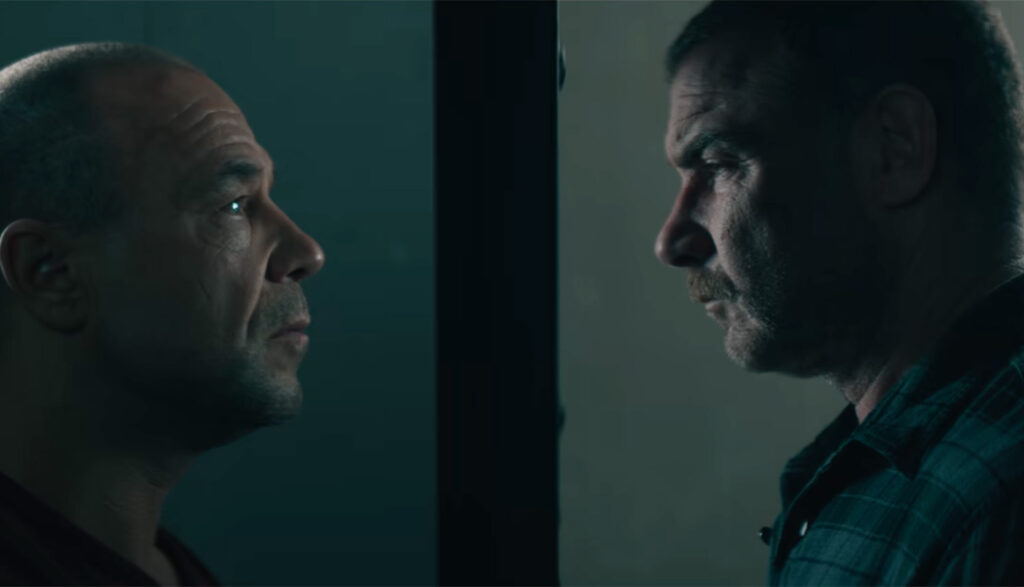
Based on a couple of novels by the husband-and-wife writing team of Alexander Ahndoril and Alexandra Coelho Ahndoril (who use the pen name Lars Kepler), Nocturne gives us a diabolical bad guy in Jurek Walter—one whose thirst for sadism is boundless and whose powers can feel practically supernatural. We’re treated to lurid descriptions of how he kills, and sometimes we see how he does it, too (even without laying a hand on his victim).
But the show’s good guys have their own sets of problems. Jonah hardly comes to the table with a clean conscience. Others have their own skeletons that Walter can use to his own ends. So, everyone seems guilty of something. And the more troubling that sin is, the better the show seems to like it.
We see blood and dead bodies. We hear plenty of swearing. We’re privy to lies and schemes, drug deals and shady activities.
The skies around Fairhaven seem perpetually shrouded in clouds, giving the show a grim, gray feel. And Nocturne, while at times compelling, comes with that same drab, bleak tone. But the content concerns? No shades of gray for those. While the streaming landscape may be filled with worse shows, Nocturne is bad enough.
(Editor’s Note: Plugged In is rarely able to watch every episode of a given series for review. As such, there’s always a chance that you might see a problem that we didn’t. If you notice content that you feel should be included in our review, send us an email at letters@pluggedin.com, or contact us via Facebook or Instagram, and be sure to let us know the episode number, title and season so that we can check it out.)

A boy stumbles into a roadway and is nearly hit by a truck. But when the lad is taken to the hospital, authorities quickly learn that he’s Michael Frost, a boy who disappeared three years before and had been presumed dead. But the jubilation at finding Michael alive quickly turns to a pressing question: Could Michael’s sister, the now 17-year-old Felicia, be alive, too?
Meanwhile, Jurek Walter—the man some suspected of being behind the kids’ disappearance—bides his time in a high-security psychiatric ward, looking for the right mark to do his bidding. He finds one in the well-meaning but vulnerable nurse, Karl.
In the opening scene, which takes place six months before most of the events of the series, we see Walter at work. He’s talking to another psychiatric inmate, encouraging him to bash his brains in and using religious justification to do so. “There’s only one way to stop the pain,” Walter says. “By making amends for all of your sins. And only then will the voices stop.” Walter goads the disturbed man on the other side of the wall, chiding him that prayer and talking to God won’t help him. He needs to “smash those voices out of your head.” And so the man tries—taking a running start and slamming his head into a concrete wall. He falls to the ground, a bloody mark on his forehead and blood pooling around his head. We later hear that someone killed himself in that high-security unit—presumably this poor soul—but no one knows Walter’s connection to the death.
Later, Karl is assigned to give Walter his meds—secretly a powerful sedative. It’s given via an injection, and Walter begins to convulse (a “rare side effect,” Karl is told) while Karl searches for a shiv that Walter had hidden under his bed. Walter wakes up before Karl can leave the cell, and a security team is dispatched. But Walter, instead of trying to hurt Karl, instead lures him into delivering a message to his “lawyer.” “They say I’m a monster,” Walter tells Karl. “But I’m still a human being.”
A woman is thwacked in the gut with a rifle butt. (We see the lurid-looking bruise on her abdomen throughout most of the rest of the episode because the woman wears a midriff-exposing shirt.) Several people are punched and knocked around in the same scene.
Michael is found “malnourished, dehydrated and temporarily blind” from being kept in a completely dark place for so long. Michael’s mother expresses relief that Michael’s disappearance wasn’t sexually motivated. We hear that Jonah’s last partner killed himself. We see the squalor in which Michael was kept—and perhaps where Felicia was, too. Detectives find a bottle that once contained sevoflurane, a powerful anesthetic that was one of Walter’s calling cards, at the scene.
A character works undercover in a drug operation: We see bags of either cocaine or heroin, along with a great deal of money. (A member of the cartel says that perhaps they should “party” with some of the merchandise, while another says that the merchandise will kill him.) A police briefing gathering is compared to an Alcoholics Anonymous meeting. Someone makes a reference to testicles.
We see and hear several allusions to religion, including the show’s title. A small statue of the Virgin Mary is found in a room. A cross hangs on a wall. Michael’s recovery is called a “miracle,” and we hear a reference to the Salem witch trials.
A male character takes off his shirt. Other peoples drink beer. We hear the f-word about 10 times and the s-word about seven. There’s a suggestion that Jonah might be hiding a bit of scandalous truth. We also hear “d–n,” “a–,” “h—” and “p-ss. God’s name is misused twice, once in combination with the word “d–n.” Jesus’ name is abused once.
Quinn, the FBI agent in charge of rescuing and recovering Felicia Frost, wonders how much she should trust Jonah—and whether she should put Saga into Walter’s mental facility as an undercover agent. Meanwhile, Walter continues to exploit and manipulate Karl for his own ends.
The episode opens three years before as Jonah and his former partner, Sam, question Walter about someone he allegedly buried alive. We receive an extensive description of how Walter wanted to make sure his victim “died slowly” before Walter starts suggesting that Sam has been drinking—and insinuates that he beats his wife. Sam then turns off the monitoring equipment and assaults Walter—punching him in the gut before Jonah can stop him. We later hear that Walter’s accusations were spot on: Jonah admits that his former partner did drink, and when he drank, he was a different, more violent person. (Sam later killed himself, and the show seems to suggest that it was at least partly Walter’s fault.)
Saga indeed goes undercover—wearing a cross around her neck that includes a small recorder. (The facility is unable to take it away from her because Saga is allegedly wearing it for “religious reasons.”) She’s made to take off all of her clothing, and the guard asks her to lift her breasts one by one. (The television audience’s view is sequestered to just the upper part of Saga’s chest, and nothing critical is seen.) Before checking in, Saga talks to Jonah about how to avoid taking her medication.
“What’s the worst that could happen?” Saga asks Jonah.
“You could OD on Thorazine,” Jonah tells her.
Walter purposefully chokes on his food, triggering a medical response. (He eventually spits food on a nurse and uses the opportunity to plant something on the guy.) Jonah investigates a house from which an entire family has mysteriously disappeared. We hear about Saga’s father (an alcoholic who apparently died from the effects of the disease) and meet her mother (who Saga says was once incarcerated but is now, apparently, living with a nurse. Someone chokes himself into unconsciousness.
Characters drink beer. We hear 22 f-words and about five s-words. “b–tard,” “h— and one abuse of Jesus’ name are also on tap.
Paul Asay has been part of the Plugged In staff since 2007, watching and reviewing roughly 15 quintillion movies and television shows. He’s written for a number of other publications, too, including Time, The Washington Post and Christianity Today. The author of several books, Paul loves to find spirituality in unexpected places, including popular entertainment, and he loves all things superhero. His vices include James Bond films, Mountain Dew and terrible B-grade movies. He’s married, has two children and a neurotic dog, runs marathons on occasion and hopes to someday own his own tuxedo. Feel free to follow him on Twitter @AsayPaul.

Vision is alive again—or as much as the AI synth ever is—in Disney+’s ‘VisionQuest.’ Though violent and profane, the show itself returns close to ‘WandaVision’ form.

‘American Horror Story’ combines just about every kind of fear you can imagine with sexual deviancy and blasphemous, convoluted plotlines.

The NYPD hires a quirky, former defense attorney in ‘Elsbeth.’ And while it’s a likable show, the content is sometimes out of order.

Peacock’s ‘Crystal Lake’ gives slasher fans a prequel to the ‘Friday the 13th’ franchise—a prequel that we really didn’t need.