

While The Mosquito Bowl does find a way to circle back and honor the men whose story its telling, the carnage of war is on full display here. With little new to add to the genre, combined with some concerning spirituality and near constant harsh language, many parents would be better off sharing other, more notable World War II with older teens.
Bob Bauman. Tony Butkovitch. John McLaughry. Dave Schreiner.
While certainly not household names for modern football fans or World War II history enthusiasts, these four men were big deals in the 1940s college football scene. These college boys met on the football field as their teams battled on multiple occasions.
But a real battlefield is an entirely different entity. And how one defines “victory” is a lot less cut and dry.
And that’s what these four men—barely more than boys, really—are facing as they’re pulled into the maelstrom of World War II.
For each man, leaving home means something different. Tony is giving up a continued football career with the Cleveland Rams—and his dream to play in the NFL. Bob shakily reassures his loving mother that he’ll make it back in one piece. John holds his girlfriend a little tighter than normal before saying goodbye. Dan watches through teary eyes as the train pulls away from his own lady, and the unborn child she carries in her womb.
These men are told that success now comes in the form of how many enemies they can kill, rather than how many touchdowns they can score. But as the war drags on, each man quickly realizes that a ticket home is not just a battle away. And perhaps the Japanese men that their drill instructors have demonized through months of training are just as scared to die as they are.
The characters at the core of The Mosquito Bowl are, football players, and their experiences on the football field both helped shape them and, ultimately, bond them to each other. In their college days, they compete against one another, leveraging lifelong lessons they’ve learned about teamwork and sacrifice. And during morale- boosting games overseas in army camps, these men—now teammates–clearly bond over strategy, leaning on each other’s abilities and drawing closer over the shared love of the game.
While some men’s motives for battle are deeply disturbing in this movie, we hear of at least a few soldiers who are fighting for noble reasons—to defend their country and save future lives. These same men also hold a respect for the loved ones they left back home, speaking fondly of family members and lovers alike.
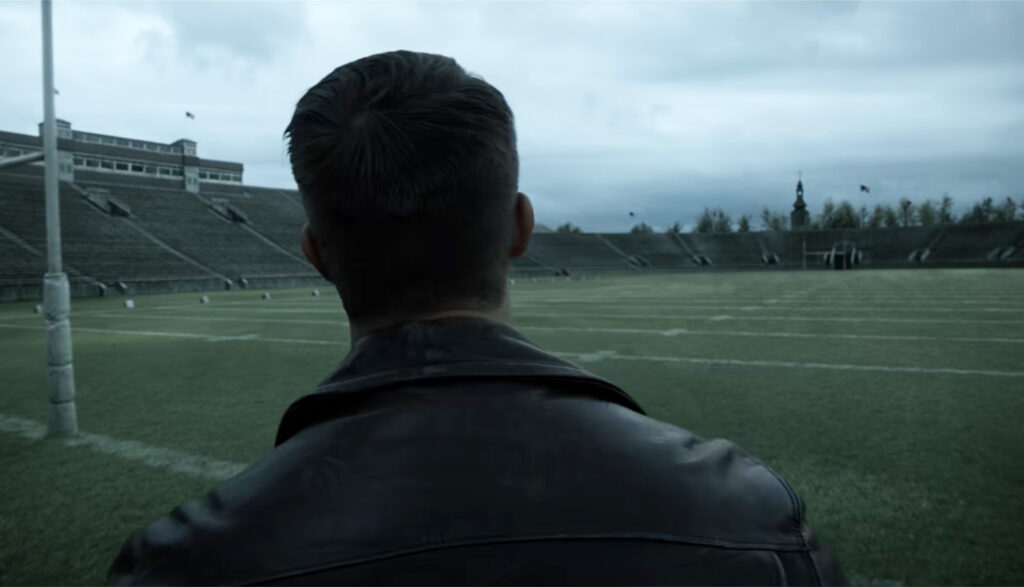
A veteran buries the dog tags of his fallen friends on the football field in which they played the game that they once loved, honoring them in death.
Soldiers make comments such as “before God, my rifle defends this country” and “we will make any Japanese that fights us a proper Christian—through proper Christian burials.”
A soldier who left his pregnant girlfriend back home speaks of the unborn child in a way that certainly feels Pro-Life, and he elaborates that he believes death toll from both sides is a “sacrifice for the unborn.”
A chaplain prays before a group of Marines invades a Japanese-controlled city. A Marine recites Psalm 91 from memory, which is often referred to as the “Soldier’s Psalm.” A soldier comments that “death doesn’t pick sides.” Johnny Cash’s rendition of the Christmas carol “The Little Drummer Boy” plays in a scene.
During a football game, a player comments that the rival team will “need more than heaven and earth to stop us.”
A soldier has a child out of wedlock with his girlfriend and mentions later that he regrets not marrying the woman. Multiple couples kiss, and one couple bathes together: While it is clear they are both naked, nothing pivotal from either person is shown. The pair discuss the magical moments of life that make it worth living–a conversation that quickly turns explicit as the woman says, with some graphic detail, that sex with her bathing partner is pretty magical.
During the harsh training the soldiers endure, a superior demeans a trainee by calling him a “sperm malfunction.” While certainly not meant to be tantalizing, a couple scenes show naked prisoners of war—crouching in a way where no private parts are seen.
Men bathe in the ocean, with the entirety of their bare backsides on display.
If I were to mention every moment of bodily carnage here, this review would take close to the runtime of the film to read. Parents be warned—the carnage of the battle scenes here rival that of the opening of Saving Private Ryan, potentially exceeding that film at times.
The camera is given a full, unflinching view of the deaths of what feels like hundreds of soldiers and civilians. Bullets, grenades, firebombs, flamethrowers, and bayonets fatally rip through scads of people. Some of these deaths are ancillary, adding to the overall carnage on display, while others are up-close, drawn out, and sickeningly personal.
Bullet wounds and blown-off limbs are accompanied with blood. Close-range head shots are frequent. A whimpering, nude prisoner of war is grotesquely shot in the neck, gurgling on his own blood for a few seconds before dying. Men wail in pain from wounds for minutes on end before finally being put out of their misery. The backs of multiple heads are exploded from close-range gunfire, spraying the recipient’s brain matter on nearby soldiers.
In an over-long and disturbing scene, a deranged American soldier asks other men if they’d like to purchase “trophies” of dead Japanese soldiers. These items include a skull, a human ear, and human teeth—some of which belonged to children.
Civilian women throw themselves off cliffs, bloodily slamming into rocks rather than (they think) suffering death at the hands of their enemies. As American soldiers torch a village, a woman screams that her baby is in a house. A woman detonates a bomb vest, blowing herself to bits, and taking a couple limbs off a nearby soldier. Japanese soldiers fall on their own swords in extended, wince-worthy scenes.
Bombs drop and gunfire pounds down on boats full of soldiers, who hardly have anywhere to hide from the onslaught. Waves crash them to shore, only for most of the soldiers to get obliterated by gunfire before they can even regain their bearings. Battlegrounds are littered with horrifyingly mangled dead bodies.
While clearly not nearly as visceral in comparison to scenes of battle, dozens of men take some pretty hard falls in football games—sometimes with the limited padding that was commonplace in the game in the 1940s, at other times with no such protection. Men engage in fistfights with each other, both in training for war and out of anger at one another.
Real footage of World War II, and specifically of the attack on Pearl Harbor, are briefly seen.
Harsh profanities fly as frequently as bullets on this cinematic battleground, and the damage from both is extensive. By my count, close to 115 audible f-words and 10 s-words, along with a handful each of “a–,” “b–ch,” and “d–n.” God’s name is misused about a dozen times, with half as many paired with “d–n.” Viewers also hear 15 uses of “h—” and a single use of “pr–k.” Japanese people are referred to using offensive slurs throughout the film.
Men smoke throughout, and they drink during a couple scenes that take place within a bar. Morphine is offered to a soldier whose injuries are causing him immense pain.
A couple soldiers’ vomit after battle. While it seems every man who enlisted has a slightly different reason, at least a few revel in the carnage they are causing, bragging about the body trophies they will take home to help embellish the stories they’ll share to friends and family.
Likely influenced by the dehumanizing propaganda fed to American soldiers about their enemy, a soldier screams, “this is what you do—you die” over and over again as he slowly kills his enemy.
Talking with fellow soldiers after they barely survive a skirmish and brutally kill multiple enemy soldiers, Bob describes to his fellow comrades the feeling of “white buzz” that he’s had throughout his life: His father forcing him to castrate a bull on the family farm. Slamming into another athlete on the football field. Shooting a man before his synapses can fire. These are all moments where his senses go blazing hot, as the “white demon” takes over, doing what needs to be done.
“I love that feeling” Bob admits. “Is that crazy?”
It seems annually around this time of year, a filmmaker forces audiences into the trenches of the Second World War. Those who forget history are doomed to repeat it—but must viewers indulge in such a brutally violent reminder every year?
While the hearts of the filmmakers are likely in the right place, one begins to wonder if the frequency of which these stories are told, or the realism, is entirely necessary.
The four men the film follows sacrificed to a level that most viewers will never fully understand. But in order to show us those sacrifices, it shoves its audience in the muddy, bloody trenches of war–all while screaming, “look at how hate and violence took so many innocent, civilian lives!”
That’s true enough. War does take life, and brutally so. To occasionally be exposed to the horrors of war will remind us just how awful it really is—and remind us of the sacrifices that people have made. But sometimes, all that onscreen brutality can feel salacious—serving up buckets of blood to pull people into their movie, not to make a greater statement about war and its cost. It’s hard to convincingly tell audiences that, on one hand, “no one should face such awful inhumanity,” while on the other saying, “except you! Watch our movie!”
The sepia-soaked images of brutality border on becoming a “white demon” in their own right. And while these are stories worth being told and men worthy of respect, the medium of film is not the only way to do so. Much more impactful war movies have hit theaters, even within the last few awards cycles. While The Mosquito Bowl is likely to leave a mark on audiences from the sheer, unflinching carnage on display, I would seek potential viewers to ask themselves a question: Is the intensity of this perilous journey going to ignite your own “white demon,” or is the goal of viewing such a film truly to respect the sacrifice of the men who died in this harrowing conflict? And if so, is subjecting yourself to similar visuals always the healthiest way to do so?

Jonah Parker’s first interaction with Plugged In came when he was just five years old, after his parents read a review for The Chronicles of Narnia: Prince Caspian and deemed the content too intense for him. What started out as a contentious relationship between Jonah and a staff of reviewers who knew not of his existence would later turn into an appreciation for the site’s ability to present media content in a way that was accurate and fair. Jonah enjoys analyzing how our entertainment echoes the creativity of our Creator while finding glimpses of Biblical truths within every genre. He believes that Robert Pattinson’s Batmobile is the perfect mix of cool and practical.