

A master thief recruits two younger thieves for an epic heist—stealing the Mona Lisa from the Louvre. The kicker? He’s also their long-lost father. You might expect this heist flick to be breezy, easy fun, but a wash of harsh language and some suggestive and sensual moments gum up the works.
Chiara is a master thief, who uses her prodigious hacking abilities to pull off her heists. Jay is also a master thief, who utilizes his expertise in controlled explosives to blast his way in and out of secure areas.
Chiara and Jay have never met. She lives in Italy; he in France. But they’re thrown together when they accept the same smash-and-grab job in Lake Como.
However, what was supposed to be a robbery is revealed to be a recruiting pitch. Roger, another master thief (how many master thieves are there, anyway?), hopes the pair will join him for a different heist. But Roger doesn’t want Chiara and Jay to join him for their talents alone. No, he wants them by his side for a more sentimental reason. He’s their father.
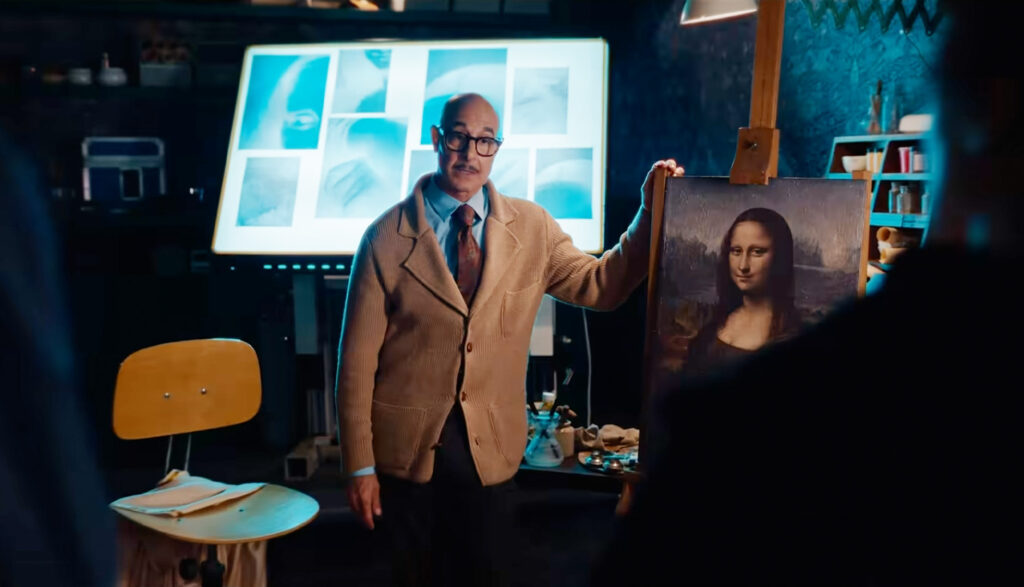
While Chiara and Jay reel from this revelation, Roger details the job they would undertake—a “family heist,” as he calls it, and one about as high profile as you can get:
Stealing the Mona Lisa.
After learning they are related, Chiara and Jay develop a bit of a rivalry. But eventually, the two come to care for each other and forge a sibling bond. Roger regrets the time he spent away from his children.
While building anticipation for an exquisite culinary experience, Roger tells a man that he’s “about to see God.”
Roger had short, separate flings with both Chiara’s and Jay’s mothers (making them half-siblings). Before Chiara and Jay discover they are related, they lightly flirt with one another while on a job, which includes Jay shaking his backside at Chiara.
We see Jay’s bare torso a few times and one shot of him lounging in boxers. Chiara wears a waitress disguise that reveals some cleavage. Later, she dons tight-fitting leather pants.
Characters chime in with some crude sexual quips and innuendo. Roger makes vulgar jokes about orgasms and pubic hair. Suggestive comments are made to disparage the size of certain male anatomical features. Chiara and Jay refer to the concept of “strip poker” as a way to settle bets—this is before the two know they’re related, and it doesn’t go beyond Jay strolling around shirtless.
There is a brief glimpse at a few sketches said to be from an art class, one of which shows a rendering of a topless woman.
One odd moment requires Roger to get in close to a target to steal something from the man’s waistcoat. Roger does this by faking an injury and asking the man to “stretch” him. Roger goads the man into jostling him around while he shouts encouragements. The whole encounter is awkward and could be seen as the film trying to get laughs from a semi-sexual allusion.
A text meant to distract a man includes the phrase “me so horny.” Someone jokes that a man will end up “butt-naked” as a result of a wager.
A scene takes place during a toga party, and we see flashes of skin which include most of a woman’s legs leading up to her buttocks and a man’s bare torso. A marble statue in the Louvre depicts a figure with the top of its buttocks visible. Someone is seen in his underwear. Someone jokes about the Tinder dating app.
Much of the violence that takes place in Masterplan is of the breezy, action-comedy variety. The most explosive action (pun intended) comes from Jay when he exercises his demolition expertise. But even these detonations are almost always controlled, a way to break down a wall or bypass a lock.
That said, there is one major exception: While pursued by a squad of soldiers, Jay blows up a car with C4, which causes a huge explosion that knocks the soldiers off their feet. Now, it must be said that the soldiers aren’t working for a villain or some governmental conspiracy. They are lawfully pursuing Jay and Chiara for a criminal act—and are killed (or nearly killed) by the movie’s “heroes” for their trouble. Masterplan clearly doesn’t intend for us to dwell on the moment, but it’s a thornier situation than presented.
A villain intends to kill someone, and he tells his henchmen that, if a man doesn’t comply with their wishes, they should “shoot [the man] in the face.” Soldiers breach a compound with guns, breaking through glass and arresting those inside. Some fire their weapons, though their bullets never hit anyone. A man briefly holds two people at gunpoint.
Nearly 40 f-words are heard—including one preceded by “mother”—in English, Italian and French. (The word is frequently spelled out in the movie’s subtitles.) The same goes for the almost 20 s-words that are heard here.
God’s name is misused four times, and Jesus’ name is abused once. Additional profanity includes uses of “d–n,” “a–hole” and “a–” (including the British pronunciation), “b–ch,” “b–tard,” “d–k,” “pr–k,” “p-ss” and “t-t.” The phrase “bugger off” is used.
Characters drink wine, champagne and liquor. Jay is seen holding a bottle of beer. A waitress totes a serving tray full of flaming shot glasses. Someone smokes a cigarette.
Masterplan is a movie about thieves. As such, our protagonists get up to plenty of, well, thievery throughout the runtime, which includes lying to and manipulating their targets.
Jay was raised without a father. Chiara grew up as an orphan and says that she was left in the care of an irresponsible foster family for a time.
Characters frequently lie to each other. A few betrayals take place. Someone fibs about an old war wound.
A man explains a woman’s delay in the bathroom by saying she has “urinary issues.” (She is actually planting a device for their upcoming heist.) Someone urinates in a can while riding in a car; we don’t see anything critical.
Heist movies will often try to recontextualize the theft that their protagonists commit: Someone must steal to survive; the heroes are stealing from a person or corporation who amassed their ill-gotten wealth through nefarious means; a reformed criminal is coerced into stealing once more as a way to pay off a past debt.
You get the idea. Call it the “Robin Hood Rule”—someone may be stealing from the rich, yes, but at the very least they’ll give some of it to the poor. Point is, there’s generally more justification given to a premise like this than simply “it looks cool.”
Not so with Prime Video’s Masterplan. It doesn’t give its premise much additional thought and hopes we won’t, either. In my mind, Masterplan is the very definition of what me might call a “direct-to-streaming movie.” It’s a lightweight film that’s as serviceable as it is disposable.
What’s not lightweight is this TV-MA flick’s content issues. Perhaps the biggest content alarm that Masterplan trips is found in its torrent of harsh language. Suggestive, sometimes vulgar, jokes and sensual moments break in, too. And, of course, the whole story revolves around a group of (unsympathetic) thieves as they lie, cheat and steal for their own gain.
Masterplan is no masterwork, and its content crimes will keep it from being breezy, flashy fun for discerning viewers.

Bret loves a good story—be it a movie, show, or video game—and enjoys geeking out about things like plot and story structure. He has a blast reading and writing fiction and has penned several short stories and screenplays. He and his wife love to kayak the many beautiful Colorado lakes with their dog.