

Based on the well-regarded video game Street Fighter II, the movie is much, much worse. Paramount Picture’s Street Fighter is loud, dumb and not much fun. And for families, the violence, language, sultry outfits and homoerotic jokes make this a very, very hard movie to navigate.
Ryu doesn’t want to fight. Really.
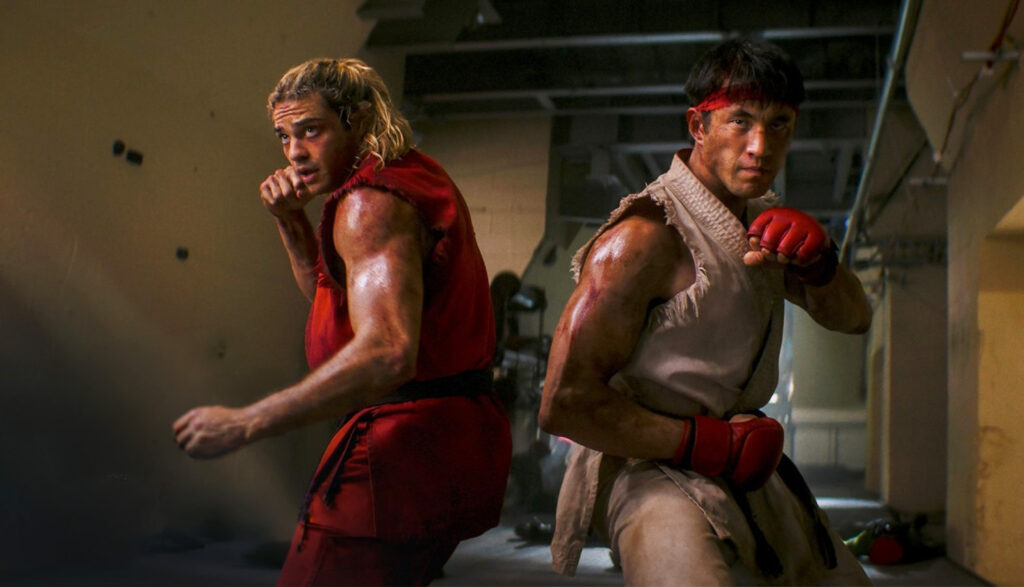
Oh, he used to be pretty good at it back in the day. In 1987, he won the first ever World Warrior Tournament, but he did so by tapping into some rather unfortunate powers that should’ve been locked away. (If Emperor Palpatine from the Star Wars universe had been in the audience, he would’ve been so proud.)
Ryu’s quick detour to the, um, dark side might’ve earned him a nifty little trophy, but it lured a demon into the mortal realm—a demon that, in an effort to draw out Ryu and his darkness, murdered Ryu’s mentor, Gouken.
That was a bummer. Not only did Ryu lose his sensei in Gouken, but his best friend and training partner, Ken. So Ryu decided to swear off fighting forever and spend his days as a street vendor, cooking pigeon soup for tourists.
But while he’s boiling birds, another World Warrior Tournament is forming.
M. Bison, dictator of the country of Shadaloo, wants this latest tournament to be huuuge. The best ever. Way better than the one those losers put on before. But Bison has an ulterior motive: See, he’s trying to siphon off something called “psycho power” from the strongest folks he can find. But the local tough guys he’s been milking haven’t given him the juice he’s looking for. No, what he needs is some real fighters. Some real street fighters. And if he can draw Ryu back into competition, why, Bison can kidnap the guy, drain him of his dark powers and be that much better for it.
That’s hardly enough to pull Ryu into the arena. He promised himself he’d never fight again. He promised his old dead master, too. The promise of another trophy just won’t cut it.
But then he learns of a new threat: Akuma—the very same demon who killed his mentor—says that he’ll face off and kill whoever wins this second World Warrior Tournament. The demon really, really hopes its Ryu. But if it happens to be Ken—that’s right, Ryu’s ex-bestie who’s competing in the hope of finally freeing himself of Ryu’s shadow—well, that’d be just too bad.
So Ryu decides he has no choice: He needs to enter the tournament and win it to save Ken’s life and the lives of everyone else involved. And if he’s good enough, maybe he can defeat Akuma, foil Bison and have enough energy left to slurp down a cup of pigeon soup.
Ryu’s desire to save lives at the risk of his own is nice. Ken doesn’t appreciate it at first, but the two ultimately patch up their relationship, and both take turns saving the other—sometimes physically, sometimes spiritually. Ryu also befriends an unlikely opponent.
A couple of other fighters have ulterior, and positive, motives of their own. Guile, a flat-haired U.S. Air Force pilot, is keeping tabs on the nefarious M. Bison, perhaps hoping to bring him in for some red, white and blue justice. Meanwhile, Chun-Li, secretly a member of Interpol, has infiltrated M. Bison’s inner circle with the same general idea in mind. And while her form of “justice” may look a bit more like revenge, at least both she and Guile do aim to stop a notorious dictator from wreaking any more damage.
Some of the fighters in the tourney seem to know and like each other. One, the Indian fighter Dhalsim, even tries to give Ken some helpful fighting and life advice during their bout.
Gouken does his best to teach both Ryu and Ken about the right way to go about fighting—and to not let their worst inclinations get the better of them.
A lot of the fighters here seem to pull strength from some spiritual or supernatural place.
Dhalsim is perhaps the most overtly faithful fighter we see: In the originating video games, he’s characterized as a yogi (a practitioner of yoga that goes waaay deeper than what you’ll see at the local health club), and I believe that he references the elephant-headed Hindu god Ganesh at some point. His limbs seem to stretch and slither more than strike.
Ken and Ryu draw power from somewhere, though the source is a little uncertain. In animated flashbacks to their training, we see them both try to conjure blue balls of power (elements of the original video games, of course) that have the ability to knock folks back and out. Ryu manages this better than Ken, but he also accesses a darker form of that power (represented by purple energy balls and Ryu’s own glowing red eyes). We’re told that this is a very dark power, one that turned Akuma into a demon. (Ryu, naturally, risks the same fate should he continue utilizing it.)
We’re told that evil or selfish thoughts can lead to one being infected (or empowered) by the dark powers we see here. And we learn that a character’s own jealousy and fear may have been the conduit for his own infection.
Akuma looks pretty demonic. He materializes into the mortal realm by way of a cloud pillar. Shadowy tendrils vibrate off his body, and he bears rows of extraordinarily pointy teeth.
M. Bison can levitate. A sumo wrestler seems to have some otherworldly powers. Ken totes Gouken’s ashes, and talks to them, to the tournament. An announcer tells the audience to “praise Lord Bison. Praise his name.” Someone is, essentially, resurrected when someone else sings a special song. When two fighters are held aloft by another, bigger fighter, someone shouts, “Let my people go!”
The original Street Fighter video games certainly did their share of objectification of both male and female fighters, and the movie gleefully follows suit.
Many of the men fight without shirts, of course. Ryu and another fighter battle while wearing towels wrapped around their respective waists, and at one point, Ryu’s opponent loses his. (We see the man’s ample bare backside while, from the front, the man covers his privates.) Ken admires his own abs in the mirror at one juncture. Women combatants wear, without exception, ridiculous, form-fitting outfits. One of Chun Li’s female rivals notes that M. Bison apparently loves Chun Li’s thighs. The rival gives those legs an ogle and sniffs derisively, “Not sure what the big deal is.”
That same lady rival leers flirtatiously at Chun Li while depositing what might be a wad of chewed gum in Chun Li’s hand. It’s hard to say whether the woman is simply taunting Chun Li or seriously attracted to her—which opens the door to discuss Street Fighter’s consistent homoerotic content.
The movie seems to play it all for laughs (mirroring, perhaps, the less sensitive 1993 timeframe in which the movie takes place), but we’re exposed to a steady stream of lewd allusions and double entendres. We can’t detail them all here (nor would we want to), but to give you a taste of what to expect:
Bison talks with a fighter and says, “You poor, dumb, pretty, handsome boy,” seeming to grow evermore agitated as he describes the fighter’s attractiveness. Another fighter talks about “fresh meat” entering a nightclub, then specifies that he “didn’t mean it sexually.” We hear references that are meant to hint at sexual acts.
We should also mention Dan, Ken’s promotional manager and current best friend. The film seems to play with the idea that Dan may have a Mr. Burns/Smithers-like relationship with Ken—an insinuated crush that presumably goes unrequited. In one scene, a morose Ken tells Dan that he loves him (platonically speaking), and Dan tells him that if they have any more similar heart-to-hearts, Ken should put on a shirt. In another scene, Chun Li interrupts Ken and Dan literally sleeping on a club floor next to each other, with Dan (wearing just brief-style underwear) apparently spooning with his client. (Much is made of Dan’s pink gi, which he insists turned pink when he accidentally washed it with a red shirt.)
We see people wearing skimpy bikinis. Chun Li’s Interpol partner dresses a computer-based image of his partner with various bits of revealing clothing, like a digital paper doll.
The tagline for Street Fighter is “To live is to fight, and to fight is to live.” That, and the film’s title, should give you a hint that there’s a whole lotta fighting going on here.
People indeed fight in the street. And in nightclubs. And in prisons. And in hotel rooms. And sometimes, they even fight in actual arenas. The action is unremitting, and, of course, it’s impossible to document the fall of every fist here. But the action definitely comes with an outlandish video game sensibility. Opponents can be given uppercuts that launch them 20 feet into the air. One fighter comes with a set of blades on his fists, and his opponent bears some deep scars on his face proceeding their encounter. (The opponent seems largely unbothered, though.) Characters are occasionally knocked through walls or slammed into floors. And one poor soul is literally vaporized when his opponent reaches into his chest.
One fighter (an unofficial one in this movie, but a fixture in the Street Fighter games) can conduct electricity in addition to being super strong. Three lackeys try to draw him into a large room with some massive chains: The fighter (Blanka) flings two of his would-be captors into walls and electrocutes the third.
Live-action fights can feature flying blood and lots of concussions. But the film sometimes slips into animated flashbacks, which feel both more violent and a bit bloodier. It’s in this mode where we see Gouken brutally murdered via supernatural chest manipulation.
In order to prove her loyalty, Chun Li pushes the palm of her hand into a flaming brand, and she bears the wound for the rest of the film. The process through which M. Bison drains fighters of their energies features those unwilling donors bound and strapped to tubes—tubes that seem to funnel purple-looking fluid to Bison. The scientists who supply Bison with this energy are occasionally killed through mysterious (but violent) means.
A vehicle is blown up.
We hear at least one f-word, likely more. About 10 s-words are also uttered, along with multiple uses of “a–,” “b–ch,” “b–tard” and “h—.” God’s name is misused five times—most of those with the word “d–n”—and Jesus’ name is abused once.
Ken is a notorious party animal. We see him attend several nightclubs and parties, And he’s seriously intoxicated at least once. He tries to encourage some other revelers with the promise of more beer.
Other fighters drink beer, whiskey and mixed drinks at a nightclub. M. Bison talks about the “intoxication” he feels when he absorbs other fighters’ energies.
Ken can seem rabidly irresponsible at times, and we’re told that his fellow fighters often look at him as something of a joke.
It’s apt that Street Fighter is set in 1993, an era when Hollywood was just beginning to make movies based on video games and failing spectacularly at doing so. It was the very same year that moviegoers were treated to the legendary disaster of Super Mario Bros.—a film that boasts a generous 26% rating on Rotten Tomatoes.
Street Fighter might not be that bad. But it’s bad enough.
The film seems to try to tap the same well that 2026’s Masters of the Universe did, which gave moviegoers a fun, silly, action-packed sendup of the original property. But while Masters sold its inside jokes with a wink and a wry smile, Street Fighter tries to win you over with a drunken laugh that goes five minutes too long.
The action is fine, as far as it goes. And Street Fighter does try to give us a small bit of redemptive value in its story of Ryu and Ken. But as a movie, Street Fighter just doesn’t work. At all.
And that’s before we take into account its content issues, pegged at ridiculous levels given its PG-13 rating. We’d expect the violence, of course. But the blood? The bare bums? The constant patter of eye-rolling, homoerotic jokes? The language? It all makes for a dispiriting two-hour watch for anyone—but especially abhorrent for a family audience.
In the originating video game, Street Fighter II, the announcer would helpfully tell the player just what happened after playing: “You win!” he would say. “You lose!” he might shout. “Perfect!” you’d hear, if you didn’t lose any life.
Well, this is a perfect disaster of a movie. And I’d hate for you to lose two hours of your life watching it.

Paul Asay has been part of the Plugged In staff since 2007, watching and reviewing roughly 15 quintillion movies and television shows. He’s written for a number of other publications, too, including Time, The Washington Post and Christianity Today. The author of several books, Paul loves to find spirituality in unexpected places, including popular entertainment, and he loves all things superhero. His vices include James Bond films, Mountain Dew and terrible B-grade movies. He’s married, has two children and a neurotic dog, runs marathons on occasion and hopes to someday own his own tuxedo. Feel free to follow him on Twitter @AsayPaul.