

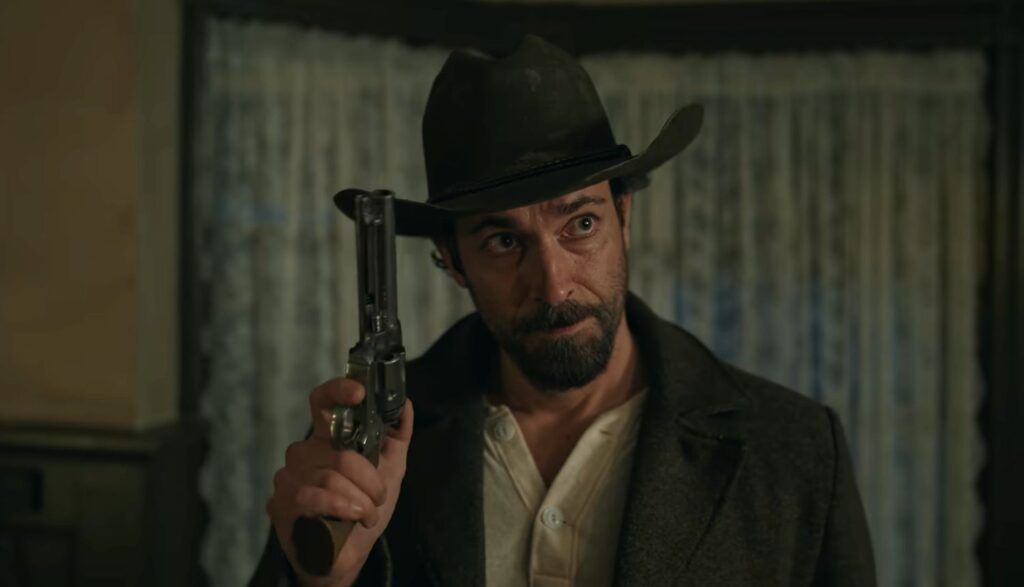
In Angel and the Badman, outlaw and killer Quirt Evans is reformed by a frontier family’s Christian charity. This Western flick has some gunslinging violence, a bit of language and references to prostitution. But it also presents Christianity in a wholly positive light and contains plenty of heroism and self-sacrifice.
“If I ain’t looking out for me, ain’t nobody else going to.”
Of all the mantras held by outlaw Quirt Evans, that might be the one he holds closest to his heart. Life ain’t easy on the Western frontier, and Quirt has gotten pretty good at looking out for himself. His talent with a six-shooter hasn’t hurt, neither.
But Quirt might have bit off more than he can chew this time. He swiped a case of Confederate gold from a fellow named Laredo—a former business associate and desperado—and caught a bullet for his trouble. If that weren’t bad enough, Quirt has the law nipping at his heels, too.
The buzzards are circling. It seems mighty likely that Quirt Evans will soon end up six feet under, whether by an outlaw’s bullet or a lawman’s noose.
Then, the unexpected happens: Quirt’s horse carries its wounded master to a solitary ranch, into the care of the Worth family.
The Worth women—daughter Penny, mother Irene and grandmother Harriet—decide that the Christian thing to do is to tend to the injured and delirious Quirt, despite the dangers he may pose. Under their care, Quirt makes a full recovery. But no sooner is the outlaw back on his feet than he’s looking to mosey on with his ill-gotten gain.
However, circumstances prevent such an easy exodus, and Quirt remains with the Worths a little while longer. In spite of himself, the outlaw finds himself drawn to the family’s peaceful and prayerful ways—not to mention, to the lovely and spirited Penny.
Angel and the Badman is about, well, a bad man coming to recognize the error of his ways and becoming a better person thanks to his exposure to virtuous people. Quirt’s initial dismissiveness of the Worth family’s trust in God (which he sees as naivete) changes to genuine admiration when he sees their faith in action—and the change their faith enacts in the lives of others (including his own).
For instance, Quirt helps the Worths by intimidating a greedy neighbor to stop hoarding precious water; however, the film reveals that this would have only been a temporary victory. The neighbor tells Quirt that what convinced him to continue sharing his water was not the threat of violence, but the kindliness and generosity shown to him by the Worth family. (Though he still thanks Quirt for his part in initiating the change.)
Penny is patient and kind. She sees the promise of good in everything around her, even if deeply buried, from a stubborn, wild stallion to the equally bull-headed and rugged Quirt. Irene willingly tends to the wounds of a man who would kill her without hesitation.
Characters make self-sacrificial choices and risk their lives for one another. A lawman pursues justice.
While some characters scoff at Christian practices, including prayer, Christianity (and Christian fellowship) is portrayed in a wholly positive light in Angel and the Badman. Faith in Jesus Christ is presented as the path to redemption, even if one has wandered far from God, exemplified by a pastor’s sermon on the Good Thief from Luke 23:39-43.
As mentioned, the Worth women decide to care for Quirt because they feel it is the “Christian thing to do.” Due in a large part to their influence, Quirt experiences something of a spiritual conversion himself: He initially scoffs at Christian ideals but comes to embody them by the time the credits roll.
Characters pray to God. A family holds hands and prays over a dinner table. Penny clarifies that she does not pray for a change in her circumstances, but for God to change the hearts of those hardened.
In a moment of doubt, Penny looks at a cross and wonders if God has “another plan for her.” Quirt asks God a similar question. (They both receive fairly clear and immediate answers.) Penny says she doesn’t believe in luck, but that things happen for a reason in “God’s plan.”
The Worth family attends church together and invites anyone they come across to join them. A minister preaches from the pulpit of a country church; we see crosses and the instruments of Holy Communion.
Early on, Quirt lies to the Marshal, saying he was “reading his Scripture” that morning in an attempt to deflect suspicion about his criminal deeds. A man says that he’s “a doctor, not a monk.”
A man is praised for “igniting the love of Christ” in a person’s heart. Someone wonders why people were afraid to meet angels as recorded in the Bible. He then compares a confrontation with Quirt to those experiences. The Marshal believes in a “natural order” to the world—that, sooner or later, every man gets what he “deserves.”
An outlaw quotes the first part of Revelation 22:11 (“He that is unjust, let him be unjust still”) as if to imply that he is beyond God’s redemption.
Someone says that he’ll look for a woman “at [church] service.” Someone uses the phrase “heaven knows.” The term “she-devil” is heard. A prostitute makes a snide remark about a man’s Bible. There is a joking reference to a “virgin birth.” Women sing part of the hymn “There Is a Fountain Filled with Blood.” Someone mentions “the evil light” from Latin American folklore.
We see a handful of crosses hanging on walls or on dressers, including a crucifix. Crosses mark the graves of the dead.
Quirt and Penny develop romantic feelings for each other over the course of Angel and the Badman, but their interactions remain chaste. However, during their first interaction, Quirt assumes they had sex since Penny is asleep next to him in bed. In actuality, Penny simply fell asleep there while tending to his injuries, and Penny tells Quirt as much when she realizes what he’s implying.
A couple shares a kiss and embrace.
Quirt says Penny is “pretty.” In his wounded delirium, Quirt mumbles about some of the women with whom he’s been romantically involved. We see a bit of Quirt’s bare upper torso.
Irene is practical and initially tries to set up Penny with a nice (if dull) young man who fancies her. Irene invites the young man over for lunch and even lays out her old wedding dress to “encourage” the man to ask for Penny’s hand in marriage.
While the film never shows anything remotely explicit, nor dives into graphic detail, female prostitutes are present in several scenes, and their business is fairly obvious. These women wear clothing that shows some of their shoulders. We see a man kissing the neck of one of these women. An older woman offers “company” to a group of outlaws “for a fair price.” It’s never mentioned outright, but one man has a persistent cough, skin sores and a particular distaste for prostitutes—which could indicate that he suffers from a sexually-transmitted infection, such as syphilis.
A few suggestive comments crop up in dialogue, including a leering comment about Quirt’s relationship with Penny. Quirt half-jokingly wonders if any of the Worths’ fellow churchgoers “know how babies are made.”
Angel and the Badman contains a fair bit of shoot-’em-up Western violence. Characters fire guns, and people get injured or killed. That said, the film restrain its use of blood, saving it for the moments when we need to know that someone is wounded (i.e., a blood stain through a shirt). A grislier scene is glimpsed at one point, the aftermath of a cold-blooded killing, but the camera doesn’t linger for long.
A man is interrogated, beaten and then choked with a rope. Someone accidentally shoots his own foot. People are knocked unconscious with blunt objects. A man is tackled off his horse. Someone gets a railroad spike stabbed into his shoulder; it happens off camera, but we see the bloody wound afterward.
Laredo’s gang threatens people with death; some unfortunate victims experience the gang’s brutal follow-through (mostly off-screen). A man sets fire to a saloon after having his men kill everyone inside (again, mostly off-screen).
Quirt hits a man with the butt of a gun. Saloon patrons brawl and beat up someone. A doctor prepares to amputate a man’s leg, chisel in hand. (He is interrupted.)
One of Laredo’s men makes a not-so-veiled threat at sexual violence against Penny. A villain forces a woman to put on a wedding dress in an uncomfortable scene that one could interpret as a prelude to sexual violence, but the man’s specific intentions are unclear. (He leaves the room while she changes.)
It’s implied that Quirt’s father whipped him as a boy. Someone tells a gross story about an animal’s death. Quirt has a disturbing dream featuring a snake and a hangman’s noose.
“H—” is the most frequent profanity heard here, popping up five times. “B–tard” is used three times. Milder language includes “crap,” “heck” and “holy smokes.”
A few people use the term “whore.”
People drink in saloons. A cowboy tells his friend that the “drinks are on you.” A doctor gives a man alcohol to numb the pain of a surgery. Laredo lights and smokes a cigarette. Someone asks a doctor for mercury.
When the Marshal calls Quirt’s bluff about reading passages from the Bible (“What Scriptures were you reading?”), Quirt replies, “The one about the wine.”
Johnny, the youngest member of the Worth family, is a bit disrespectful to his mother and quick to complain. (The film clearly means this for comic effect.)
A remake of the classic 1947 film starring John Wayne and Gail Russell, Angel and the Badman tells the story of a killer outlaw who is reformed by a family’s kindness and generosity.
There’s plenty of self-sacrifice and heroism here to cheer for—and those deeds are not exclusively reserved for those who wield a gun. The film demonstrates how acts of prayerful generosity can lead to a lasting change in someone’s heart. Early on, Quirt remarks that he’s “never seen God change a man’s heart” but he has seen a “gun … change [a man’s] mind.” But over the course of the film, Quirt witnesses how God does change hearts—through the love of Christ, poured forth through those who seek His will.
This is a Western, so viewers can expect a fair bit of gunplay in Angel and the Badman. Some drinking and a few stray curse words show up, too. And while handled delicately, the presence of prostitution may kick off some uncomfortable conversations with curious younger viewers.
Those concerns aside, Angel and the Badman is a sincere Western that stuffs its saddle with positive and faith-filled messages about the transformative power of Christian charity.

Bret loves a good story—be it a movie, show, or video game—and enjoys geeking out about things like plot and story structure. He has a blast reading and writing fiction and has penned several short stories and screenplays. He and his wife love to kayak the many beautiful Colorado lakes with their dog.