Game Review
Fire Emblem: Fortune’s Weave is a tactical, role-playing adventure that’s the latest entry in a long-running franchise, beginning way back in 1990. Of that long list of games, however, Fortune’s Weave might be most closely defined as a prequel, of sorts, to 2017’s Fire Emblem: Three Houses. The action here takes place in the same gaming universe (though a different timeline), with similar tabletop tactical battles, team-building challenges and character relationship developments.
In fact, this new game attempts to capture all that fans loved about Three Houses and pack even more into its management systems and branching character paths. As gamers wade into this title’s 150-plus hours of epic play, though, they may decide that “overpacked” is a better descriptor.
Taking place on the continent of Dagda, Fortune’s Weave spans three acts taking place at three major points in time. Things begin in an era where the resurrected demon god Balor has decimated mankind’s forces and left the world in an apocalyptic ruin filled with the undead.
Humanity’s only hope is for the progenitor god Sothis (from Three Houses) to guide a revived “promised one,” to a better path. As that promised one, you must find your footing and travel to the past to rearrange history and create a better future.
There are four powerful fighters from the recent past: Cai, an exuberant boy with explosive fire powers; Dietrich, a detached, battle-obsessed swordsman; Theodora, a spear-wielding queen with a magically powerful right arm; and Leda, a talented musician and dancer on a dark quest for revenge. If you can visit their pasts and steer them in the right directions, they can become the flame heroes that will potentially rise up and defeat Balor.
Simple, right? Well, not exactly.
Not only do you need to choose a hero to team up with and recruit powerful forces for (or jump back and forth, working with several or all of the heroes at the same time), you must also develop and strengthen your characters. And there are scores and scores of sub-lords and route-specific recruits that you can talk to and develop relationships with in order to pull them onto your team.
There are weekly routines that you plot out—wherein you explore dungeons, train, restore HP, give gifts, take on side quests, manage armor and weapons, shift character classes, unlock new abilities and fulfill many character-developing activities. And, of course, there are many, many grid-based tactical skirmishes to battle through and gain from.
That may sound like a lot to wrap your brain around, but it’s really only the tip of the mountain of activities players will encounter and manage throughout this game’s three acts of play. That said, Fire Emblem: Fortune’s Weave somehow eases players into these routines and responsibilities with an even and relatively intuitive pace. (If you played Three Houses before this, that required workload will be a little easier to grasp.)
Fortune’s Weave is a single-player game with no local co-op or multiplayer options available. There is no internet connection required other than for a digital download.
POSITIVE CONTENT
Fortune’s Weave focuses on heroes who fight to defeat a demon and save humanity from destruction.
The scope of this game is large and sweeping and offers players a lot to manage, and a deep story to immerse themselves in.
The gameplay centers on both battle strategies and the relationships established between characters. Characters that trust and support one another, for instance, grow stronger and are able to lend their power to defend and attack on their team’s behalf.
The close relationships and conversations also deepen the story as players learn about someone’s background, fears, strengths and personal goals. Relationships can even grow to the point of verbally establishing commitments between certain characters by game’s end.
CONTENT CONCERNS
Grid-based tactical battles are a central part of play. Units clash in action sequences using swords, spears, pistols, magic and other weapons. Some sequences show characters getting stabbed or shot at. One character has her arm lopped off. (However, the visuals are presented in a fantasy anime style that doesn’t display blood spatter or graphic injury.)
The game also offers perma-death in the game menu. With that choice, fallen players are permanently removed from play. It should be noted that those deaths can be surprising emotional if players have developed a close relationship with a fallen character.
Foul language is not a constant, but uses of “b–tard,” “h—” and “d–n” are sometimes heard. There are conversational references made to drinking alcohol, and characters do drink.
Also in the mix are sexualized winks in conversations that feature flirtations and innuendo. There are same-sex attractions and flirtations in some of those interactions, but marriage and matchmaking are not a part of the game. Some female characters wear outfits or armor that sport exposed midriffs and cleavage.
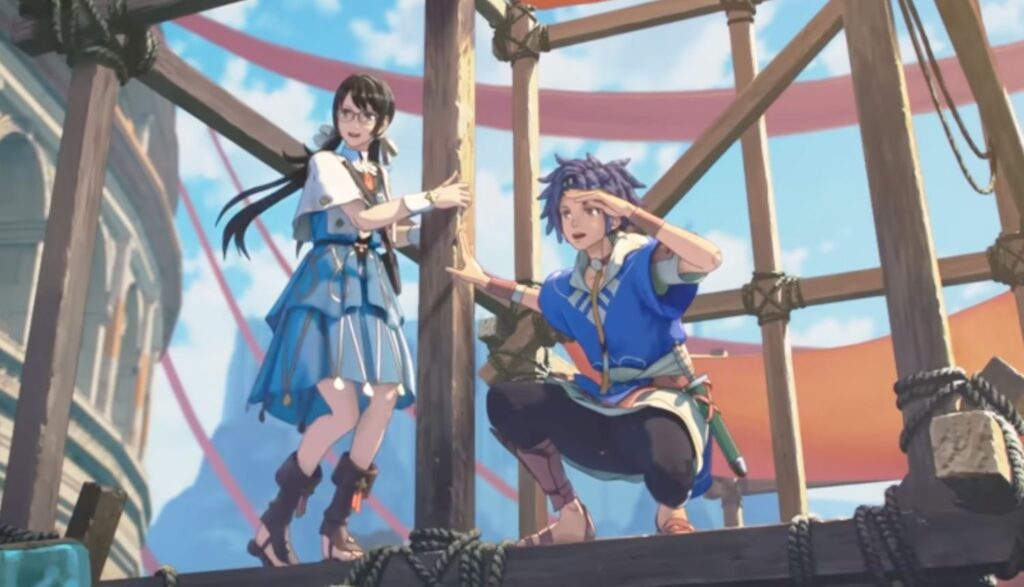
A large part of the action and storyline centers around a blending of polytheistic and mythological lore—struggles between gods and demons featuring blessings and curses. A central goddess character uses her powers to turn back the sands of time and magically send characters to other places. The world has an ancient Rome-like appearance with massive arenas and temples.
There are undead battlers controlled by demonic forces. Some areas are transformed into “hellish,” war-torn battlefronts and players enter the Underworld for battle.
(However, there are no real-world religions represented here.)
GAME SUMMARY
Fire Emblem: Fortune’s Weave is a massive game of heroes that centers on grid-based battles, army building and deep relationship development. It’s epic and immersive. But parents of younger players may not appreciate the game’s darker undertones or the 150-plus hours of play.