

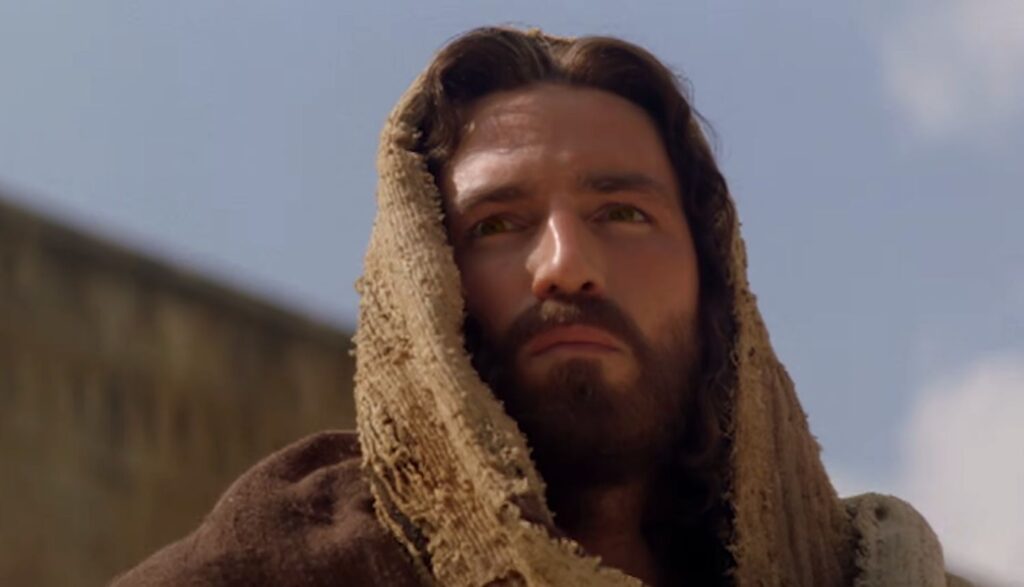
The Passion of the Christ is a resonant portrayal of the last hours of Jesus’ life. It is also disturbingly violent and bloody. While the film is undeniably impactful, parents will want to make sure that their kids are mature enough to handle both the brutality and beauty found in The Passion of the Christ.
A Man of Sorrows stands in a garden; anguished prayers pour from Him with sweat like blood. He knows what is coming.
Soon enough, the soldiers come for Him—the minions of those who want Him dead. It is a friend who leads them, betraying the Man with a kiss.
The Suffering Servant is led away like a lamb to slaughter. He will be accused, condemned and put to death. He has done no wrong. He is innocent.
But that is the point. He who knew no sin will be made sin for us.
This plan was laid before the foundation of the world. Now, the time has arrived: In the hours to come, the Good Shepherd will suffer greatly for His sheep. His body will be broken and His blood outpoured. He will die.
And in so doing, He will save a fallen world.
The Passion of the Christ emphasizes the relationship Jesus had with His mother, Mary. One extrabiblical scene shows us a tender moment between mother and son. Jesus loves and respects His mother. Mary loves her son and is anguished to witness what He must endure at the hands of His accusers—something that reinforces Jesus’ humanity alongside His divinity. Before His death, Jesus entrusts His mother to the Apostle John.
Two Pharisees speak in defense of Jesus as He stands accused before Caiaphas, the high priest.
The wife of Pilate, the Roman governor, warns her husband against condemning Jesus. After Jesus is whipped and scourged, she provides Mary with clean linens so Mary may clean Jesus’ blood from the ground. As Jesus carries His cross to Calvary, a woman cleans the blood and sweat from His face. One of the thieves crucified alongside Christ proclaims Jesus’ innocence and mercy. A pair of Roman soldiers seem moved by Jesus’ death and help Mary lower His body from the cross.
Simon of Cyrene is pressed into service to help carry Jesus’ cross. What begins as a distasteful task for Simon becomes a transformative experience—he aids and advocates for Jesus, and by the end of their journey, he must be torn away from Christ.
Obviously, The Passion of the Christ is a deeply spiritual work. The film combines accounts from the four canonical Gospel narratives, details found elsewhere in Scripture and a few elements from Christian tradition to create a moving portrayal of Christ’s sacrifice.
The Passion of the Christ opens with a slight paraphrase from Isaiah 53, a prophecy that speaks of Jesus nearly 700 years before His birth. From there, the film follows the chronological events of the Passion account—Jesus praying in the Garden of Gethsemane, His arrest, trials and crucifixion—while weaving in connected moments from Jesus’ earlier ministry, such as the Last Supper, the Sermon on the Mount and the Triumphal Entry.
Jesus has divine power and authority, but He submits Himself to suffer for the sins of the world. He lays down His life and (spoiler alert, I suppose) Jesus takes it up again when He rises from the dead.
Satan torments Jesus while Jesus prays in Gethsemane, telling Him that “no one man can bear the full burden of sin.” In a visual callback to Genesis 3:15, Jesus crushes the head of Satan’s serpent with His heel. In one scene, Satan carries a demonic-looking baby. Satan makes frequent appearances throughout the film to watch Jesus be brutalized and abased. (His gloating tune changes once he realizes what Jesus has accomplished.)
After betraying Jesus for 30 pieces of silver, Judas is wracked with guilt. He is tormented by demons, many of whom take on the guise of children.
The Pharisees accuse Jesus of blasphemy. Others say that Jesus has cured the sick “by magic” or through “the help of devils.” After Jesus’ death, darkness descends and an earthquake shakes the land, tearing the Temple in two.
Jesus prays to God the Father throughout the film. He submits to the Father’s will, even knowing it means He will suffer greatly. Jesus prays for God to “save [Him] from the traps” of Satan. Jesus even asks that God would forgive those who have condemned and abused Him—a radical act of mercy that shocks those who hear it. Jesus references Revelation 21:5: “I make all things new.”
Jesus heals an injured man.
The Apostles Peter and John respectfully refer to Mary as “mother.” Mary and Mary Magdalene repeat a prayer from the Jewish Passover.
When questioning Jesus, Pilate asks, “What is truth?” Later, Pilate’s wife tells him, “If you will not hear truth, no one will tell you.” Jesus tells Pilate that the Roman official “has no power over [Jesus] except what is given from above.”
Jesus’ blood and sweat leave an imprint in a cloth that bears a striking resemblance to the Shroud of Turin. Several names for Jesus are used that bear religious significance: “King of the Jews,” “Son of God,” “Son of David,” the “Good Shepherd” and more. “Adonai” is used to refer to God the Father. Jesus tells His disciples about the “Helper,” the Holy Spirit, who will come to them. Jesus sees a dove flying overhead, likely a representation of the Holy Spirit.
The film presents Mary Magdalene as the woman who was caught in adultery and brought before Jesus in John 8:1-11. (This is purely speculative since the Bible does not identify these women as one and the same.)
A man is naked in one scene, but we do not see anything explicit. Some men are seen in their undergarments, while others wear clothing that exposes some of their torsos.
For many viewers, The Passion of the Christ is known for its graphic violence. And, as the film depicts Christ’s death on the cross, Jesus bears the brunt of that violence.
Jesus is beaten, strangled, whipped and scourged—and all that is before He is crucified. For much of the film, Jesus’ eye is swollen completely shut. After His torture at the hands of Pilate’s sadistic soldiers, His flesh is left a bloody and shredded mess, and pools of blood are left in His wake. A crown of thorns is pressed onto His head. Blood spurts from wounds, including when Jesus is nailed to the cross. A soldier pierces Jesus’ side following His death, and blood and water flow out. It’s all presented in gory, unflinching detail and is, frankly, hard to watch.
Other characters are caught up in the violence, too. A soldier has his ear sliced off with a sword, and we see the bloody stump. People are beaten with fists and whips. Pilate says Caesar threatened him with death if he could not keep Judea under control.
Someone hangs himself. An animal carcass decomposes. Briefly, a riot breaks out, and some people (including a woman) are beaten into submission.
One use of “d–n,” as listed in a subtitle. (The characters speak exclusively in Hebrew, Latin and Aramaic.)
A man is called an “idiot.” Others are referred to as “stupid fools.”
Jesus pours and blesses wine during the Last Supper. A servant pours wine for Pilate. Though not made explicit, a few members of King Herod’s court appear drunk.
The film includes a scene of pure invention—Jesus, the carpenter, crafting a very modern-looking table and proudly displaying it to Mary. (She replies that this style of table “will never catch on.”) It’s a charming scene and a sweet moment between mother and son, but some viewers may not appreciate the swerve from biblical and traditional sources.
“He was wounded for our transgressions, crushed for our iniquities; by His wounds we are healed.”
Those words serve as the opening and the thesis of 2004’s The Passion of the Christ. Director Mel Gibson is not interested in giving viewers a sanitized version of the Passion of Jesus Christ. Nearly all the physical torment that Jesus would have suffered is shown here, to a disturbing degree.
Many critics decried the film’s use of extreme, unflinching violence as gratuitous during its initial release. I can sympathize. It’s still shocking to watch all these years later. (I first watched The Passion of the Christ at the ripe old age of 14, accompanied by a group from my church.)
But despite the film’s unsettling and continuous brutality, I would make the case that it’s not gratuitous. Gratuitousness implies that something is unwarranted.
Personally, I resonate with what Roger Ebert said in his review of the film in 2004: “What Gibson has provided for me, for the first time in my life, is a visceral idea of what the Passion consisted of.” That 14-year-old kid staggering out of a dinky theater in small-town Kansas felt much the same way. The Passion of the Christ is a film that “works powerfully for those who can endure it.”
The Passion of the Christ is about more than violence, more than simply what Jesus endured or a realistic depiction of crucifixion. “By His wounds we are healed,” Isaiah tells us. The Passion is about forgiveness—a supreme act of mercy and love, only possible through the divine. Jesus Christ, God made flesh, died for us, His sinful and fallen creation, so that we might be reconciled to Him.
The savagery depicted in The Passion of the Christ is a tool, a diorama: Witness Christ’s sufferings, witness His love for you. There are no ends to what Christ would do for you.
That message, and this film, moves me in a way that few others do. When you pair that message with all the craft elements of the filmmaking trade—strong cinematography, heartfelt performances and a clever narrative structure—in my mind, it makes The Passion of the Christ a masterpiece, however difficult. (And judging by the results of our “Best Christian Movie” bracket last year, many of you would likely agree.)
But that’s my subjective opinion. Others may disagree. But I think most would agree that The Passion of the Christ is not what you’d traditionally consider family-friendly viewing. It’s not for kids. Honestly, it probably wasn’t for a 14-year-old me, either. Parents looking to stream or take their kids to a re-released showing of this biblical epic should consider it with care.
The Passion of the Christ demands a certain maturity of its viewers. But those who choose to watch will find a masterful movie, both horrifying and beautiful, and a landmark work in Christian filmmaking.

Bret loves a good story—be it a movie, show, or video game—and enjoys geeking out about things like plot and story structure. He has a blast reading and writing fiction and has penned several short stories and screenplays. He and his wife love to kayak the many beautiful Colorado lakes with their dog.