


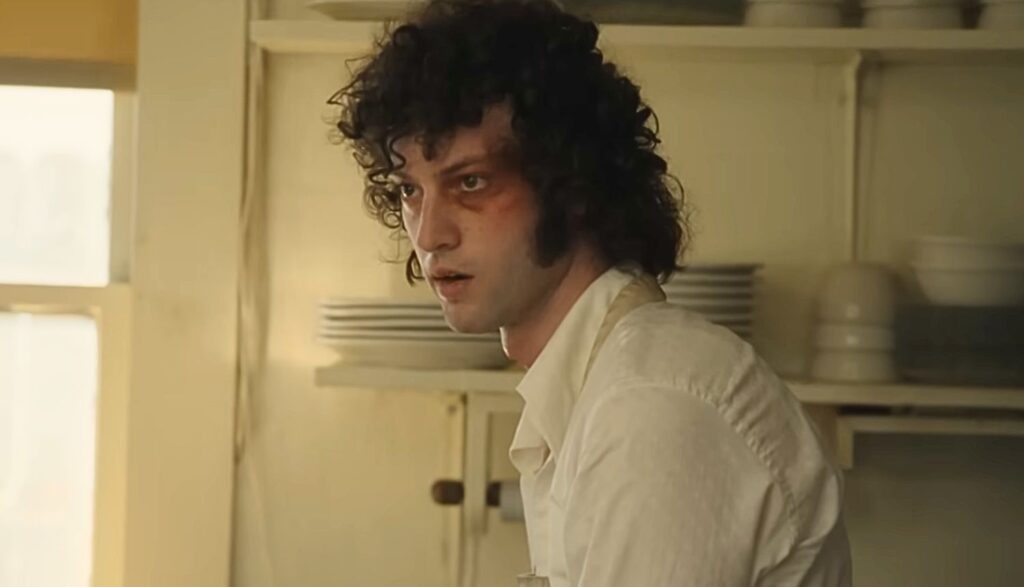
Tony provides an unflattering look at the summer that pushed the late chef Anthony Bourdain into his culinary career. Tony, the character, comes across as a selfish, womanizing narcissist, moping around the screen while others give him second and third chances. While there are some nice redemptive moments by the film’s end, the heavy language, drug use and sexual content spoil them.
“God is finally starting to notice me,” college student Anthony “Tony” Bourdain tells his friend. “The word for that is providence.”
What’s the reason for the young Vassar College student’s optimism? Tony is certain he’s about to land the college’s writing fellowship, one that will provide him funds to write a novel. It’s a coming-of-age story, a “buildings roman,” as Tony calls it—or bildungsroman, if you’d like to say it correctly.
But maybe the fact that Tony didn’t say it correctly is part of the reason the college decides to choose another student.
But he’s already told plenty of people that he’d gotten the fellowship: his friends, his family. Tony even conjured the confidence to talk to his crush, Nancy, who he’d hoped he might sway out of her summer away in Provincetown, Massachusetts.
Embarrassed to tell his parents after all but guaranteeing himself the fellowship, the hopeful writer steals some of his dad’s money and runs away.
And where does he go? Why, to Provincetown, hoping to find a little “fellowship,” as it were, with Nancy.
That’s the second fellowship Tony’s not selected for: The moment he arrives, Tony sees Nancy kissing her previously undisclosed boyfriend.
Tony ends up inside The Flagship, a small fast-food joint where he can drink his misfortune away. He flirts with the bartender instead—and when he drunkenly grabs her wrist, two of the restaurant cooks throw him out and beat him unconscious.
He wakes up in a porch-strung hammock with an empty wallet and an alcohol-and-fist-induced headache. It’s the home of The Flagship’s head chef, simply called Chef. And despite Tony’s behavior, Chef takes a single look at him and offers him a job washing dishes at The Flagship—just to help him get back on his feet.
Of course, Tony’s not a cook. He has no interest in being a cook. He’s a writer, through and through. That’s his plan. That’s the providence the God Tony doesn’t believe in has for him.
But what does God have to say about providence?
“The heart of man plans his way, but the Lord establishes his steps.”
Tony gains two mentors while in Provincetown—one good, one bad. Chef attempts to steer Tony on a good path, teaching him culinary basics, offering him mercy, taking him to church and giving him positive opportunities to grow—all in spite of Tony’s bad attitude and selfish desires. Meanwhile, line chef Sal influences Tony the opposite way—seeking out one-night stands with women already in relationships, offering Tony hard drugs and demonstrating a complete lack of respect for anyone else. The film shows the end result of both men’s choices, and it’s made pretty clear which way is the path of a good man.
And, speaking of good men, Chef is a very forgiving person. Despite Tony’s inebriated introduction, Chef takes pity on him when he realizes Tony has no money and nowhere to live, giving him a place to sleep and work. Throughout the film, Chef extends this grace to others, too. Even after someone punches Chef in the face, he offers mercy—all while maintaining authority over his kitchen. He’s likewise forgiving when Tony betrays him.
Chef teaches Tony that black on food doesn’t mean it’s burnt or ruined, and when Tony bites in, he’s impressed at how great it tastes. One might take the scene as a metaphor for how Chef sees Tony—someone who’s got his own charred exterior that, on the outside, might make him seen ruined, whereas the truth of who he is hasn’t yet been revealed.
Tony’s father clearly cares about him. He expresses interest in Tony’s educational pursuits, and when Tony calls him—long after disappearing to Provincetown—the man’s first response is to immediately offer to come get Tony rather than express anger over the stolen money.
Though Tony is, in the words of the real-life Bourdain himself, “a spoiled, miserable, narcissistic, self-destructive and thoughtless young lout” throughout the film, he at least has the gumption to confess his lies to Nancy rather than take advantage of her sexually.
Chef is a Christian man, and he’s prone to offering mercy to his thankless employees. He tells Tony that, so long as Tony is sleeping on his hammock, the college student has to come to church with him. When Tony tells Chef he doesn’t believe in God, Chef replies that that’s like saying he doesn’t believe in air—and yet he still breathes it.
A Catholic church depicts a stained-glass image of Mary crushing the head of a serpent (a Catholic interpretation of Genesis 3:15).
Chef objects to his employees using God’s name in vain. He tells Tony that rather than abusing God’s name to express enjoyment over food, he should praise God instead. Another chef, Stavros, says, “Sorry, Jesus is awesome, Chef,” when confronted.
Tony muses on the definition of the word providence—which he muses is “when God starts finally paying attention to you.” His friend says that such a thing sounds scary.
Chef calls Sal a “sin-eater.” He explains to Tony that a sin-eater is someone who eats food placed on the body of the dead at a funeral. The belief follows that the sin-eater absorbs the community’s sins so that everyone else can be in the light. Tony tells someone that being left-handed is a sign of the devil. A woman references horoscopes.
Sal convinces a bride (in her wedding dress) to cheat on her husband and have sex with him. This takes place on screen, and we see her exposed breasts. Nancy removes her clothes, though the camera never strays lower than her shoulders. We often see Tony sleeping in his underwear. Tony sketches a depiction of Nancy wearing lingerie. Women wear bikinis, and men are shirtless. Nancy wears a shirt that makes it obvious she isn’t wearing undergarments.
A man disappears into a bedroom with a woman, and he later marks this dalliance by cutting off a piece of the doorframe. Sal asks Tony if Tony is trying to have sex with Nancy, and Tony replies, “I guess.” When Sal hears of the lengths Tony is going to in order to get with Nancy, he quips that Nancy must have two sets of female genitalia for Tony to be so interested.
When asked about the nunchucks in his pocket, Tony quips that it’s actually his genitals. We hear references to masturbation, genitalia and brothels. A man gives Tony a nickname based on a specific part of the scrotum. Someone flirts with women by offering oysters as an aphrodisiac.
As Tony walks down a street, we see two men kissing as he passes them. Men and women kiss elsewhere.
Tony spends most of the movie making advances towards Nancy, who already has a boyfriend. Then, when the unnamed boyfriend gets upset at Nancy for continuing to meet with Tony (even after Tony’s friend attacked him), Nancy ignores his concerns and decides to start a relationship with Tony instead.
Sal brutally beats a man to the ground. Someone punches Chef in the face, too. An inebriated Tony aggressively grabs a woman’s wrist. When Tony gets argumentative afterwards, Chef punches Tony in the face, leaving him unconscious and with a sizeable shiner. Tony accidentally stabs his palm onscreen while trying to cut open a mussel.
Line chef Stavros burns his stomach, and he pours liquid on himself to treat it. Tony burns his hand after grabbing a hot skillet. An oil fire rages. Chef shoots a tuna with a shotgun. An angry Tony punches a hole in a wall.
Someone tells a story about a chef who killed himself because his fish order did not arrive on time. Someone says that Sal has a statutory rape charge.
Somewhere around 120 f-words (though very possibly more) and 15 s-words. Crudities referencing male and female genitals are used are couple of times each. In addition, we hear the words “a–,” “d–n” and “f-gg-t.” God’s name is used in vain five times, including an instance paired with “d–n.” Likewise, Jesus’ name is used in vain six times, including three instances with the f-word interjected.
Someone tells Tony that attending a party by himself will make him look like a “creepy loner rapist,” to which others nod in agreement.
Sal purchases drugs, and he brings them into the kitchen to share with his colleagues. (Chef does not partake.) Tony, Sal and Stavros snort cocaine. Later, Sal uses heroin.
Tony turns to drinking whenever he’s upset—and that means he often has a bottle at his mouth. We see him inebriated occasionally. Others drink beer and liquor, too.
People smoke cigarettes.
Tony runs away with much of his father’s money. Someone robs Tony, and men work together to try to steal a man’s cash. Tony vomits onscreen. Tony lies to most people he comes across.
Almost everyone looks back at their teen selves in the same way you might stare at a car crash. Sometimes, the car crash even sounds preferable.
It’s a complex thing to grow into yourself, and chances are you’ll end up doing something foolish, something you regret, something that makes you cringe in shame when you think about that era of your life years later.
I know I’m not the only one who can relate. A quote from the late chef Anthony Bourdain’s memoir Kitchen Confidential opens the film with the same general sentiment about his teenage years:
“I was—to be frank—a spoiled, miserable, narcissistic, self-destructive and thoughtless young lout, and badly in need of a good [butt]-kicking.”
As such, though Bourdain grew to become one of the world’s most beloved culinary icons, it should come as no surprise that Tony, which features the man at 19 years old, offers no flattering depiction of Bourdain. The Tony we meet on screen is sullen, selfish and scheming, spending much of the movie abusing the kind Chef’s grace and pursuing an already spoken-for love interest. And while many viewers will relate to Tony’s awkward struggle to find his place in the world, it doesn’t make him a character you’d exactly want to root for.
Of course, this is the story of a single summer in Bourdain’s life, one that influenced him to pursue the culinary world over his previously aimless writing. That decision seemingly gave Bourdain more direction and helped him to grow out of that aforementioned, negative self-description—which leaves us on a more positive note by the film’s end. At this point, we’ll note there’s no mention of the real Bourdain’s tragic suicide later in life.
But that also leaves the majority of the movie steeped in the content that comes before the conclusion, which includes plenty of sexually charged talk, onscreen nudity, heavy language, drug use and some violence—all centered around a protagonist whose incessant pursuit of a woman is, well, creepy.
As Chef (the movie’s best character) makes clear, there’s mercy, grace and forgiveness for all of this and more. But for many families, even with the uplifting ending, the time the movie spends dwelling in that content won’t be something they’ll want to see.

Kennedy Unthank studied journalism at the University of Missouri. He knew he wanted to write for a living when he won a contest for “best fantasy story” while in the 4th grade. What he didn’t know at the time, however, was that he was the only person to submit a story. Regardless, the seed was planted. Kennedy collects and plays board games in his free time, and he loves to talk about biblical apologetics. He’s also an avid cook. He thinks the ending of Lost “wasn’t that bad.”