



The problems each generation of parents face naturally change over time. But it’s instructive, perhaps, to compare what we’re anxious about today compared to a generation ago—and to ponder whether we’re paying enough attention to the issues our teens are really grappling with today.
Today’s Top Parental Concern: Screen Time
Parents have no shortage of things to worry about when it comes to the potential threats arrayed against our children. In 2023, the C.S. Mott Children’s Hospital National Poll on Children’s Health identified the top 10 concerns parents have today. Want to take a shot at what No. 1 was? Overuse of device and screen time, which 67% of parents reported as a concern. The next five things on the list all have direct or indirect connections to technology usage as well: social media, internet safety, depression/suicide, bullying and stress/anxiety.
Those are issues Focus on the Family Parenting and Plugged In have addressed extensively in the last five to 10 years. They’re real issues with real consequences, and that fact is reflected in contemporary parents’ concerns about them.
As a fiftysomething parent of three teens (two girls ages 16 and 14, and one boy who’s 18), what was interesting to me is what doesn’t show up on the list at all compared to the fears and concerns parents had just a generation or so ago.
“When I Was Your Age … ”
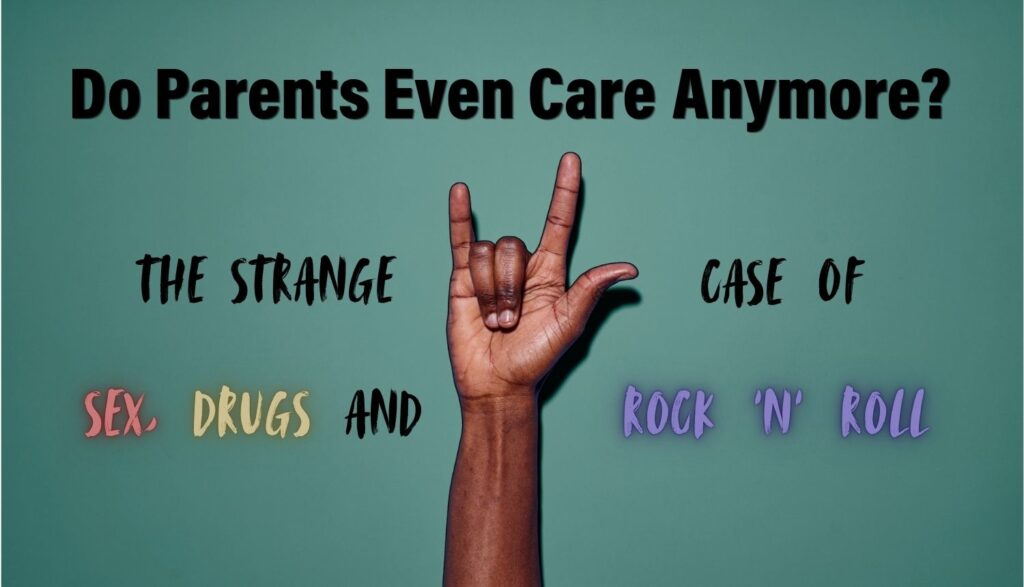
When I was growing up (and I’ll wait for you to go get the popcorn to settle in for my story), the fears parents had were largely related to, well, sex, drugs and rock ‘n’ roll.
By the early 1980s when I hit adolescence, the fruit of the late ‘60s counterculture had begun to arrive in the form of increasing sexual promiscuity and a rise in sexually transmitted infections—especially AIDs. In March 1993, Laurie Becklund wrote an article for the L.A. Times looking back on the spike of teen pregnancy in the previous decade called “The ‘80s: ‘Greenhouse for Teen Pregnancy.’” Interestingly, the article notes the role entertainment played in influencing teen behavior: “The average adolescent was being exposed to 14,000 instances a year of glamorized sex on TV—only 165 of which were linked to topics related to education or contraception.”
Then, of course, there was the war on drugs. If sex was a growing concern, so, too, was illicit drug use. “This is your brain,” a popular PSA commercial told us, picturing an egg. “This is your brain on drugs,” it followed, cracking the egg and frying it. First Lady Nancy Reagan partnered with D.A.R.E. (Drug Abuse Resistance Education), which launched in 1983. Among other things, the campaign featured the logo/slogan “D.A.R.E. to Keep Kids off Drugs,” and, of course, the ubiquitous phrase, “Just say ‘No.’” Though often mocked at the time and still ironically referenced by hipsters wearing vintage D.A.R.E. T-shirts today, the program took the issue of teen drug use and abuse seriously.
Finally, we have that good old punching bag, rock ‘n’ roll. In the 1980s, concern about rock’s negative influence mushroomed from fears of artists and bands like Ozzy Osbourne and AC/DC—and their alleged connections to Satanism and murder—to a full-blown crusade by Al Gore’s then-wife, Tipper Gore, to inform parents of explicit material in music. She cofounded the Parents Music Resource Center to try to raise awareness about the content of popular music and its connections to violence, drug use and sexuality. In 1985, the battle to label music with explicit content culminated in congressional hearings that featured the likes of Twisted Sister’s Dee Snider and Frank Zappa testifying against the PMRC’s efforts.
Whatever Happened to Sex, Drugs and Rock ‘n’ Roll as Parental Concerns?
If you’re wondering what this history lesson has to do with the things parents are concerned about today, let me connect those dots. The things that parents a generation ago feared most barely even show up on the radar of parental fears today.
Looking again at the Mott Poll Report referenced above, smoking/vaping clocks in at No. 10. Further down the list, we get drinking/using drugs at No. 15 and teen pregnancy/sexual activity at No. 20. Sorry rock ‘n’ roll, but no one’s afraid of you anymore. In fact, the old accusation “rock is dead” has largely come to pass, at least as far as this genre’s culture-wide influence in 2025 is concerned.
But here’s my question: Did those issues just go away?
Obviously, we know that our concerns about too much screen time are important, given that excessively staring at our phones potentially links with outcomes such as anxiety, depression, suicide, cyberbullying, reduced attention span, learning disabilities and more. Those are real issues, and that’s why Plugged In and Focus on the Family work hard to help you navigate them in your family.
But what about those other things that parents had congressional hearings about just 40 years ago? It’s hard to imagine anyone caring that much about drugs, sex or pop culture’s influence these days. And yet our kids face questions, temptations and opportunities to engage in all of them every bit as much as we did back in the day.
Eye-Opening Conversations
I’ve been sensitized to this reality by ongoing conversations with my two teenage daughters regarding these issues. I’m thankful that they seem willing, so far, to talk with me about some of the decisions their friends and classmates are making in these areas. My oldest daughter, who’s now a sophomore in high school, began talking with me about friends at school having sex when she was in eighth grade, for example.
And having recently moved from Colorado to California has given me an interesting opportunity to compare and contrast those two cultures. Perhaps surprisingly, my daughters have told me sex is a more common thing in Colorado, while drugs and alcohol usage are more frequent (anecdotally speaking in a very, very small sample size) here in California.
One of my daughters told me that when she gets invited to a party, she has to ask, “Is this a drinking party or a parents-are-home-watching-a-movie party?” That’s the world she’s living in, and I’m thankful that she’s willing to talk to me about her perspective on it and the choices she has to make that I could easily be completely unaware of.
Nothing Has Changed. But Everything Has
These conversations have given me new understanding: As much as we worry about screens, the stuff our parents worried about a generation ago is still a clear-and-present danger to our kids. The potential for my kids—or yours, or anyone’s—to make a life-altering choice with regard to sex or drugs hasn’t changed one bit.
But these ongoing conversations with my girls have also spurred me to ponder why we’ve seemingly grown less concerned with sex and drugs as issues that our kids are likely exposed to and thinking about, even if they’re not engaged in either. Why is it that we no longer care so much or recognize these concerns as a big part of teen culture?
I think there’s actually a sideways connection here to rock ‘n’ roll. Or, at least, popular culture in general.
Even as late as the 1980s, we still lived a world where harder, more explicit content was considered out of bounds for children. I remember sneaking into R-rated movies (lest you think I was a perfect kid myself). But we still had a feeling that an R-rating actually meant something. It was restricted for a reason, even if we were tempted to transgress that system and find out why.
Today, we’re awash in a vast sea of what we affectionately call “content.” And much of it, courtesy of streaming services with no broadcast limits on what they can show, is graphically explicit. Do parents today have the same concerns about R-rated or M-rated material? I think (again, anecdotally) the answer is no.
One result of all that content has been a normalization of the depiction of both sexual activity and drug use that has, I’d argue, culturally desensitized us. A graphically explicit hit show like Euphoria, in which teens regularly engage in drug use and sexual activity onscreen, wouldn’t have been thinkable in 1985. These days, it barely raises a cultural eyebrow. It’s “just the way it is.” Toss in the legalization of marijuana and the de-criminalization of drugs in many places and you end up with a world that looks back at a slogan like “Just say ‘No’” and laughs at it.
And our kids are growing up in that world, being exposed to the overarching worldview that pleasure and personal fulfillment on your own terms are the only things that really matter.
So How Do We Respond?
It’s easy as parents to feel overwhelmed and defensive when we look at the onslaught of issues facing our families today. We might be tempted to batten down the hatches, to doubled down on our attempt to make sure nothing ever gets past us. Or, we might be tempted to do just the opposite, shrugging and throwing in the towel because it seems like there’s just too much to address in the crazy world we’re living in today.
I think the best road, however, treads down the middle between those two extremes. Limits and boundaries on screen time are an important starting point for our kids. But as they move into their teen years, our strategy changes. We’re likely not going to be able to protect them from everything, despite our best intentions and vigilance.
And so, we want to be nurturing a relationship with them where our children know that they can talk to us. Even better: They want to have conversations with us and know that even if they bring up tough stuff, we’re not going to “freak out” on them. The goal by the time they leave our protective, nurturing nest is that they’ll have cultivated the ability to think critically and make good decisions in these areas on their own.
Our family isn’t quite “out of the woods” yet with regard to this stuff. But I think we’ve tried to cultivate a family culture where we can be honest, where we ask questions, and where we’re engaged in an ongoing conversation about all of these things. It’s not a one-time “talk,” but a dialogue in which we invite them to tell us what they’re really dealing with and what they think about it. They might not tell us what we want to hear. But it so important that we make space to hear what they’re facing, what they have questions about, what they’re struggling with.
And, if we’re lucky, they might just ask to hear back from us as well.

Recent Comments