

A teen gets sucked into an alternate reality that appears to be part of her phone. Meanwhile, an alternate form of herself is in the real world, using social media to become a star. While muddled at times, Labyrinth comes with some strong messages about the dangers of phones and social media. But it also comes with a smattering of unwanted sensuality, spirituality and language concerns.
A lot of teens get sucked in by their smartphones. But Shiori Maezawa has taken it to another level.
She didn’t mean to lose herself in its digital corridors. But when Kirara—her very best friend in the entire world—posted an embarrassing video of her for all the world to see, something weird happened: Shiori’s phone broke, and Shiori broke with it.
Now, Shiori is living in a strange phone-based netherworld, both familiar and alien. She can find her home, but it’s totally empty. She can visit her school, but it’s vacant, too. “The whole world is a cracked smartphone with buildings,” she says. She’s almost alone in this odd mirror of Yokohama, Japan. But not quite.
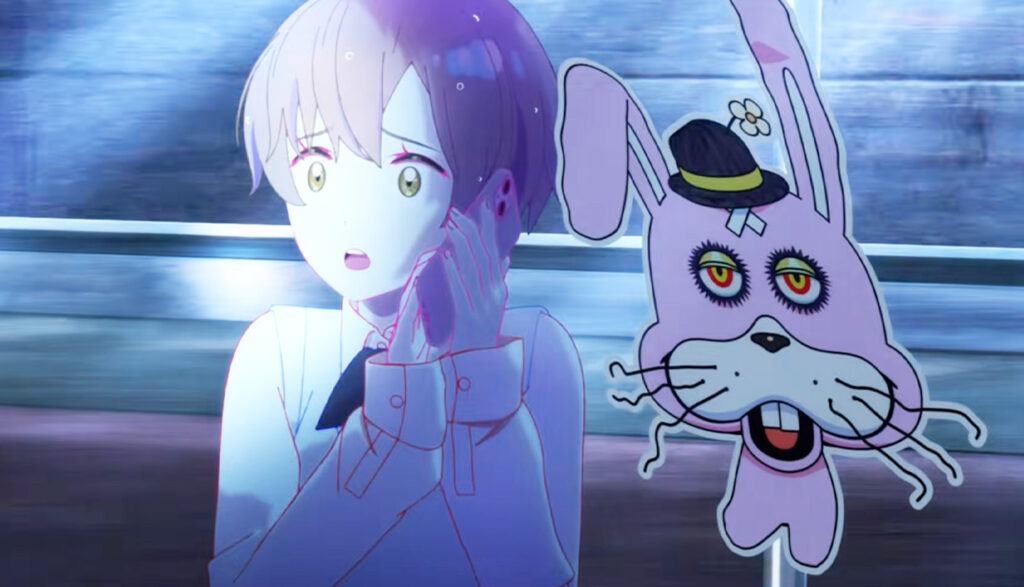
This world is filled with stickers—pixelated doodads that flit about like insects. They can be stickers of almost anything: cats, dogs, crying babies, pieces of pizza. And most seem uncommunicative and unconcerned with anything but their own sticker-ness. The one exception is a sad, rabbit-like sticker called Komori. It doesn’t know much, but it knows enough to hold a decent conversation with Shiori and give her a few tips about this strange, strange place.
Oh, and then there are the hands—shadowy, purple things that seek to grab Shiori and pull her to her doom. (Or turn her into a sticker, which is essentially the same thing here.)
You’d think that Shiori’s parents would be missing their teenage daughter. And perhaps, in a way, they are.
They don’t know that Shiori’s gone. As far as they can tell, she’s still very much with them—but different. She’s changed her hair. She’s wearing more revealing clothes. And most of all, she’s posting, posting, posting—on a quest to get evermore “likes.”
For this Shiori—soon to be known as Shiori@Revolution, likes are life. And if she can somehow get to 100 million likes, she’s told she just might have one.
[Note: The following sections may contain spoilers.]
You don’t need to squint too hard to see Labyrinth’s core message. This anime is meant to be a morality play, of sorts—a cautionary tale pointing to the dangers of social media. We’ll deal with that side of Labyrinth in the conclusion. But in this space, let’s set aside the story’s metaphorical aspects and concentrate on the characters.
Shiori—the one who gets trapped in her phone’s alt-reality—seems like a nice, albeit shy, girl. She’s hurt and angry with her friend, Kirara, for apparently posting that embarrassing vid (where Shiori tumbles down the stairs). But when Shiori suspects that Kirara might be in trouble herself, Shiori does everything she can to save her friend. Later, Kirara returns the favor: Despite years of secret hurts between the two besties, the girls confess, patch things up and step up as friends should.
Shiori also gets a little help from another classmate of hers, a boy named Kento. The two haven’t done much together as of late in the real world. But when Shiori gets trapped in her phone’s labyrinth, Kento becomes Shiori’s own conduit to the real world. Together, the two try to stop the nefarious machinations in play— machinations that endanger the entire world.
But a sticker—that’s right, the sad, hat-wearing bunny called Komori—proves to be the movie’s most outright heroic character. He serves as Shiori’s guide through the labyrinth, acting a little like Virgil through Dante’s Inferno. He risks his life for her and, in the end, does battle with a towering do-badder, sacrificing a great deal along the way.
Dante’s Inferno seems to be an apt comparison, at least superficially, to Shiori’s labyrinth. This screen-based wasteland feels a little like an electronic hell, where souls are lost and (to paraphrase the sign leading into Dante’s diabolical afterlife), hope is to be abandoned.
Most of the stickers indeed represent once-living souls that have been, apparently, lost forever. (Shiori believes that one may be her friend Kirara.) They have no memory of their past lives, drained by the place itself. Only Komori seems to have some semblance of sentience and memory, though even that may be fading. (He has, for instance, no memory of his past life.) We see the process of stamping real people (or, at least, their online selves) into stickers, and it’s not pretty. Moreover, the labyrinth comes with a darker ring—a pool of black teeming with stickers that Shiori falls through at one point.
During her adventures, Shiori discovers that her presence in the alt-reality may come with a sinister, supernatural explanation. She and Komori make their way to someone’s bedroom and find it littered with the knickknacks of witchcraft: candles, spellbooks and the like. It’s described as “black magic on smartphones,” and Shiori finds that her own online image has been scrawled over with a dark symbol, a “curse of sorts,” Komori explains. (They later discover the practitioner, who admits that she was engaging in witchcraft.)
We see crosses in a graveyard. And a quasi-wedding takes place in a quasi-church, complete with organ music and stained glass windows.
Meanwhile, in the real world, Shiori@Revolution prays while holding an incense bowl. “Please help me, god,” she says—more likely praying to one of Japan’s traditional gods than to the Christian one. “Let me win more likes so I can crush [my opponent].”
One sticker comes with devil horns. We hear about zodiac signs. We see what looks like a haunted house.
In Labyrinth, “online influencer” is closely associated with “immodest dresser.”
When we first meet Shiori and Kirara, we can tell who’s more comfortable in front of the camera because of their respective wardrobes. Both wear Japanese school uniforms, but Shiori’s own short skirt is accompanied by a pair of leggings that go down to her knees. Not so in Kirara’s case. She’s tied up her shirt to expose her belly button, too. When Shiori@Revolution shows up, she apes that same dress style, using her feminine allure to get more likes. And in a later sequence, she wears a dress that exposes a shoulder and a leg. And at times, the shimmering outfit can make her look almost nude.
Shortly after things start going amiss for the 17-year-old Shiori in the real world, she runs into a “creepy” guy who we later learn is named Suguru. “You may be my destiny,” he tells her.
We learn that Suguru is a key architect—and victim—of the alt-reality that Shiori eventually finds herself in. But Suguru does not live there: He’s far more interested in the future of Shiori@Revolution and guiding her path toward stardom.
But the movie points us to another ooky piece of social media culture: The objectification of women and the sexualization of children. As mentioned, Shiori (and Shiori@Revolution) is 17. Suguru is older: At times he seems to be in his 20s, at others in his 40s. But he’s definitely attracted to Shiori@Revolution, who is warned that the “guy’s brain is now driven totally by testosterone.”
No matter: Shiori@Revolution goes out to dinner with Suguru, during which Suguru kneels before her and proposes … an intimate business relationship. What should be a ring is in actuality a phone. He wants Shiori@Revolution to become a catalyst for everyone in the world to become their “ideal selves,” and a program that he’s written will allow that catalyst to happen.
Later, the two huddle in Suguru’s suite—a scene designed to look like a honeymoon night or an intimate tryst. They sit on the hotel bed, Suguru starts unzipping his top, revealing a massive, swirling hole. He touches Shiori@Revolution, and she (and we) discovers that she has that hole, too. “Just as I thought,” Suguru says. “We are destined for each other.” Neither of them are “real,” but they’re hoping to become so through Suguru’s plot. But just as they start to get into a really intimate moment, Kento (Shiori’s male friend) bursts in and beans Suguru with an unopened champagne bottle. “She’s only a high schooler!” he shouts.
We learn that, years before, Kento had a crush on Shiori and asked her out. Shiori, presented as a little girl at the time, was totally uninterested: The daughter of a judo instructor, she flipped him over her shoulder and broke his arm. Even now, the real Shiori seems uninterested in guys. When Komori asks her whether her “boyfriend” can help them, she says, “I’m not really into that.”
Given that, perhaps it’s worth noting that Shiori and Kirara do indeed seem quite close. But the movie never indicates that their relationship is anything but platonic.
Shiori@Revolution and Suguru cement their business/personal relationship in a faux wedding ceremony. People gossip about how “cute” Shiori is in some of her videos. We see a picture of a woman in a bikini.
When people in Shiori’s alt-reality get turned into stickers, they’re literally placed into a press and stamped. Red oozes from the space between the two plates, and in one scene, it definitely appears to be blood. Ghostly hands float and sometimes grab people.
Two kaiju-like creatures battle. Both get seriously damaged, and one gets skewered through the middle—apparently killing it.
Shiori sometimes complains about being the daughter of a judo master—and thus being forced to take judo lessons throughout her childhood. We see some of those lessons take place, and they appear to come in handy. She uses some judo moves a time or two—in one case throwing someone across a stage.
Thanks to his social media program, Suguru can simply eliminate anyone in the real world who gets on his nerves. He pushes a button and they vanish—landing in the labyrinth where they’re turned into stickers.
Shiori takes an ungraceful tumble down some stairs. As mentioned, Suguru gets clocked with a champagne bottle.
Three uses each of the words “crap” and “h—,” while “d–n” is used four times. We also hear a bit of name-calling.
In what Suguru clearly hopes will be an intimate moment, the guy offers the underage Shiori@Revolution some champagne. “It’s non-alcoholic,” he clarifies.
In her quest for 100 million likes, Shiori@Revolution can sometimes engage in some disrespectful hijinks (making fun of her teacher behind his back during class, for instance).
We learn that Shiori had a secret social media account—one in which she poured out all her frustrations and worst thoughts. Suguru is particularly bothered by “unfair flaming” online, wherein social media users might post insulting or even threatening comments about someone.
Suguru engages in plenty of misleading behavior.
“Image is power in today’s world,” Suguru says. And in such an imaginative, often crazy film, that line seems to be all too true.
Labyrinth is a sprawling, movie-length allegory exploring the dangers of screen time and social media. It focuses especially on those ever-present, ever-important likes (and, on the downside, the brutal flaming that folks can be subjected to online).
Shy Shiori is crippled by the fear of being mocked online. We meet other characters who were practically destroyed by social media, and one guy notes how the constant flaming he experienced did a number on his mental health. The imaginative way that these ills manifest in Labyrinth is rooted in real-world science. Just a glance at our blog or a skim through our Parents’ Guide to Technology will show just how much social media can hurt us—especially if we’re teens.
Meanwhile, Shiori@Revolution is on her own Quixotic journey to get those elusive 100 million likes and thus become her “ideal self”—and allow others to do the same. She sees this quest as a good one. Everybody should have the right to live out their ideal lives, right? Lives full of excitement and fun and, most critically, likes. But of course, that “ideal self,” once realized, isn’t so ideal at all.
All of that makes Labyrinth a powerful and, for Plugged In, extremely on-point film. The movie takes the stuff that we’ve been warning you about for years, plants them in the fertile art of anime and lets them bloom. The result is a mix of techno-introspection, crazy storytelling and some clever asides that let us know that the film is in on its own insanity.
“Without smartphones, humanity’s doomed,” Shiori intones at the beginning of the film. But by the end, we wonder if humanity could be doomed because of phones.
The movie’s peppering of problematic content doesn’t doom it, but it does make it a bit harder to navigate. Certainly, the film’s sexuality comes with a purpose, but it comes with a bit of a cost, too. Its language can be off-color. Labyrinth’s scattershot spiritual asides may bother some families, too. And then there’s just the movie’s story-born oddities. While the moral of this story hits its mark, the story itself can be uneven.
GKIDS’ Labyrinth can feel like one, narratively speaking. But it ultimately leads to some good points. And it just might make us all think more about what we post online—and why.

Paul Asay has been part of the Plugged In staff since 2007, watching and reviewing roughly 15 quintillion movies and television shows. He’s written for a number of other publications, too, including Time, The Washington Post and Christianity Today. The author of several books, Paul loves to find spirituality in unexpected places, including popular entertainment, and he loves all things superhero. His vices include James Bond films, Mountain Dew and terrible B-grade movies. He’s married, has two children and a neurotic dog, runs marathons on occasion and hopes to someday own his own tuxedo. Feel free to follow him on Twitter @AsayPaul.