

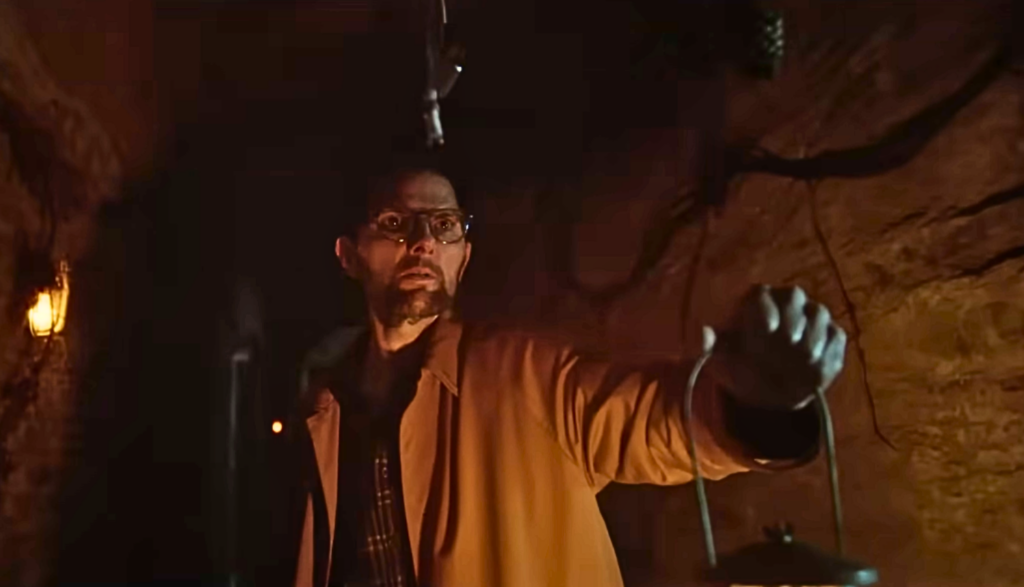
A cynical writer visits Ireland to spread his parents’ ashes. He’d very much like to be alone, but all the ghosts keep getting in the way. Hokum is a well-written, atmospheric horror flick that tones down the gore and amps up the chills. But the movie’s heavy themes, language and ever-present death make this a no go for kids.
The honeymoon suite is always locked. Always.
No visitor to Ireland’s Bilberry Woods Hotel has slept there for decades. The hotel’s owner, Mr. Cob, swears it’s haunted by a witch. And every now and then—if guests leave their children unattended—he’ll hint to the hotel’s youngest visitors what may lurk behind the suite’s metal gate. What awaits the unwary.
Another visitor, Ohm Bauman, watches Cob spin one of his ghost stories for a couple of twin boys mesmerized by the tale of a witch dragging children down to the underworld.
“Go find your parents,” Bauman tells them. He adds, “and don’t talk to strangers,” eyeing Cob with a glare.
“There are worse things than strangers out there,” Cob says as the children scamper away.
Bauman knows that terrible truth. He knows it well. Bauman, too, is haunted: by his past, his regret, his guilt. His ghosts have made the writer rich, perhaps. How else can you explain the horrors he writes?
Perhaps he imagines that his past is locked behind doors and gates and walls—shut safely in the darkest recesses of his mind—still, it leaks through the cracks. Though he writes about conquistadors and buried treasure and times long past, his pain still fills the page, his scar-tissue cynicism finding voice in the paragraphs. For his characters, there is no happy ending, no hopeful coda. They find no escape. Why do they deserve better than Bauman himself?
But Bauman’s here to put a piece of the past to rest.
In happier times, Bauman’s parents honeymooned at the Bilberry Woods Hotel, and they always wanted to come back. They looked so happy in the pictures, before …
Well, Bauman can’t dwell on that. He brought his parents’ ashes with him—putting them to rest as well as he can, in a place he knows they loved. The writer gently pours piles of his mother around a massive, ancient tree that he knows she loved. He dumps his father out like trash.
Could Bauman’s parents have stayed in the honeymoon suite? Now locked and barred and dark?
Perhaps Bauman wonders, but he doesn’t dwell. He’s almost done now. His latest book is nearly finished. Perhaps soon he will rest. Perhaps he can silence the ghosts in his head forever—one way or another.
[The following sections contain spoilers.]
Ohm Bauman is a jerk when we first meet him. Though the hotel staff is professionally courteous, it’s pretty clear that no one much likes him, and it sometimes seems like Bauman tries to make himself unlikable.
The exception appears to be a woman named Fiona. She calls Bauman out on his rudeness when they first meet—the only staff member to do so—and that seems to soften the writer a bit. Later, they talk a bit at the hotel bar. She’s the only person who seems to care anything about the man, and her willingness to get involved in his life ultimately saves it.
When Fiona herself goes missing, only two people seem determined to find her: Bauman and a local vagabond named Jerry. Both ultimately put their lives in danger to track down Fiona.
We learn that an unmarried pregnant woman is planning to keep her child.
We must begin with the witch.
Cob refers to her as a, or perhaps the, Cailleach, the Irish Gaelic word for “old woman” or “hag,” and in Old Irish, it means “veiled one.” The name could refer to just any ol’ witch, but it is also associated with a pagan goddess connected with winter, which she would usher in at Sahmain (Halloween). Perhaps tellingly, Hokum takes place around Halloween.
In Cob’s telling, though, this particular witch was known to shackle people—children especially—and drag them down to the underworld for a little tour. It’d be a terrifying trip, to be sure, and Cob says that these mortal visitors would often leave something behind there. But in Cob’s telling, it doesn’t seem to be necessarily fatal.
The witch that apparently haunts the honeymoon suite may have more sinister intentions. Fiona says that, should Bauman encounter the witch, he should draw a chalk circle around himself—an effective barrier between our world and the supernatural one, according to an Irish folklore book that Fiona has. (Chalk is seen as a symbol of purity and protection in some cultures.)
While Hokum definitely suggests that the hotel is indeed haunted by a supernatural presence, it leaves the door open for alternate explanations. (More on that later.) The film also seems to nod to another aspect of Irish lore—that of the Irish hare. In the island’s folklore, the hare was thought to be a shape-shifting critter with ties to both Ireland’s fairy folk (a far more threatening race of supernatural beings than we think of today) and the underworld. We see a character dressed as a hare during a Halloween party, and some sort of supernatural being sports rabbit-like ears on his head.
Before he leaves for Ireland, Bauman writes in his darkened house. As he writes about the potential death of a child in his book, he sees what appears to be a child standing on his staircase—and an older woman lurks behind the child’s shoulder. Bauman’s mother seems to haunt both his dreams and, at times, his waking world. In one scene, the two talk to each other.
Another character sees a ghost, too. Ghostly sights and sounds are sprinkled throughout the film. Hokum gives us a glimpse of what we take to be the underworld, a land filled with glowing-eyed humanoids who seem to rake and claw at the living.
We see two characters in the movie’s depictions of Bauman’s novel: A weathered conquistador and a young boy who follows him like a squire. In the aftermath of a critical scene—one that contains a hint of Abraham’s near-sacrifice of Isaac—we see that the boy wears a cross around his neck.
We learn that the unmarried Fiona is pregnant.
Extra-special note, here. Most everything in this section could be considered a spoiler. So if you don’t want details but want to get a gist of the violence to expect … the story involves murder, attempted suicide and accidental death. With one exception, nothing is particularly bloody. But scenes can be jarring, triggering and just plain creepy.
Fiona asks Bauman how his parents died. Bauman tells her that his mom was murdered: “Shot in the face when she came home from work.” The killer, he says, was never caught, but Bauman believes that the culprit should’ve been hanged. (A dream-like flashback shows the moment of death: Instead of blood, though, milk spills to the floor, and Bauman’s mother is shown relatively unscathed.) As for Bauman’s father, he “turned into a monster and drank himself into an early grave.”
We eventually learn that Bauman himself was responsible for his mother’s death. As a child, he had been playing with a gun he’d found and the weapon went off. At the hotel, Bauman tries to kill himself. Hotel employees see him hanging from a light fixture, and in flashback, we see a couple of people struggle to cut him down.
Someone gets shot and killed with a crossbow bolt to the head.
As mentioned, Fiona goes missing, and Jerry—who believes he saw her ghost—is certain that the woman is dead. He’s right: Fiona’s corpse is found after several days, eyes glassy and skin gray. We learn that she was, essentially, murdered: While it’s possible that something else did the actual deed, her very human attacker knew that Fiona would most certainly die—perhaps of starvation—where he left her.
Bauman walks by a dead, slightly bloodied ram. A hotel employee explains that the critters are a nuisance, frequently eating intoxicating mushrooms and bounding on top of the guests’ cars.
The witch shackles two people, preparing to drag them down into the underworld. One escapes (and suffers either bruises or burns on his wrists as a result), but the other gets pulled into this netherworld, screaming. (Some sculptures illustrate a similar scene, and the child victims depicted in the artwork look terrified.)
The hotel gets purposefully set on fire. Bauman heats up the end of a spoon and burns someone’s hand with it. We hear that someone was accused of killing his wife: The character later confirms that he did, but he insists it was an act of mercy. A hotel employee threatens Bauman. “The best thing you could do now is get in your car … and get back to the airport while you still look like your passport picture,” he says. A man leaps out of a moving vehicle and, while he survives, he also trails plenty of blood.
In Bauman’s book, the two characters—the conquistador and the boy—reach a mysterious ring in the desert, the apparent object of what they’ve been looking for. They’ve reached a point of no return there, and their only hope for survival is to solve the puzzle of the ring (which, we assume, will open up some sort of magical cave or chamber or something). But the instructions to solve the puzzle are sealed in a bottle. They need to break that bottle, but there’s nothing hard enough to smash it open for miles around … except for one of the travelers’ heads. The conquistador knows that, for either of them to live, someone will need to die. (Bauman initially plans to have the conquistador murder the child and still fail in his quest to open the ring. Subsequent drafts are less bleak and more hopeful, but they still contain plenty of conversation about murder and blood.)
About 16 f-words and two s-words. We also hear a smattering of uses of “a–,” “h—” and “p-ss.” God’s name is also frequently abused, paired with “d–n.”
Is a witch at work in Hokum? Well, probably—but the movie suggests that there could be another explanation. Everyone who has a close encounter with it (or other supernatural entities) is either drunk or high or both.
When we first meet Bauman, he’s writing and drinking. He sees a couple of spectral entities, and we’re left to wonder whether they were real or in his imagination.
That element of uncertainty ratchets up in Ireland. The vagabond Jerry, we learn, makes his own moonshine; he shares some with Bauman. He also drinks milk spiked with psychedelic mushrooms. When Jerry tells Bauman that he saw a ghost, Bauman asks if he was drinking some of his “magic milk” at the time.
“That’s how I saw her,” Jerry insists. “When my mind was open!”
Bauman drinks heavily throughout the movie (though he declines a bottle of wine by the end of it, suggesting progress on that front). In the teeth of his apparently supernatural adventures, he drinks from a flask regularly. Later, someone admits to spiking that flask with some of Jerry’s “magic milk.”
As mentioned, Bauman’s father essentially drank himself to death. We see characters drink at a bar. Someone falls unconscious after consuming a drugged drink. Someone breaks into the hotel to steal medications left behind by guests.
Bauman is, as mentioned, a jerk—especially at the start of the film. He treats most everyone dismissively and disrespectfully, and he flat-out insults a kindly worker. When he doesn’t answer his room door after a night of heavy drinking, a bellhop quips that it’s probably because he passed out in a pool of his own urine.
One character here is not what he seems. He’s guilty of a horrific crime, and he lies, steals and kills to try and get away with it.
When Bauman first hears the story about the witch haunting the hotel honeymoon suite, he dismisses it as “hokum.” But don’t let the movie’s title fool you: This bit of Hokum is the real deal.
It’s real scary, for one thing. Without resorting to salacious gore or cheap jump scares, this film gives viewers chills from the first five minutes on. It earns its goosepimples through suggestion as often as what we actually see or hear: We strain to pick out a face through the darkness. We feel our hearts beat a little faster as the lights flicker out.
But Hokum comes with a deeper purpose, too: This film is as much about guilt as it is about ghosts. And the real monster here isn’t a witch or a bug-eyed bunny demon, but a warm-blooded man with cold-blooded motives. This is a film with something to say—about sin, about shame, about justice and, yes, about forgiveness. And while these quasi-Christian themes take place in a pre-Christian, folkloric framework, Hokum still might trigger some worthwhile conversation.
That’s hardly an endorsement, though. Hokum comes with plenty of issues, from its witchy antagonist and pagan underpinnings to its harsh language and unsettling themes. The film winks and arguably smiles at psychedelic drug use. It seems to offer an understanding nod to euthanasia. It fires off plenty of R-rated profanity and gives us a very unlikable protagonist.
As a horror flick, Hokum works. But it’ll hardly work for everyone. This is a film that even adults should walk into with their eyes wide open.

Paul Asay has been part of the Plugged In staff since 2007, watching and reviewing roughly 15 quintillion movies and television shows. He’s written for a number of other publications, too, including Time, The Washington Post and Christianity Today. The author of several books, Paul loves to find spirituality in unexpected places, including popular entertainment, and he loves all things superhero. His vices include James Bond films, Mountain Dew and terrible B-grade movies. He’s married, has two children and a neurotic dog, runs marathons on occasion and hopes to someday own his own tuxedo. Feel free to follow him on Twitter @AsayPaul.