Movie Review
For centuries, the orangutans of Sumatra were creatures on the edge of myth. We’re told that the island’s first Western explorers had no idea what the primates were: The explorers could hear them. Occasionally they might catch a glimpse of them. But when they asked the island’s indigenous residents what the creatures were, the islanders said that they were “forest people … who hid themselves away to avoid being put to work.”
Turns out, those orangutans have nothing against hard work. In the jungles of Sumatra, it’s a full-time job just to stay alive.
But the primates still find time for family and fun, too. And that’s the focus of Disney+’s charming nature documentary Orangutan.
It’s in Disney’s Nature
Disney has a long history with nature docs. In 1948—two years before it released Cinderella—the studio trotted out Seal Island, the first, 27-minute installment in Disney’s True-Life Adventures series. Seal Island won an Oscar (for Best Short Subject), and the series cruised on until 1960. The short films gave their mostly young viewers a sanitized peek into the animal kingdom: adorable critters, riveting (if somewhat fictionalized) storylines and beautiful footage—without, y’know, all the mating and blood that’s sometimes a part of nature, too.
DisneyNature picked up the baton in 2008 and has run/swam/flown with it ever since. It typically releases a new documentary every year, most often on Earth Day, and its dynamite film crews have focused their lenses on everything from elephants to tigers to giant pandas. And while these movies never deny that the wild can be a brutal, unforgiving place, DisneyNature concentrates its efforts on the beauty, wonder and humor found there. These are the sorts of docs that inspire young viewers to become biologists—not cry themselves to sleep.
Optimus Primate
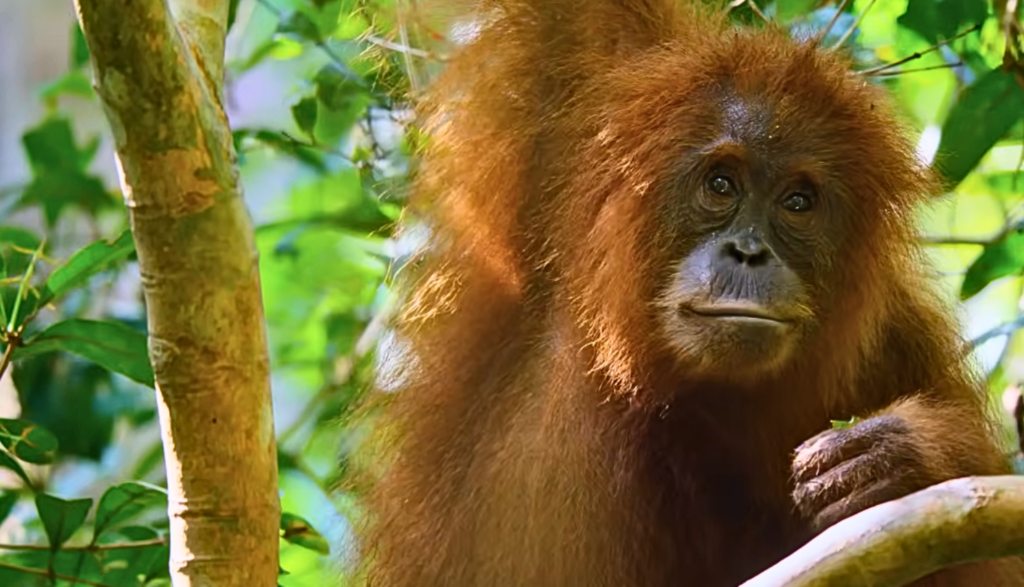
In Orangutan, we’re introduced to an orangutan family of three: 9-year-old Indah (a teenager in orangutan years) is the doc’s focal point. But we spend a lot of time with Indah’s mom, Diann, and 2-year-old baby brother, Bimo, too.
Where’s Dad? Oh, he’s around. Indeed, Bintang is the region’s alpha male. But orangutan males appear to be indifferent fathers. He spends his screen time chasing away rivals and gobbling up a goodly number of wasps.
Plenty of orangutans must eat equally appetizing fare: We enter the story in the dry season, when most of the fruit is gone and—unless you’re one of the area’s orangutan two-percenters (and we meet them, too)—you can’t be too picky. Eating requires some clever finesse, as well. Indah’s an expert in using a tree stem as a tool, inserting it into a bee’s nest to retrieve a few bees and honey.
But even then, there’s only so much food to go around, and Indah makes the difficult decision to leave Diann and Bimo and move on—to find new sources of food and, perhaps, companionship. She doesn’t go far, though: Indah sometimes reunites with her family, emphasizing how surprisingly social these creatures are.
It’s a Jungle Out There
Orangutan introduces us to plenty of other jungle creatures, too, including the Sumatran tiger. “Fewer than 400 Sumatran tigers are left in the wild,” narrator Josh Gad tells us, “but it only takes one to eat you.”
Which explains why the jungle’s other inhabitants spend as much time in the trees as possible. Snakes leap and literally glide from tree to tree. Sun bears make their own nightly nests high in the treetops. Slow lorises cling to tree branches as if their lives depended on them—which they do.
But that doesn’t save these creatures from other predators—including the orangutans themselves. One of the orange primates gorges himself on a loris he captured and killed. Some female orangs do their best to get a few leftovers, but to no avail. “You don’t bring chocolates on a date and eat them yourself, bud!” Gad scolds.
While we don’t see the orangutan actually kill the loris and the subsequent meal is played for laughs, you can’t ignore that the filmmakers had shown us a couple of the animals alive and happy just moments before—or that fur and claws stick (somewhat comically) out of the orangutan’s mouth.
Plenty of insects get eaten, too, of course. We’re told that when male orangutans fight, it can sometimes be fatal. (We do see a couple of males tangle, but the loser simply strolls away, unharmed.) The threat of death is never that far away, and the documentary is honest about that.
The doc also tosses out a couple of references to evolution: The orangutan is called both a “cousin” and “close relative” of ours.
We see one or two quick glimpses of orangutan genitals (they rarely wear pants in their natural environs), and we see and hear plenty of references to orangutan “dating” practices. (When a male makes a few faux pax while approaching Diann, Gad says that it’s the “orangutan equivalent of stumbling across the dance floor and spilling his drink all over.”)
But the documentary steers clear of any actual mating practices and instead focuses on the adorable and often astonishing behaviors found in the jungle, all of which serve to both entertain and educate.
After all these years, Disney still has a knack for both. Orangutan serves as proof of that—a G-rated delight for animal lovers of all shapes and sizes.