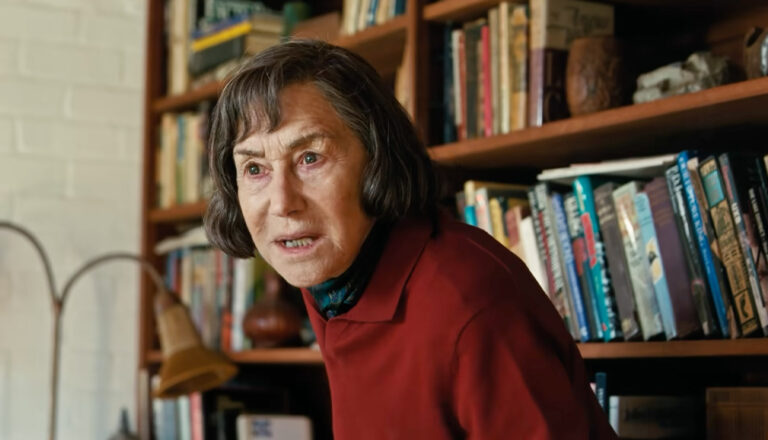



The lives of three people—a thief, a cop and an insurance broker—intersect at a violent crossroads in this L.A.-based crime thriller. While Crime 101 has some style, it gets stuck in a deadlock of content issues, including over 100 uses of the f-word, intense violence, some sexual content and nudity and some New Age spirituality.
Davis is a jewel thief, pulling heists along Los Angeles’ Highway 101.
Sharon is an insurance broker, working to make partner at her company.
Lou is a detective, chasing the trail of the elusive “101 Robber.”
Each of these people has reached a crossroads in his or her life. Davis was nearly killed during his last heist, leaving him searching for human connection—and a way out of his criminal career. Sharon, who has sacrificed so much for professional success, is rapidly reaching her expiration date (at least, in the eyes of her employers). And Lou’s pursuit of justice has been hamstrung time and again by corruption and indifference within the police department.
All three have reached a breaking point. A moment of desperation. And that desperation is pulling these three different people together toward the same critical point.
Davis looks for his “final score.” Sharon wants to “get even.” Lou hopes that all this unraveling mess can, somehow, someway, end in “justice.”
In different instances, Davis and Lou protect Sharon from physical harm. A detective stays loyal to his partner even though he has been encouraged to jump ship. Davis truly tries to leave his life of crime—which has forced him to be more violent than he seems comfortable with—behind.
A few of the main characters attend yoga classes at different intervals. The instructor of those classes repeats several humanistic, New Age self-actualizations that are repeated throughout the film. For instance, she says, “You have the power to create all that you desire out of nothing.”
Following a near-death experience, Davis asks his mentor if he believes in omens. The man says he does not. Lou is called “Detective Buddha” at one point. Referring to a dead man, someone says, “God rest his soul.” A character says “namaste.”
Davis meets a woman named Maya by happenstance, and the two strike up a relationship. He invites her to his apartment, where they dance and kiss. Later, we see them lying in bed together, the implication being that they had sex. (We see Maya’s bare back and Davis’ chest.)
Davis also hires a prostitute. That woman wears lingerie that shows a lot of skin, including much of her buttocks. A hacker hides data for a client in the comment section of a porn site; as the client scrolls through the site, we see explicit video thumbnails that include nudity.
Before a heist, Davis scrubs himself head-to-toe so as not to leave any DNA evidence at the scene of the crime. His bare upper torso and legs are shown but we are spared from seeing any critical anatomy.
A husband and wife discuss divorce—a conversation that takes the husband by surprise. The man asks if they still love each other and the wife says that she wants “something new.” When the husband asks her if she has had any affairs, she replies, “Do you really want to know?”
Sharon looks at a picture of a man in a speedo on social media. Someone says his colleague is looking for a “hot surfer chick.” A man repeatedly says he is “not gay” to antagonize someone. A few characters talk about “getting laid.” Some women wear revealing clothing. One woman wears a bikini and lounges by a pool. A guy is seen in his underwear. A heist revolves around an impending wedding. An insurance company sends attractive female brokers to encourage rich, older men to take out insurance policies.
As you might imagine, a movie called Crime 101 is no stranger to violence. While not particularly graphic, the film’s action is plenty intense, with a handful of deaths and many more characters under the threat of death.
Davis’ early heists usually involve the thief holding a gun to someone’s head. And while the man may not want to use deadly force, he will if necessary. He stalks his targets, threatening their families to get them to comply with his wishes.
Ormon, another criminal who’s been hired by Davis’ boss to follow Davis, has less restraint. He robs a jewelry store, threatening the people inside and hitting them with his gun, drawing blood. He beats a woman to extract information. He assaults a man as well. He holds people at gunpoint, and it’s clear he would have no misgivings about pulling the trigger.
A few people are shot, and we see some blood. A few people are beaten bloody. Characters drive recklessly through traffic, causing one car to flip and crash. Another car hits a guy.
The f-word is used nearly 120 times. The s-word is heard 14 times. Jesus’ name is abused six times, and God’s name is misused twice. Additionally, there are uses of “d–n,” “a–hole,” “h—,” “b–ch” and “pr–k.” The slang term “screw” is used a handful of times. A police officer is called a “pig.” Someone uses a rude hand gesture.
Lou smokes. Davis and Sharon share a drink at a bar. One scene takes place in a convenience store, where we see shelves of alcohol and neon signs promoting brands of beer. An insurance broker is given a bottle of champagne for closing a deal.
Davis hires a hacker to pull information on his targets, which involves stealing their personal data. The thief lies and impersonates individuals to get closer to his targets. Sharon initially turns down an offer from Davis to rob one of her clients, but she later changes her mind, cutting a deal with Davis in exchange for a piece of the take.
Sharon tells Lou that money is indeed the way to happiness and seems comfortable with her company’s underhanded methods to deny legitimate insurance claims. She is skilled at reading people, which she says is necessary in her line of work to determine if her clients are “alcoholics, gamblers, adulterers.”
What we see of the L.A. police department seems incredibly corrupt, with detectives ignoring certain crimes, lying and even planting evidence to protect themselves. Lou is encouraged on a few occasions to drop his pursuit of Davis and instead “play the game” and find a solution that benefits his coworkers.
A detective steals evidence and, later, something even more valuable. A criminal is allowed to go free. A woman accidentally rear-ends someone—when she tries to exchange insurance information, the other driver attempts to pay her off. A man calls insurers “parasites.”
A man’s wife barges in on him while he’s using the toilet. We hear someone was so scared during a robbery that he soiled his pants.
“I do what I do best, I take scores. You do what you do best, try to stop guys like me.”
That’s not a line from this movie, but 1995’s Heat, another sweeping, L.A.-based crime thriller. It’s a film I felt Crime 101 had modeled itself after. In Heat, an obsessive police detective name Vincent Hanna pursues a skilled thief named Neil McCauley, bent on putting him behind bars.
It’s the same premise here: Chris Hemsworth’s Davis is like a slightly nobler McCauley, Mark Ruffalo’s Lou a stabler Hanna. (I’ll equate Sharon to Heat’s Michael Cheritto, if when she says “The action is the juice,” she’s referring to insurance brokerages rather than bank heists.)
But that’s all really beside the point: Crime 101 is movie chock-full of compromises. Sharon compromises her professional integrity when faced with an increasingly antagonistic work environment. Lou compromises his pursuit of justice when he becomes disillusioned with the system. And Davis compromises his methods when he falls for a woman and seeks to leave his criminal career behind. (His is the only one with a truly positive character development, though it still comes with plenty of problems.)
Crime 101 makes plenty of compromises on its content, as well.
Foul language peppers the film’s dialogue, with some scenes including a seemingly endless barrage of f-words. Violence is frequent and, while not gory, is plenty intense. And nudity and sexual content make frequent and unwelcome appearances.
Crime 101 does not lack style but substance. Thumping action and slick production can’t cover a story full of mixed and muddled messages. Much like the highway from which it takes its name, families will want to avoid this 101 and its content gridlock.

Bret loves a good story—be it a movie, show, or video game—and enjoys geeking out about things like plot and story structure. He has a blast reading and writing fiction and has penned several short stories and screenplays. He and his wife love to kayak the many beautiful Colorado lakes with their dog.