



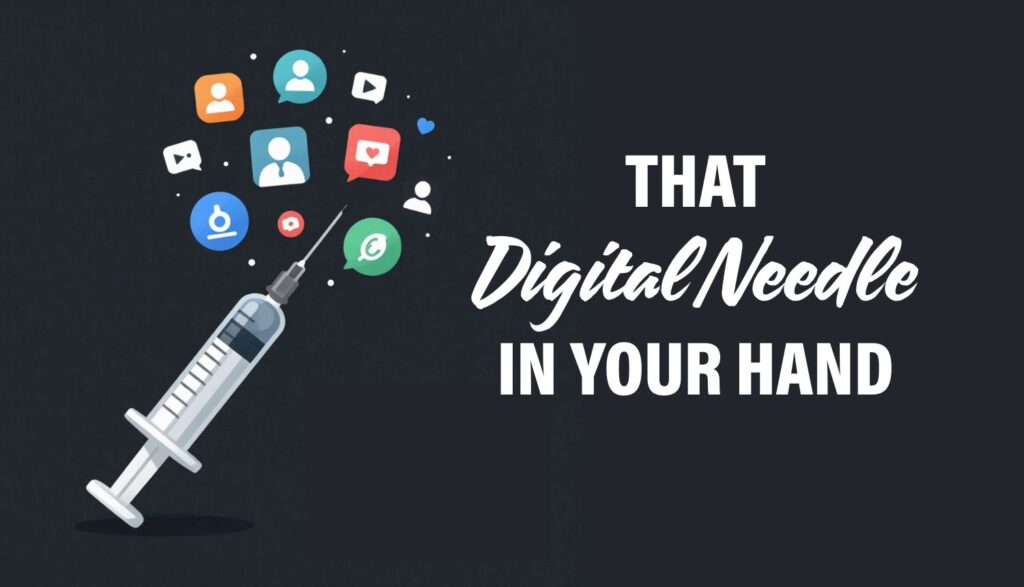
Way back in 1927, a political scientist named Harold Laswell came up with a theory on mass media that some called the “Hypodermic Needle Theory.” Laswell believed that injecting media into a passive audience had a direct and significant impact on people’s thoughts, beliefs and behaviors.
Of course, in Laswell’s day, media information was primarily communicated through newspapers and radio programs. Jump ahead 100 years and we live in world that’s plugged into a constant stream of news, entertainment, interactive videos and random noodlings. And not only do studies suggest that we are indeed highly influenced by those regular injections of data, but some researchers take Laswell’s needle imagery in a whole new direction.
Stanford psychiatrist Anna Lembke, for instance, has compared our ever-present smartphone and social media apps to a “digital needle.” Lembke’s book, Dopamine Nation, suggests that our real concern shouldn’t be media’s influence so much as social media’s addictive nature.
Now, you’ve heard people discuss social media addiction in the past. It all comes down to pleasing images and vids that cause our brains to release a small surge of dopamine—a neurotransmitter linked to pleasure and reward. As our brain becomes accustomed to those little pleasing elements (the stuff social media regularly cranks out by the barrelful) it also gets used to those dopamine rewards, and it demands: Give me more, more, MORE!
That progression of emotional and physical dependence is very similar to what happens when someone becomes addicted to drugs. In fact, studies suggest that compulsive social media use and drug addiction are remarkably similar, with both hijacking the brain’s reward system, triggering dopamine jolts and fostering compulsive, withdrawal-prone behaviors. (Just snatch away a teen’s phone, for instance, and see what kind of reactions you get.) And that’s not even considering the feelings of depression, anxiety and decreased self-worth that come along as a, uh, bonus with social media use.
OK, so if our smartphones are indeed injecting us with all this trouble, how can we deal with it? Is a cure for the common smartphone similar to what you’d do for other addictions?
Yes.
Dr. Danesh Alam of the Ambrosia Behavioral Health organization suggests that destructive digital behaviors and addictions to drugs or alcohol are very similar in both formation and resolution. And one of the first steps he recommends is to recognize that addictive behavior isn’t just some moral failing—”a conscious choice made by individuals who lacked willpower”—but a deeply ingrained set of habits shaped by the brain’s learning and reward systems.
And these habits can be broken.
Lembke agrees; in a Stanford Medicine article, shesuggests that anyone slipping into negative patterns with their social media use should take some time to step back—at least for a day. “But a whole month is more typically the minimum amount of time we need away from our drug of choice, whether it’s heroin or Instagram, to reset our dopamine reward pathways,” she writes. “A monthlong dopamine fast will decrease the anxiety and depression that social media can induce, and enhance our ability to enjoy other, more modest rewards again.”
Of course, anyone who’s feeling the unhealthy pull of social media’s siren song needs to recognize the simple fact that habits form through repetition. And habits break the same way. Getting healthier isn’t about one decisive good choice, it’s about multiple small victories that strengthen new neural pathways.
Oh, and it’s also important to understand that removing a habitual behavior will leave a void behind. So, we need to replace that activity with a fun alternative—a trip to a ball game, a creative endeavor, exercising with friends, meeting a bestie for a nature hike. In doing so, we give our brains some heathier things to rejoice over with dopamine bursts.
So, there’s a couple things to consider and a few bits of healthy advice to try. But again, breaking bad habits is a process. And if you want more ideas, check out Plugged In’s newly released and absolutely free Parent’s Guide to Technology. We’ll give you all we can to keep those addictive tech injections at bay.

Recent Comments