




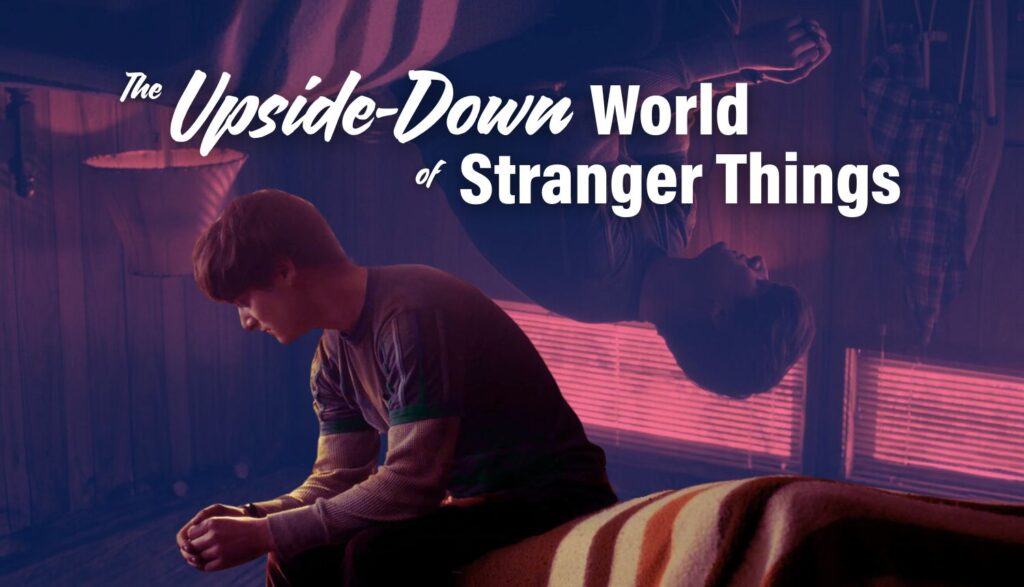
We’re on the cusp of the grand finale of Stranger Things, a five-season sensation that has become one of Netflix’s cornerstone shows.
Lots of Christians have been watching Stranger Things, too—overlooking the show’s significant content issues and embracing its writing, character development and cool retro vibe. Oh, and let’s not forget its good-versus-evil ethos.
But after the show’s penultimate episode, many of those same Christians may have felt like they were being force-fed by one of Vecna’s tubelike tentacles. For some, it seemed like the show was not just shoehorning another LGBT storyline into the plot but making it the key to defeating the show’s Big Bad. It’s as if the Duffer Brothers were saying, Will’s come out of the closet now and can embrace his superpowers because of it! Watch out, Vecna!
That’s not an unfair reading. But for Christians invested in the show, I wanted to walk through some of my own thoughts on the issue. And I thought you might like to walk along with me. (And if you’re not familiar with the show, buckle up: I won’t be sharing a lot of backstory.)
Secrets and Lies
Let’s take a look at the broader context of Stranger Things for a minute. While Vecna and his legion of toothy demo-things is the story’s most obvious threat in the show, something else may be just as insidious if not quite as CGI glamorous: secrets.
Season 5 has been preoccupied with secrets. They form the barriers that have hindered, and still hinder, Stranger Things’ heroes from operating as a team. And in almost every episode, another secret is confessed or discovered.
And here’s an interesting thing: Confession, almost without exception, leads to greater connection and cohesion within the context of this show. Think of Jonathan and Nancy’s tabletop barrage of declarations. Or when Dustin tells Steve Harrington that he really, really doesn’t want him to die. Whenever someone confesses in Stranger Things, the story arc improves. Our heroes may gain an ally, or Vecna may lose a weapon. Confession, in Stranger Things, is power.
But when secrets—even secrets kept for what would appear to be good reasons—are unexpectedly revealed, we experience dissonance and division. We see that very literally when El starts digging around in the mind of a secret-keeping soldier in Episode 3 (a very unpleasant experience for the soldier, to be sure). But when Hopper keeps his explosive vest a secret from El, El feels betrayed. As we enter into the story’s final act, Hopper and El seem slightly estranged—even as El may be harboring her own secret plans.
All of this feels quite biblical: Satan, like Vecna, can use our secrets—and what we desire to keep secret—against us. But Scripture tells us that “whatever you have said in the dark shall be heard in the light, and what you have whispered in private rooms shall be proclaimed on the housetops (Luke 12:3).”
But when we confess our secrets and sins, we’re freed from them. We’re called to confess our sins. We’re asked to allow our fellow Christians to help us with our burdens.
Will’s been harboring a secret for a long time now. And even if we in the audience knew for a long time that this reveal was coming, this season’s Episode 7 was the first time Will addressed the matter directly. He confessed. That confession is in keeping with the overall story arc that Stranger Things has been tracking with all season long: Secrets kill. Confessions free.
And while Stranger Things probably isn’t the best catalyst for such a revelation, it’s an example of what we, as Christians, should all do with our own secrets and sins: We must confess them. We must ask for help and understanding from our own Christian friends and family. We all need help. When we try to deal with our gunk alone—when we keep it secret—that’s where we run into trouble.
But here’s the thing: We have to be honest about the nature of those secrets, too. To ask for help is not the same as to ask for blanket acceptance.
Inconvenient Truths
When I was a secular religion reporter, it was during a time when many mainline denominations were discussing the issue of homosexuality. Is it a sin, as the Bible says it is? They were asking. Or do we need to interpret this ancient faith with modern context?
A stalwart conservative priest I interviewed insisted that churches needed to embrace Scripture—even if it went against the modern rush toward acceptance. And he said the issue wasn’t same-sex attraction: It was acting on that attraction. In other words, if your desires lead you away from God, you gotta stay celibate.
Perhaps some readers of this very blog deal with same-sex attraction. Many more do not. But everyone reading these words—everyone—has had some worldly desire that threatens to lead us away from God. We’re fallen creatures in a fallen world, and we can fall prey to temptation, addiction and sin. Maybe it’s porn. Or drunkenness. Maybe we’re selfish or prone to sloth. Even good things, like work or tasty food or even family, can turn into idols if we’re not careful.
And what does the Bible ask us to do? To sacrifice. To deny ourselves. To live for God, and to mirror Him in everything we say and do. We die to ourselves so we may live in Christ. And it’s through Christ that we become more ourselves than ever before.
That, I know, will sound heartless when we’re talking about this particular issue—one that, for so many, feels absolutely core to what and who they are. But if you believe the Bible is core to not only who we are but what the universe is, I don’t see how you could wriggle out of what it calls us all to do.
Will has not acted on his same-sex attraction, as far as we know. But we know the direction Stranger Things would encourage us to take: Robin tells Will that when she embraced every part of her—including and especially her sexual inclinations—she felt whole.
But the Bible asks us to take a harder road. It asks us to refine ourselves every day—to draw closer to what God wants us to be in what we say, what we do and what we believe.
In the real world, confessing our secrets isn’t where the story ends: It’s where the hard work begins. It’s where we acknowledge to ourselves that we are not perfect creations unto ourselves. We need God to perfect us.
That’s not an easy thing to accept—at least for those of us who would most assuredly like to go our own way. But when we follow Christ, we—by definition—stop leading.
The Real Upside Down
The theologian Augustine suggested that evil isn’t a thing in itself. Rather, it’s a corruption of something good. And so we see in Stranger Things’ Upside Down: It itself is a corruption of Hawkins. It’s ruled by Vecna, a corrupted creature in his own right, twisted by pride and sin and pain and insanity. That’s powerful, and it has the whiff of the biblical about it. And I believe that, as we look at much of what we see in Stranger Things, we can ourselves see hints and echoes of Christianity within it.
But let’s make no mistake: Stranger Things is also a product of a fallen world that has lost its way. Hawkins? Our own towns and cities and countries? Biblically, they are the Upside Down—a corruption of what God intended. Yes, they still bear some of the beauty and wonder of His original creation. But let us not get lost. Let us not get entangled in tentacles and pumped full of lies the world spins—imagining ourselves in a beautiful Victorian mansion when, in reality, we’re trapped and tied.
Is it so surprising that, as we try to walk a different path and find our way through, we find ourselves dealing with paradox? How victory was found in what looked like defeat? How love is mightier than anything? How we die to ourselves to live?
Stranger Things? Christianity itself is a strange, countercultural, otherworldly thing. But within its paradoxical folds we find beauty, glory and truth. Vecna would be envious indeed.

One Response
Nicely written, need to send this to my daughter. You and the team do great work by the way. God bless