

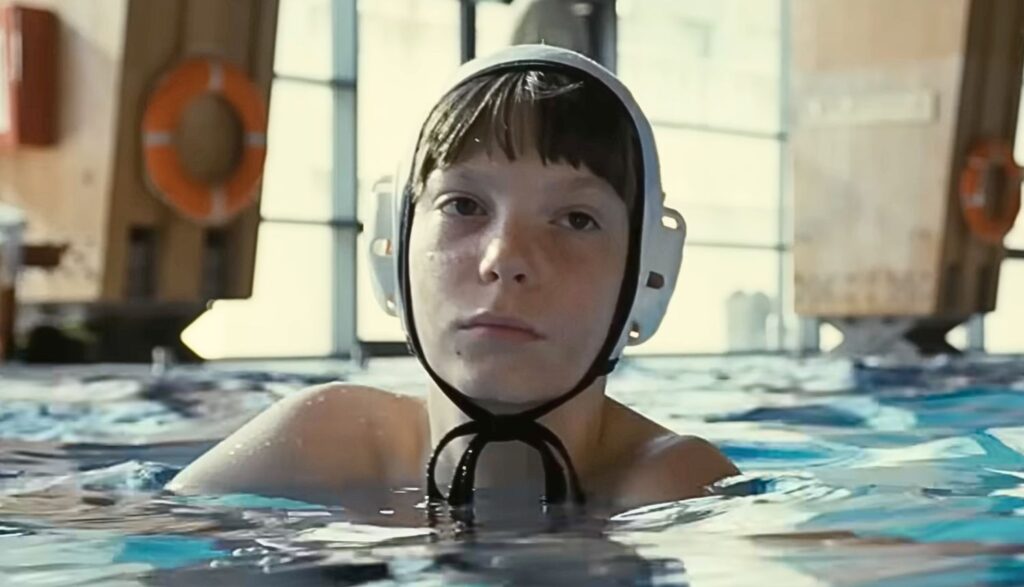
Adolescent boys can be cruel, and The Plague is a 95-minute exploration of that cruelty. Ironically, most of the movie’s actors wouldn’t be old enough to see their own film, filled with a pool of profanity, extreme sexual dialogue and blood.
The Plague begins with a pimple or two.
“Those aren’t regular pimples,” 12-year-old Jake tells his new water polo pal, Ben, as he talks about one of the infected. “Those are plague pimples.”
Soon those pimples turn into a rash, Jake cautions. Then the Plague infects the nervous system, impacting the victim’s motor skills. Before long, the infected can’t even form complete sentences.
“Turns your brain into baby food,” Jake says with a smirk. “No brain, no nothing.”
And, Jake adds, there is no cure.
Jake knows all about the Plague. He’s been at the Tom Lerner Water Polo Camp (circa 2003) for a full session already and is just starting his second. Jake watched the Plague claim one victim, who was sent home early because of it. “Last I heard, he was in some sort of mental institution,” Jake says. But the kid infected Eli before he left: Now Eli wears a shirt to hide his rash. He blurts out strange, barely comprehensible sentences. He keeps, mostly, to himself.
Of course he does. No one sits with Eli. No one stands near him. The Plague is spread by touch, Jake says. If you so much as brush up against Eli, the only remedy is to wash yourself immediately.
Ben knows it’s all nonsense. Or, at least, it’s probably nonsense. It’s a game, right? A harmless, silly game—as long as you don’t have the Plague, of course. As long as you have someone to sit with. Talk with. Laugh at Eli with.
Because once you catch the Plague, you’ll never find a cure. Jake will make sure of that.
For a while, Ben falls into the camp’s Plague narrative. But after Eli experiences a moment of acute embarrassment thanks to Jake and his pals, Ben begins to feel sorry for Eli—even seeking him out to befriend him. He begins to talk with Eli. And when Eli is clearly having trouble rubbing some medicinal cream on his back (for Eli’s very real skin condition), Eli offers to help him.
This moment of kindness directly leads to all manner of horrors. But the moment shouldn’t be forgotten.
None. But we do hear a reference to leprosy, a disease that garnered its greatest notoriety in the Bible. Jake insists that leprosy is just a made-up disease—but that the Plague is real.
The water polo camp is populated with 12- and 13-year-old boys, and they talk relentlessly about sex. Late one night, the boys talk about their fantasies as they apparently masturbate. We don’t see anything, but we hear squeaking beds, and the kids pass around “lube.” It’s clear that some of the boys are fibbing during this scene.
We hear plenty of lewd conversation revolving around sex and sex acts (including incest and bestiality), and the boys (naturally) claim to have had far more sexual experience than they likely have had.
The boys’ polo camp also shares pool space with a girls’ synchronized swimming camp; the boys leer at the girls as they pass by. (And while we don’t hear anything specific, a couple of boys make a ribald comment or two, causing their peers to giggle.) One child becomes visibly excited during this scene and is mocked by his peers.
When Ben rubs lotion on Eli’s back, someone apparently sees it. Once Jake and his cronies know, they suggest (but never outright say) that Ben and Eli may have same-sex leanings, and these crude jokes continue throughout the film.
Ben tells someone about his mother’s extramarital affair and subsequent separation from his father. Ben and his mother moved from Boston because of it, so Ben’s desperate to make new friends.
Someone draws an obscene picture on a whiteboard—much to the delight of the other boys. Kids make fun of someone for having an erotic dream. We obviously see plenty of boys and girls in swimsuits, and Ben and other boys sometimes walk around with towels wrapped around their middles. A boy asks his peer to consider how he might feel if there were a rumor that his mother was a stripper.
Shortly after Eli and Ben meet, Eli pretends to cut off his finger, letting a fake, bloody digit fall to the ground. He later explains the secret to the illusion, but he also confesses to actual self-harm, showing Ben several small cuts he’s made on his hands. “It’s soothing,” he says. “Like a sound bath.”
Ben tells Eli that he shouldn’t cut himself—but he admits that sometimes he digs his fingernails into his thumb until it bleeds. And later in the movie, the camera zooms in on him sinking a nail into flaps of raw, bloody skin around his thumbnail.
Water polo can be a rough sport. One of the camp’s boys celebrates the fact that it’s a full-contact game, and we see plenty of wrestling underwater. Ben and Jake talk about how college and professional water polo players are known to grow their fingernails longer—sharpening them to points after they’ve been inspected. (Ben also repeats rumors about how players shave their genitals so that there’s no hair there for opponents to pull.)
We see someone scratch another player, drawing blood. One boy holds another underwater, apparently trying to drown him. Punches are thrown. Someone pushes a boy down; later, we see the victim’s leg bearing a big, nasty bruise. We hear references to killing animals. Boys break and destroy things in an alleyway, and someone snaps a water pipe.
Ben squeezes pimples, and blood dribbles into a sink. He sleeps on a towel stained with his own blood.
Someone does cut off part of a finger: Blood spills on the floor and trails down the hallway as the character is ushered out of the facility (and to a hospital). The people helping him get their shirts and shoes stained with blood.
Nearly 30 f-words and half as many s-words. We also hear “a–,” “b–ch,” “d–n,” “h—,” “p-ssed” and “d–k.” God’s name is misused once.
A boy spikes drinks with vodka before a coed dance. Kids sneak out of the swimming facility and smoke. We hear a reference to pirates drinking champagne.
The Plague is predicated on unrelenting bullying, and we see plenty of it here. For instance, Jake and his friends pour cockroaches onto Ben’s bed (as Ben sleeps) and then they use a blanket to hold in a now-screaming Ben with the cockroaches. Eli talks about how, at school, someone spiked his thermos with laxatives before a school outing to Les Miserables—and the bus didn’t have a bathroom. “It sucks because I really like Les Mis,” he says.
Characters shower and scrub themselves frantically after touching someone infected with the Plague. They vacate a cafeteria table when one of the untouchables sits down. Ben realizes that he’s been “infected” when, during practice, absolutely no one will throw him a ball.
The water polo coach tries to encourage Ben, telling him about his own experiences with bullies. He says that he was called “Chubbs” throughout his childhood—even through high school, when he had lost the extra weight. “I graduated and left it all behind, and I started fresh,” the coach says. (But when Ben asks if his 20s were good, the coach says they were still awful—just in different ways.)
That coach, by the way, means well. And he does what he can to stop the bullying. But his efforts often only exacerbate the issue.
Someone sticks cheese puffs up his nose. We hear that a character’s mother died. Boys make fun of Ben for being a vegetarian.
“Be yourself,” the water polo coach tells Ben by way of encouragement. “Who else can you be?”
But Ben knows better. In the world of pre-pubescent boys, being yourself makes you a target. Being yourself only works if you’re already a person that people like. And even as Ben listens and nods, a tear wells up in his eye. His fingernail digs deeper into his thumb.
It gets better, we adults say—and it’s often true. Be yourself, we say—and it’s good advice. But when you’re 12, that truth feels so tiny when no one will sit with you at lunch. When no one will talk with you. When people treat you as untouchable. When you have the undefinable, unshakeable, unreal-yet-so-real Plague.
The Plague, the movie, has received plenty of secular accolades, and it currently holds a perfect 100% “freshness” rating on Rotten Tomatoes. It portrays boyhood, adolescent fears with brutal, ripping honesty.
But this is a horror film—no asterisk, full stop. The Plague is 95 minutes of trauma-by-proxy, made all the more painful because of the youth of its victims and bullies—who can be, sometimes, one and the same.
Another note of dissonance: The kids in The Plague would be barred (in good theaters, at least) from watching it without a parent or guardian. You’ll see kids drink vodka, swear like seasoned pros and talk about sex so salaciously that you’d think that—even though the story takes place in a pre-iPhone era—they were raised in the seediest corners of the internet. The screenplay itself seems to almost border on child abuse.
The Plague is a disturbing exploration of bullying and its cost—its horrors all the more horrific because of the truth behind them. But the name does more than describe the societal “disease” we see in play: It describes how perhaps we should treat this film itself. Avoid it, or feel sick.

Paul Asay has been part of the Plugged In staff since 2007, watching and reviewing roughly 15 quintillion movies and television shows. He’s written for a number of other publications, too, including Time, The Washington Post and Christianity Today. The author of several books, Paul loves to find spirituality in unexpected places, including popular entertainment, and he loves all things superhero. His vices include James Bond films, Mountain Dew and terrible B-grade movies. He’s married, has two children and a neurotic dog, runs marathons on occasion and hopes to someday own his own tuxedo. Feel free to follow him on Twitter @AsayPaul.