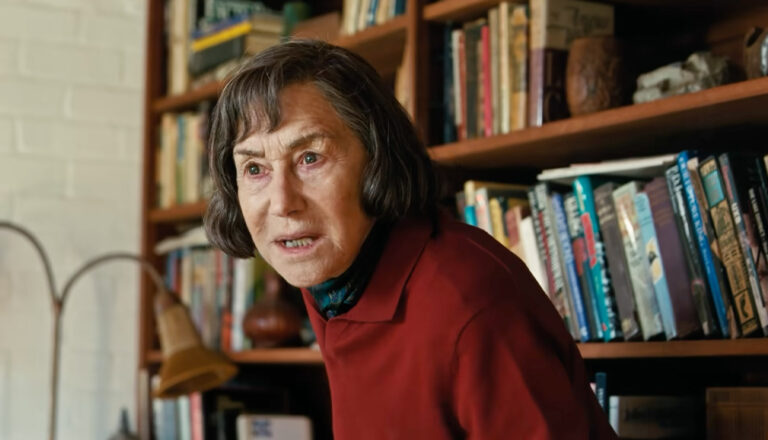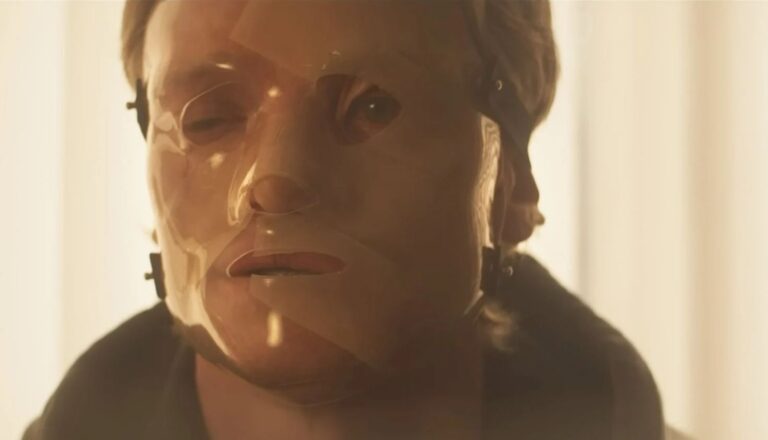


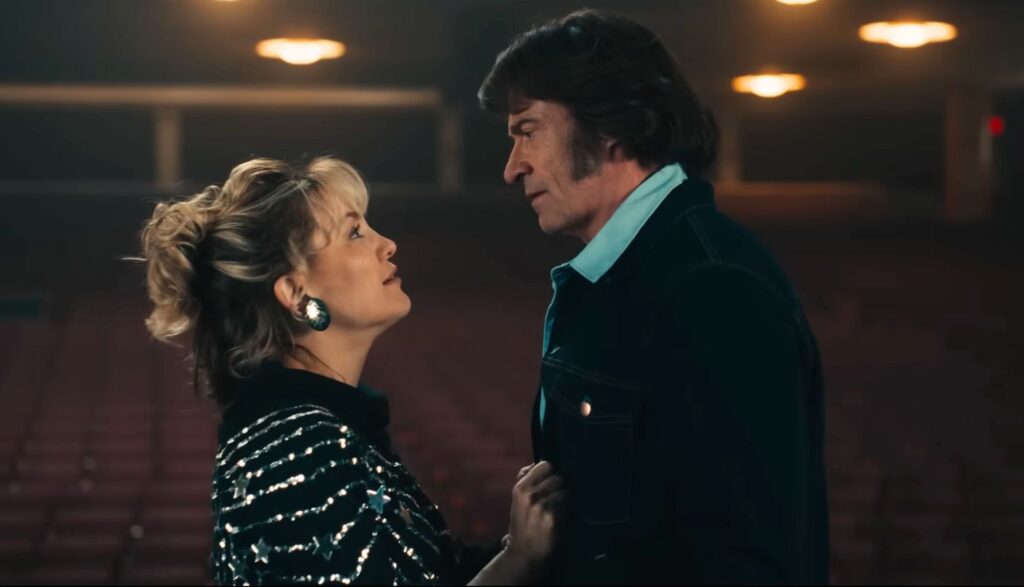
Based on a true story, Mike and Claire meet, fall in love and decide to create a Neil Diamond tribute band. Along the way, they experience a lot of trouble, and the audience gets a taste of it: Viewers will be exposed to some sexual content, harsh language and a traumatic narrative. But there’s a lot of Neil Diamond songs, too, so there’s that.
Mike Sardina’s a little like Batman.
He’s not a lot like him, mind you. He’s got no cape, no utility belt and no Batmobile. He’s not a millionaire playboy like Gotham City’s Bruce Wayne: He’s an alcoholic 20 years sober, a Milwaukee grease monkey behind on his mortgage.
But when the sun goes down and Mike steps into a bar, he becomes Lightning—a singing, playing, guitar-whaling superhero. “Like Chuck Berry, Barry Manilow and the Beatles all rolled into one,” he says.
He even puts on a mask sometimes—taking the stage as Mick Jagger or Don Ho or, heck, even the King himself, Elvis Presley.
And just like being Batman, being Lightning (or any of his other musical personas) doesn’t pay a whole lot.
But then he meets a pretty Patsy Cline impersonator named Claire Stengl. She insists that, with the right act, he could make a living at this whole music thing.
“You know who you could be?” she says. “Neil Diamond!”
Mike initially dismisses the idea. Neil Diamond? No way. He has too much respect for the guy to impersonate him.
But Claire suggests a different tack. “You don’t want to be a Neil Diamond impersonator,” she says. “You want to be a Neil Diamond interpreter.”
A Neil Diamond interpreter. Yeah, that has possibilities. Why, he might even be able to bring Claire on stage with him. If he’s Lightning on stage, maybe she could be Thunder. They could form their very own musical dynamic duo—saving the world, one song at a time.
And who knows? Maybe their partnership just might extend off stage, too.
Song Sung Blue is based on a true story. And at its core, that story is about love.
Mike and Claire get hitched and embrace their wedding vows fiercely: They’re in it together, for better or worse, richer or poorer, in sickness and health. They experience all of those lows during the course of the film, but their love and commitment survive it all.
Both Mike and Claire have kids from previous relationships. Mike’s daughter, Angelina, is essentially on her own when the movie begins, but we get the sense that Mike gave up booze, in part, to be a better father. Meanwhile, Claire’s raising two children of her own (teen Rachel and young son Dayna). When she and Mike marry, the couple blends those children into an imperfect but deeply-loving family.
This small family faces some significant challenges, as we’ll see—but perhaps the biggest comes when a freak accident claims part of Claire’s leg. Rocked by the injury, Claire nearly vanishes in a haze of depression and medication, forcing Mike to essentially turn into a single dad. And while that season isn’t pretty for any of the Sardinas, Mike does his best to hold things together—making some difficult but ultimately good decisions along the way. And when Claire eventually does climb out of the darkness, she recommits to Mike and her family with enthusiasm. “I’m here to be a mom again,” she says. “And a wife. And a partner.”
One of her first duties? Helping her teen daughter, Rachel, through an unexpected pregnancy. While that unwed pregnancy isn’t exactly a positive, Rachel’s commitment to carry the baby to term and allow a loving couple to adopt the child is. And Claire’s dedication to helping her daughter through that trying season is pretty admirable, too.
Mike and Claire make a formidable duo. But their stage success would’ve never happened without a lot of help from their friends. Mike’s dentist, Dave, has served as his advisor for years. Tom D’Amato—a guy who drives tourist buses to pay the bills—signs on to become Lightning and Thunder’s manager. Mark Shurilla decides to stop headlining as a Buddy Holly impersonator to play guitar for Mike and Claire, and Mike’s old band, the Esquires, agrees to back up the new act—at first without pay.
We don’t see a lot of spirituality in Song Sung Blue, but we do hear the blending of the sacred and secular—via Neil Diamond’s original songs.
The strongest example comes when Lightning and Thunder mash together the Diamond songs “Soolaimon” and “Brother Love’s Traveling Salvation Show.” The former includes such lyrics as “God of my want” and “Lord of my need,” though the singer’s god seems more likely to refer to a woman than the God of the Bible.
“Brother Love’s Traveling Salvation Show” seems to celebrate both godly joy and worldly pleasures, and it features a mid-song, barn-burning evangelical sermon that reminds listeners to help those in need. The movie gives the lyrics a slight revision, with Mike telling his “congregation” that the “Lord gave us two hands—one for the giving and one for the taking.” Listeners could interpret that twist cynically, but it might well be simply a paraphrase of what Billy Graham often said: “God has given us two hands, one to receive with and the other to give with.”
Later, we hear Diamond’s “I’ve Been This Way Before.” Lyrics such as “I’ve been released/And I’ve been regained/And I’ve been this way before/And I’m sure to be this way again” take on an extra-spiritual tang, given that they’re sung during a funeral.
Mike and others say the Serenity Prayer during an Alcoholics Anonymous meeting. Claire fires off a few off-color, spiritually tinged one-liners: “I’m sweating like a whore in church,” goes one. She also invokes Satan’s testicles in another. We learn that a James Brown impersonator leads worship at a local church. A religious Christmas carol plays. We hear about a “Sister Anne” from Rachel’s school—suggesting Rachel attends a Catholic institution.
As Mike and Claire talk about their potential on-stage partnership, Claire suddenly reaches over and kisses Mike. “That was not very professional of me,” she admits. “But I’ve been wanting to do that for a very—” She’s cut off when Mike kisses her in return.
It’s the first (and second) of many kisses the two share, but Song Sung Blue rarely shows more. One major exception comes after a particularly successful stage performance: The two begin making out in a dressing room, and Mike strips Claire of her costume (including her pantyhose), revealing the underwear underneath.
We see Mike in his own brief-style underwear on occasion, and sometimes without his shirt, too. Claire reminisces about how she and her friends used to attend his performances years before. “You’d push your pelvis out like Elvis, and we’d scream like schoolgirls,” she recalls.
A Barbra Streisand impersonator is actually a man in drag. The James Brown impersonator, meanwhile, goes by the stage name “Sex Machine.” We hear about both Claire’s and Mike’s dysfunctional previous relationships. Someone wistfully says that young people can “touch their toes and [have sex] all night.”
A lot of Neil Diamond songs come with mildly suggestive lyrics. During their stage performances, Mike takes a scarf and uses it to pull female concert-goers closer. It’s all an act, but Claire responds jealously at one point all the same. Some outfits reveal some cleavage. Claire laments that if her breasts were just a bit bigger, she could’ve impersonated Dolly Parton.
[Warning: This section contains spoilers]
While gardening, Claire is struck by a car. (Her family members spend time in the hospital, still stained by her blood.) She loses a foot and part of her leg in the accident, and she spends much of the rest of the movie trying to get used to her prosthetic. She falls out of bed once, forgetting that she’s missing a limb.
Later, when Claire takes stock of her still-unplanted garden, another car crashes into the family yard and runs into the garage door—just seconds after Claire vacated the spot.
Mike has, in his words, a “jacked-up heart,” and he suffers what appear to be a handful of heart attacks during the film. During one, he keels over in a bathroom and hits his head hard on a sink, causing a bloody wound. In another, he drags Rachel into a hospital room and warns her that he’s about to pass out. He doesn’t want Claire to know about his heart condition, so he tells Rachel that she’ll need to use a defibrillator to jolt him back to consciousness. “Remember, I showed you how to jump a car,” he tells a terrified Rachel. “It’s just like that.” (He does indeed pass out, and Rachel does indeed jump-start him again.)
Lightning and Thunder are contracted to play their Neil Diamond tunes at a biker’s bar. Predictably, the audience turns on them, and one listener throws a bottle on stage. Mike responds by jumping into the audience, and the resulting melee leads to plenty of thrown punches and one seriously bloodied manager. (“It’s OK,” the manager, Tom, says as he stuffs tissue up his nose. “I’m a bleeder.”)
Mike’s knee seems to give out while singing. He was also a tunnel rat during the Vietnam War, and he often had to “crawl over dead bodies” (his daughter tells us) as part of his work. Someone dies. We hear about other people passing on, too.
One f-word and a half-dozen s-words. We also hear “b–ch,” “crap,” “h— and “p-ssed.” God’s name is misused about 15 times, with three of those instances also paired with the word “d–n.” Jesus’ name is abused once. Someone uses an offensive hand gesture.
As mentioned, Mike is a recovering alcoholic, and every year, he celebrates his “sober birthday” by singing “Song Sung Blue” for his AA group. But as Lightning and Thunder grow more successful, he’s rarely able to attend meetings—sometimes sending his sober birthday songs via video.
His sobriety is tested during some really difficult times, and he admits to someone that he wonders whether “the ride would be a little less bumpy if I fell off the wagon.” His daughter begs him to return to meetings, and Mike promises that he will. If Mike does return, we don’t see it—but he never returns to the bottle. Even when he finds an old beer he squirreled away in a tool chest, he pours its content down the drain.
“You know, most recovering alcoholics just trade one addiction for another,” Mike’s daughter, Angelina, tells Rachel. “And music’s that for dad.” But if that’s true, music’s a relatively benign addition—one that keeps Mike from getting “scattered.”
During that same round of familial confessions, Rachel tells Angelina that her mother, Claire, takes antidepressants. Claire is given more drugs after she loses part of her leg, and Mike blames them for the depression and psychosis that follows. Things get so bad that Mike tearfully checks her into a mental health clinic—but it proves to be helpful. During a group session, Claire admits that she used to get frustrated by Mike’s AA meetings. “Why can’t you just deal with your problems without all the talking?” she recalls telling him.
Angelina offers to share a marijuana joint with Rachel. “You know, I thought I smelled it on you,” Rachel says by way of acceptance. Claire complains that one of Rachel’s boyfriends “smelled like a skunk. He was clearly a dope dealer.”
Lightning and Thunder mostly perform in restaurants and bars. Attendees are often shown drinking beer, wine, shots and other alcoholic beverages.
Even though Mike and Claire seem to have a strong, solid marriage, Mike seemingly keeps his heart problems a secret from her.
Music can function a little like a time machine. And when I stepped into Song Sung Blue, I was whisked back to when I was 6 years old—playing on our shag carpet as my mom cleaned and Neil Diamond sang “Cracklin’ Rosie” through the speakers.
The songs from Song Sung Blue form my childhood soundtrack, with each song carved in memory like initials on a tree.
I said from the outset that Song Sung Blue was a love story: But the movie’s not just about Mike and Claire’s love for each other: It’s about a shared love of music—and the joy that music can give.
The real Mike and Claire Sardina exploded on the Wisconsin music scene in the early 1990s, just when musical tribute bands were becoming a thing. Some listened to them ironically at first; two unhip performers playing their parents’ (or grandparents’) songs. For some, I’m sure, Lightning and Thunder felt like a lounge act that couldn’t quite make it in Vegas.
But in the midst of a chorus for “Sweet Caroline” or “Forever in Blue Jeans,” the cynicism ebbs. And the audience, like Mike and Claire, are lost for a moment in the music.
Song Sung Blue can get a little lost itself, of course. Discerning audiences will perceive some dissonant notes along the way. They’ll be exposed to sexual content and infrequent harsh profanity.
And let’s be honest: This story can be hard. Claire and Mike experience plenty of grief and trauma during their marriage. Even the good times are hard times—just as they are, I suppose, for many of us. The Sardinas live in a small house by the Milwaukee airport, where planes nearly touch the roof 10 times a day. Money’s always tight. Health scares abound. And viewers might wonder whether Song Sung Blue was a comedy or tragedy once the credits roll.
But then the music begins. The lyrics unfurl like a cape. People raise their voice in song. And we hear not just a moldy classic from days gone by. We hear something akin to joy.

Paul Asay has been part of the Plugged In staff since 2007, watching and reviewing roughly 15 quintillion movies and television shows. He’s written for a number of other publications, too, including Time, The Washington Post and Christianity Today. The author of several books, Paul loves to find spirituality in unexpected places, including popular entertainment, and he loves all things superhero. His vices include James Bond films, Mountain Dew and terrible B-grade movies. He’s married, has two children and a neurotic dog, runs marathons on occasion and hopes to someday own his own tuxedo. Feel free to follow him on Twitter @AsayPaul.