




Content Caution

HeavyKids
HeavyTeens
HeavyAdults
the housemaid

Credits

In Theaters

Cast

Home Release Date

Director

Distributor

Reviewer

Paul Asay

Too good to be true? Yep, that’s just what Millie’s new job as a housemaid is—and everyone in the audience knows it. What they might not expect, though, is the amount of nudity, profanity and blood The Housemaid comes with. And this content can’t be scrubbed away.

  • Previous
  • Next

Movie Review

Millie needs a job in the worst way.

Any job will do, really. When you’ve spent the last decade in prison and you’re living out of your car, you can’t afford to be picky.

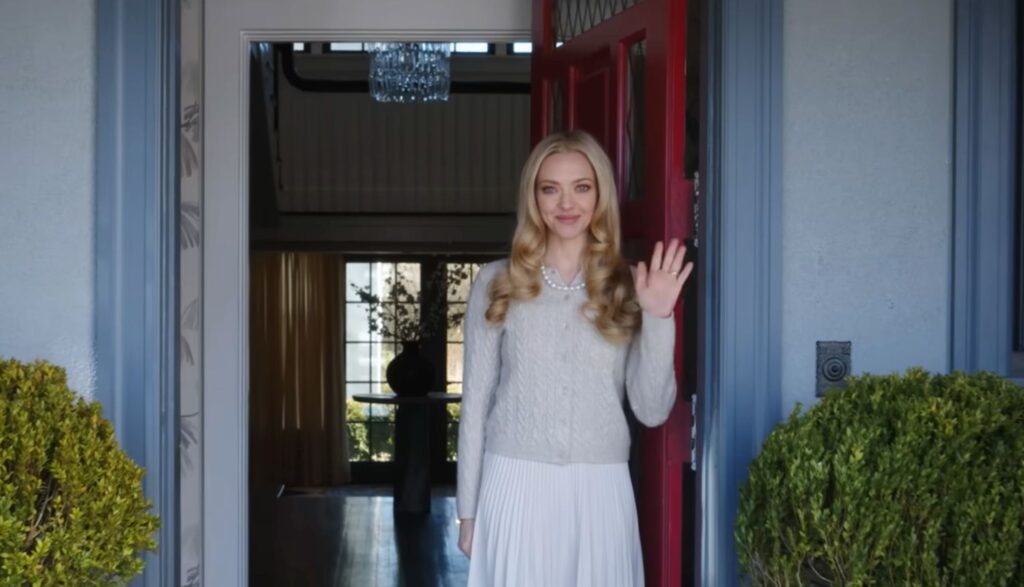
And then along comes the perfect job: serving as a housemaid for the ultra-tony Winchester family. Andrew Winchester is a rich, handsome tech mogul. Nina is his picture-perfect wife. Nina’s daughter, Cecilia, is—well, she’s a work in progress, like all kids. But with unlimited resources for ballet classes and, surely, an Ivy-League education in her future, she’s bound to succeed. And the house! How beautiful it is, with its circular driveway and white-granite countertops and dramatic spiral staircase. It’s a job to kill for.

But as Millie starts scrubbing the floors and cooking the occasional quiche, she discovers that the gig isn’t quite as perfect as it first seemed. Her live-in quarters are a little creepy, what with the door locking from the outside. And Nina does seem to be just a teensy bit crazy.

But hey, Millie can deal with crazy. And every job has its rough spots.

Still, it might be good if Millie brushed up on how to get blood out of white wool carpets. Just in case.


Positive Elements

The Housemaid offers few life lessons for its viewers. Sure, one could say that it does remind prospective live-in housemaids to always ask a lot of questions during their interviews—especially if their bedroom doors lock from the outside.

But hey, at least we can single out Cecilia’s actions here. When someone in the house seems to be in peril, she wants to help that person, even though it’s risky. Way to go, Cecilia!

Spiritual Elements

A priest presides over a funeral.

Sexual & Romantic Content

As soon as Millie locks eyes with Andrew, viewers know there’ll be some sparks a-flying. Never mind that Andrew’s married. No matter that Andrew is Millie’s boss and all. It’s not long before the two start locking lips and shedding clothes.

Graphic sex scenes feature nudity and show pretty much everything besides genitals. (We see a bared male rear in a post-coital scene, as well.) These scenes are meant to feel tawdry and sensual to the audience—the big-screen equivalent of a steamy romance novel. Other scenes feature them kissing and canoodling, and the movie begs us to excuse this extramarital affair, given that Nina seems unhinged and makes both of their lives rather miserable.

Millie’s primed to accept Andrew’s attentions. She admits that, because of her prison stint, she hasn’t had sex in 10 years. And shortly after she moves in, she dreams about Andrew making a pass at her.

Through flashbacks, we see some romantic moments between Andrew and Nina as well, though none are as graphic or titillating.

Several women talk about how “hot” Andrew is, and what a shame it is that he’s married to such a crazy, vile woman. We learn that, before she met Andrew, Nina had a sexual relationship with an older man—a relationship that led to Cecilia.

Violent Content

A character is pushed off the top of a staircase and dies. Someone’s forced to yank out a tooth with a pair of pliers. Nina grasps a bloody mirror shard in her hand. (We see that same hand bandaged in subsequent scenes.) A character is stabbed in the neck. A woman exposes bruises on her wrists, suggesting to the audience that her husband is abusive. Several dishes are accidentally or purposely broken. Some characters sport some pretty significant, bloody wounds. Serious threats are thrown around.

[The following paragraphs in this section contain spoilers.]

We learn that Nina’s parents died in a house fire, and it’s rumored that Nina started the blaze. We also hear whispers that Nina tried to drown Cecilia in a bathtub and kill herself, too. In flashback, we see what really happened—and indeed, Cecilia does nearly drown. (The only thing we see of Nina’s parents, however, is their funeral after the fact.)

But the real monster here is Andrew. And because the horrors he commits are not just physical, but emotional, we really needed to let you know.

Andrew wants whatever woman he’s with to be pretty much perfect. If she falls short of his standards, he’ll lock her in the attic room until she proves her commitment to doing “better”—and that often involves some level of self-harm. He forces someone to cut herself several times across her abdomen “long and deep” to prove her sincerity. He tells someone to pluck 100 hairs from her head. And when one hair is missing a follicle, he forces her to do it again. He sometimes threatens to murder, too. (We hear intimations that Andrew’s previous fiancée was similarly abused, though we don’t hear the details.)

We learn that Millie was imprisoned for killing a fellow student in boarding school: She catches him sexually assaulting her roommate and beans him several times with a paperweight, killing him. Later, she stops another sexual assault by smashing a guy over the head with a bottle of booze. (“I don’t handle creeps very well,” she admits to the audience.) It’s suggested that Millie’s next career will involve killing abusive men. It’s suggested that another shadowy character has experience in doing dirty deeds and covering them up.

Crude or Profane Language

More than 55 f-words, about 20 s-words and two c-words. Other profanities lobbed about include “a–,” “b–ch” and “h—.” God’s name is misused at least 10 times, once with the word “d–n.” Jesus’ name is abused once.

Drug & Alcohol Content

Characters drink martinis with dinner and declare themselves incapable of driving home. Wine is served with several dinners. Characters drink champagne.

Millie snoops inside Nina’s medicine cabinet and sees drugs designed to aid mental health. (She finds an unflushed pill in a toilet, suggesting that Nina isn’t taking all of her meds.)

Other Noteworthy Elements

Nina is a pretty abusive boss. She’s volatile, moody and accusatory, and—intentionally or not—constantly accuses Millie of the worst sorts of misdeeds. A good (but relatively minor) example takes place early on, when Nina apparently misplaces some notes she needs for a presentation. She accuses Millie of throwing them away and has a meltdown in the kitchen—throwing and breaking dishes before falling to the floor, awash in mental agony. But she proves to be incredibly manipulative, too, purposefully framing Millie for a host of sins.

On the other end of the spectrum, Andrew’s mother—whom Andrew seems to adore and constantly seek approval from—unfurls her own displeasure via barbed comments and chilly putdowns. Many of those insults are directed at Nina, and we get the sense that she’s one of the Winchester home’s most nefarious influences.

But let’s be honest: No one here is quite who they seem. Secrets and lies are as much a part of The Housemaid as sex and blood. Moreso, perhaps.

A nursing mother enters a meeting room full of men with milk stains on her blouse: Her boss is disgusted and goes out of his way to embarrass her. We see plenty of demeaning attitudes elsewhere, too.

Conclusion

The Housemaid is less a work of first-class art and more a study in cinematic guilty pleasure. With the emphasis, perhaps, on guilt.

Yes, the writing is sharp. Based on a book of the same name by Freida McFadden, the film comes with some interesting and, for some, satisfying twists. And the performances, led by Sydney Sweeney (Millie) and Amanda Seyfried (Nina), are strong.

Still, when the audience laughs at acts of abject horror and torture—and the movie apparently wants them to laugh—you’re likely not looking at an Oscar contender (unless you’re looking at The Substance): You’re looking at a made-for-TV Lifetime-esque movie with a little more sheen and a lot more skin.

This is a bloody, tawdry, fairly silly film with a strong dose of revenge fantasy mixed in. It’s clever, forgettable and quite problematic in a great many ways. The Housemaid serves as a bit of cinematic counterprogramming this Christmas: With theaters awash in more family friendly offerings, it hopes to (ahem) make a killing.

But perhaps moviegoers should imagine themselves in their own theatrical thriller. Instead of telling the screen, “Don’t go in there!” or “Don’t take that job!” pretend they’re telling you, “Don’t see that movie!”

Paul Asay

Paul Asay has been part of the Plugged In staff since 2007, watching and reviewing roughly 15 quintillion movies and television shows. He’s written for a number of other publications, too, including Time, The Washington Post and Christianity Today. The author of several books, Paul loves to find spirituality in unexpected places, including popular entertainment, and he loves all things superhero. His vices include James Bond films, Mountain Dew and terrible B-grade movies. He’s married, has two children and a neurotic dog, runs marathons on occasion and hopes to someday own his own tuxedo. Feel free to follow him on Twitter @AsayPaul.