Episode Reviews
March 22, 2026 – S1, E1-2: “The Woman Who Bowed to No One/The Woman Who Spoke to God”
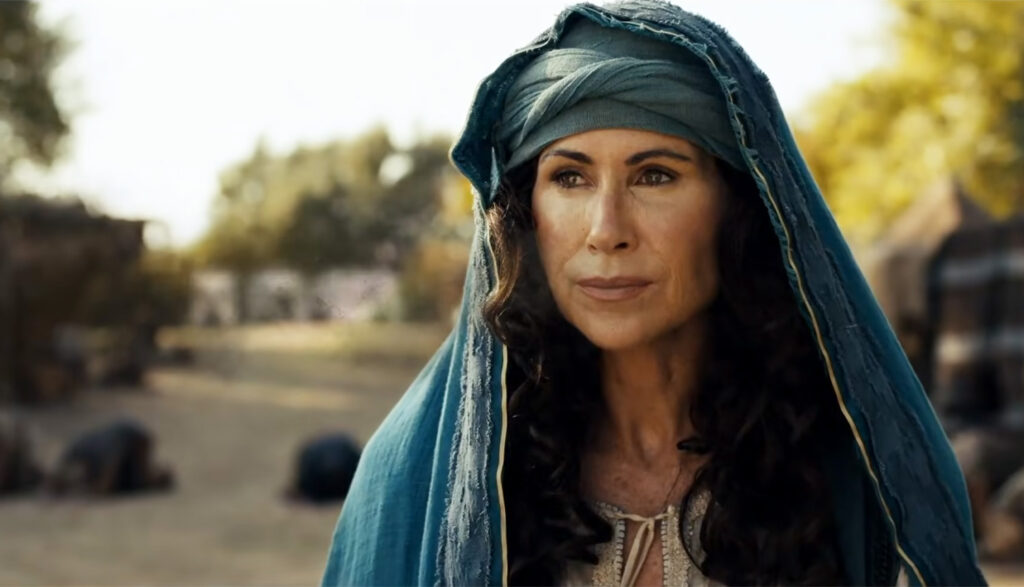
We’re shown events from the book of Genesis, from the time Abraham and Sarah (then called Abram and Sarai) were told to leave their homeland to the time of Sarah’s death many, many years later.
Two different men court Sarah, demanding that she bow before them, but she refuses, stating she bows to “no man.” (It should be noted that both of these men had other wives already.) Sarah’s father, embarrassed by Sarah’s “spirited nature” apologizes to one potential suitor. When Abraham proposes, offering Sarah love rather than money, she accepts and kisses him on the lips.
Even though Sarah is barren, Abraham remains devoted to her and only her, refusing to take another wife even though it would be culturally acceptable. When Sarah later asks him to have a child with Hagar, he is reluctant, only participating because Sarah tells him to. Even though it’s her idea, Sarah still struggles with jealousy over the situation, but she tells Abraham to continue lying with Hagar. And once Hagar conceives, they all seemed relieved to return to normal.
As depicted here, Hagar was given to Sarah as a wedding present by a potential suitor. She tells Sarah that she sold herself into slavery to provide for her family and hopes to return to them someday. She is devoted to Sarah and willingly agrees to be a surrogate. However, once the baby is born, even though she wants to return to her family, Hagar decides to stay so she can be a part of her son’s life.
We don’t see their marital relations onscreen, but Sarah and Abraham try many times to conceive a child. Hagar uses Sarah’s urine to test for pregnancy each morning (the same test is performed while Hagar is trying to conceive). She gives Sarah a mandrake tea to serve Abraham so he’ll be more virile. In one scene, Abraham talks to Hagar after having sex with her (she’s still in bed, covered by a sheet), telling her she’s beautiful before leaving the tent.
A husband and wife sleep in bed together. They kiss a few times. Servant women put a robe on Pharaoh as he steps out of a tub (the robe covers him entirely in this shot). Many of Hagar’s garments (and the garments of Egyptian women) show cleavage.
When Abraham first tells Sarah that God spoke to him, she asks, “What god?” “God,” he responds, indicating that he believes this is the one true God. Sarah is still suspicious, thinking Abraham may have simply been dreaming. And she continues to express doubts about God and His promises throughout the episode. But she also decides to trust her husband, and through the years, she eventually begins to have faith in God herself after watching Him work in their lives. Hagar also seems to develop a faith in God after witnessing Him perform miracles.
People pray on several occasions. Sometimes we hear God whisper back. We hear about God’s promises to Abraham, Sarah and Hagar. Three men have dinner with Abraham, and one says that Sarah will have a son. Sarah laughs when she hears this, but sure enough, she becomes pregnant.
Abraham’s household wakes one night to sounds of thunder. They walk outside to see fire raining down on Sodom and Gomorrah. Abraham tells the stories of Noah and the Tower of Babel to some children.
When Abraham and Sarah leave their homeland, Sarah’s father tries to give her household idols to protect her, but she declines, saying that Abraham will protect her. Pharaoh, the king of Egypt, is called a “living god,” and many people prostrate themselves before him. Hagar tells Sarah that her village was razed by Pharaoh because they worshipped the “wrong god.” Hagar wears an ankh.
A woman tries to stab a man with a hairpin after he tries to force himself upon her. God intervenes, causing the man to bleed from the eyes and nose in immense pain. Believing that Sarah is causing his affliction, the man calls her a witch. Elsewhere, a man says that God threatened to kill him and his family if he didn’t obey God’s commands.
We see the bloody corpses of a few animals sacrificed on an altar to God. A few women are manhandled by guards. Abraham punches a man in the face. Someone throws an object in anger. A woman screams in pain as she delivers her baby. We see a corpse wrapped in a shroud for burial.
Sarah plies Abraham with wine before asking him to sleep with Hagar.
We see how jealousy impacts Sarah and Hagar’s relationship and the relationship of their respective sons, Isaac and Ishmael. Sarah compares Ishmael’s hatred for Isaac to the story of Cain and Abel. Sarah never told Ishmael that Hagar was his mother, and there are consequences for that lie. Even though circumstances drive them apart, Sarah and Hagar truly care for each other. And Sarah also cares deeply for Ishmael, even though she’s eventually forced to send him away for Isaac’s sake. (Young Isaac is devastated to see his brother go.)
Sarah and Abraham are generous to the servants in their household, treating them more like friends or family than servants.
Throughout the episode, parents make sacrifices for their children.
Someone exclaims, “My god!”