
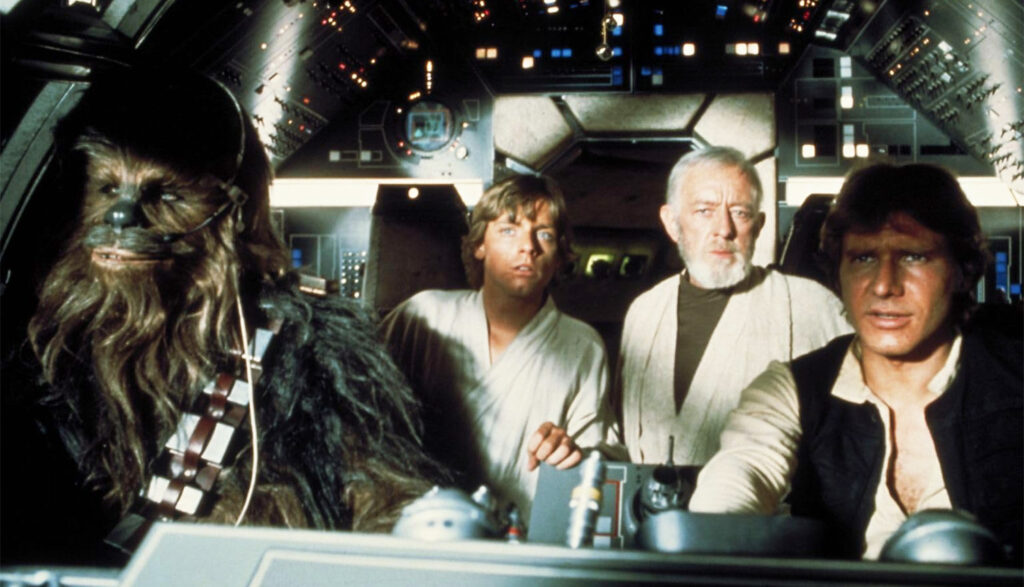
A young man from Tatooine finds himself whisked off the planet by a mysterious old codger, a rakish smuggler, a walking carpet and two feisty droids. The original ‘Star Wars’ movie is unquestionably a classic, but for kids, its spiritual murkiness and surprising violence might make it worth waiting for.
Tatooine is just the worst.
Oh, sure. Its suns are nice enough. The pod racing can be fun. And it has all the sand you could ask for.
But Luke Skywalker has been itching to get off this rock forever. Most of his friends left long ago, and he yearns to follow them: See the galaxy. Join the Rebellion. Maybe have a real adventure or two.
But his guardian Uncle Owen has different ideas. The moisture farmer needs all the help he can get. Just one more season, Owen says. After that, you can go. But Luke’s heard that before, and he’s still stuck on Tatooine. Just one more season. Yeah, right.
A couple of new droids promise a little ray of sunshine. If they work out, that might be just enough extra help for Uncle Owen to finally let Luke leave. Granted, the droids are pretty beat up, and the astromech droid—R2-D2—seems a little flaky. He keeps babbling and beeping about a “secret mission” or some such. He’s carrying a strange little hologram message, too.
“Help me, Obi-Wan Kenobi. You’re my only hope,” the hologram of a woman says.
There must be more to the message, and R2 says that if Luke disables his restraining bolt, why, it just might be able to play the rest. But when Luke does just that, the hologram disappears.
What message? R2 beeps.
A frustrated Luke heads in for dinner and receives some disappointing news. Whether the droids work out or not, Uncle Owen wants Luke on the farm. Just one more season.
But when Luke gets back to the garage, he discovers that one of his droids is missing. Without the restraining bolt, there was nothing to keep R2 on the farm, and now he’s wheeling through the desert—on the hunt for Obi-Wan.
Luke scans the horizon: No droid. No hope of looking for him ‘til sunrise, either—not with so many Sand People about.
“You know, that droid is going to cause me a lot of trouble,” Luke tells R2-D2’s golden companion, a protocol droid named C-3PO.
“Oh, he excels at that, sir,” C-3PO says.
And perhaps somewhere, far, far away, a certain Sith lord feels a slight shiver in the Force.
The universe of Star Wars can be a complex place filled with less-than-perfect characters. But in this, our first introduction to that universe, Star Wars: Episode IV – A New Hope is a clear, unmitigated story of good versus evil.
Ironically, we’ve got to begin with the evil side of things to understand the good.
Creator George Lucas modeled his fascist, militaristic galactic Empire on Nazi Germany, complete with faceless stormtroopers and an utter disregard of human life. The Empire’s leaders (the two most visible here being Grand Moff Tarkin and, of course, Darth Vader) don’t blanch at torture, murder and even blowing up entire planets in their pursuit of galactic, iron-fisted control.
Naturally, those who fight such an insidious force will be the good guys.
We learn a lot more about the Rebellion and its main players in other movies, shows, etc. But in this franchise launch point, we don’t know much about it or its adherents. We just know enough to root for them. Obi-Wan Kenobi tells us that he was once a Jedi knight, an ancient order that guarded “peace and justice” in the Old Republic for millennia. That Republic, and the other vestiges of democracy, have been swept away by the Empire, but a feisty and growing Rebel Alliance hopes to restore freedom and justice to the galaxy, if not peace.
Those who are a part of that Rebel force are willing to risk everything for their cause. We see several people who sacrifice their lives for it, and Princess Leia (the woman we see in the hologram) ends up sacrificing even more to protect a hidden Rebel base.
Luke doesn’t start out as a hero. In fact, he’s pretty whiny at first. But he quickly becomes heroic, diving into Obi-Wan’s mission to deliver two droids bearing critical information to the Rebellion. He embraces the cause quickly and without reservation, persevering through danger and loss to see the project through. And then, when that mission has been safely completed and Luke could relax with a nice glass of blue milk, he presses on—joining the Rebellion in earnest and volunteering for a near-suicidal mission against a fearsome Imperial space station known colloquially as the Death Star.
And, of course, we should mention Han Solo, the most mercenary of our core characters. He’s called out plenty for only being in this adventure for the money. But when the stakes are at their highest, he plays a critical role in saving the Alliance for another day.
A New Hope introduces us to more than the Empire and the Rebel Alliance. It unveils a theological system anchored to something called the Force.
“The Force is what gives a Jedi his power,” Obi-Wan explains to Luke. “It’s an energy field created by all living things. It surrounds us and penetrates us. It binds the galaxy together.”
The Force takes its cues from Eastern religions and mysticism, most especially (at this point) the concept of the Tao. In Taoism, the Tao (often translated as “The Path” or “The Way”) is the spring from which all creation burbles, according to adherents, and it’s the animating power behind that creation as well. It’s sometimes compared to flowing water—incredibly strong and powerful but eminently malleable, too. As such, the Force feels a bit different from the Tao: Obi-Wan says that the Force both controls our actions and “obeys your commands.” But in Taoist thinking, the Tao cannot be coerced or commanded.
Another note: We hear a reference or two to the Dark Side of the Force (and we’ll hear much more about it in future installments). But at this point, the Force’s sense of dualism—also a hallmark of Eastern religion—isn’t emphasized.
At this point in galactic history, belief in the Force is on a downswing. “The Jedi are extinct,” Tarkin tells Vader, adding, “You, my friend, are all that’s left of their religion.” And one of the Death Star’s main leaders thinks Vader should just get with the times already.
“Don’t try to frighten us with your sorcerer’s ways, Lord Vader,” the general tells the galaxy’s second-most-prominent adherent to the Force’s Dark Side. “Your sad devotion to that ancient religion has not helped you conjure up the stolen data tapes or given you clairvoyance enough to find the Rebels’ hidden fortr—”
His sentence is cut off when Vader telekinetically chokes him. “I find your lack of faith disturbing,” Vader says.
Han Solo is also a skeptic, telling Luke that “hokey religions and ancient weapons are no match for a good blaster at your side, kid.”
But from where we sit, the Force in A New Hope is plenty powerful. We see Force practitioners detect everything from fellow Force users to massive disturbances within the Force countless light-years away. It helps Luke fight a floating practice remote while blindfolded, evade a pesky Imperial fighter and shoot a couple of proton torpedoes into just the right technological orifice. Force users can cause mysterious sounds (which’ll distract gullible stormtroopers) and even psychically influence the weak-minded. Obi-Wan is called a “wizard” at one juncture, and he tells Vader that, “If you strike me down, I’ll become more powerful than you can possibly imagine.” (The old Jedi isn’t so much struck down as simply vanishes—and he’s surprisingly chatty once he shakes off his mortal coil.) The Force is indeed quite useful in the galaxy of Star Wars.
But the Force isn’t the only system in play here. C-3PO exclaims, “Thank the Maker!” as he’s being lowered into an oil bath.
From the moment that Luke sees Leia on the hologram, he’s quite clearly smitten with her (which makes the developments in later movies feel a wee bit awkward). Han torments Luke a bit over his schoolboy crush—insinuating that Han just might be interested in Leia, as well. But the only actual physical “intimacy” we see here is restricted to Leia planting a kiss on Luke’s cheek.
A New Hope may be rated PG. But this Star Wars film may have one of the highest death counts in cinematic history.
You can thank the destruction of a whole planet for that. The Death Star tests its firepower on a defenseless world and blows it up. We don’t see the carnage up close, of course, though Obi-Wan staggers (from presumably at least several light-years away) from the sudden disturbance in the Force. He says it’s “as if millions of voices suddenly cried out in terror and were suddenly silenced.” (Canonically, the death count was quite a bit higher: the Lucasfilm Wiki alleges that nearly 2 billion people called the planet home.)
The on-screen deaths we see pale in comparison to this extermination, but they’re still significant. Blaster shootouts leave bodies strewn across the hallways of spacecrafts. X-Wing and Tie Fighter ships get shot down or careen into walls, exploding spectacularly. Stormtroopers fall from ledges. Luke and Obi-Wan discover a community of Jawas (small humanoids with glowing eyes and brown robes) has been slaughtered by stormtroopers. (Their bodies are later disposed of in a makeshift pyre.)
Most of this action is bloodless: It can feel a lot like a 1950s-era Western where anonymous bodies pile up like firewood. But a few moments feel more extreme.
When Obi-Wan and Luke visit a cantina on Tatooine, they run into trouble with some ruffians, including one who has the “death sentence on 12 systems.” Obi-Wan’s lightsaber makes quick work of them both, and we’re given a lingering shot of a severed, bloodied arm. In that same tavern, Han runs into a bounty hunter hoping to bring him in. In the latest version of the film, both fire blasters, but the bounty hunter winds up dead and smoking a bit. (Han flips the barkeep a galactic credit and apologizes for the mess.)
Uncle Owen and his wife, Aunt Beru, get killed by stormtroopers: Luke finds their smoking, skeletonized corpses.
As mentioned, Darth Vader nearly chokes a coworker to death using the Force. He’s not averse to choking the life out of his enemies with his own hands, though—as shown early in the film when he strangles a soldier and throws him into a wall. He and Obi-Wan duel with their lightsabers, and only one physically survives the confrontation.
Princess Leia gets subjected to a “mind probe” (a floating orb armed with a long-needled syringe). We don’t know exactly how painful this probe is: The door shuts with a whish before the probing begins. But the lead-up might be the movie’s most ominous scene.
In a Death Star trash compactor, an eel-like creature pulls Luke into some garbage-filled water and nearly drowns him. The creature swims away when the compactor itself turns on, but that means that Luke, Han, Leia and Chewbacca (Han’s Wookie first mate) have bigger problems: They nearly get crushed to death before the compactor stops.
Luke gets knocked out by a Sand Person. Tusken Raiders (another name for the Sand People) partly dismantle C-3PO. R2-D2 gets zapped and damaged by various blasts—the last of which would seem to be “life” threatening. “If any of my circuits and gears can help, I’d gladly donate them,” a worried C-3PO says.
R2-D2 and Chewbacca play a holographic strategy game (known as Dejarik), wherein one of the “pieces” is clobbered. And Han warns that Wookies (a large, strong and hairy species) have a reputation for dismembering their opponents when they lose. We hear references to suicide and murder.
“You watch your language!” C-3PO scolds R2-D2 at one point. We can’t understand R2’s bleep-worthy beeps, of course, but everyone else keeps their own language largely in check. We only hear two uses each of “d–n” and “h—.” We also hear some name-calling.
The cantina on Tatooine is filled with plenty of folks ordering and quaffing beverages—presumably intoxicating, if not precisely alcoholic. Non-smoking ordinances have apparently never reached the planet, either, as the whole place is filled with a haze. One humanoid uses what appears to be a spindly hookah, while another seems to use a sort of galactic bong.
Droids are sentient in the world of Star Wars, but discrimination against them seems pretty common. The cantina barkeep points to C-3PO and R2-D2, telling Luke that they don’t serve “their kind.” (The droids instead wait outside.) When C-3PO greets Han, the pilot rolls his eyes and ignores the droid.
Some characters, both good and bad, lie.
If I was going to list the most culturally significant films made in the last hundred years, Star Wars: Episode IV – A New Hope would be No. 1. And the competition wouldn’t even be close.
Yes, we’ve seen better movies, aesthetically and artistically. But Star Wars (as it was simply known at its release in 1977) changed the game. Its special effects (jaw-dropping for the time) gave moviegoers a sense of what was possible on the big screen. Its staggering box office overturned the industry. In the world of four-quadrant, cinematic popcorn-munchers, it wasn’t enough to be a movie anymore: You were aiming for franchise, and Star Wars sent the concept of franchise into the stratosphere. Over its nearly 50-year run, the Star Wars brand has earned an estimated $46.7 billion. That’s more than the annual GDP of at least 130 countries.
How influential is Star Wars? The average American is on a first-name basis with Luke, Leia and Han. And what cinematic villain—outside, arguably, The Joker—is more recognizable than Darth Vader?
In my opinion, everyone should see Star Wars: Episode IV – A New Hope, if nothing else so you’ll get all the cultural references.
But waiting to see it might be a good idea, too.
Despite its PG rating, A New Hope doles out plenty of death and a bit of blood. The smoking bodies of Uncle Owen and Aunt Beru may be jarring for many kids, and the bloodied, dismembered arm we see on Tatooine is just gross.
The movie’s underlying spirituality is another concern. While a parent can certainly draw out some Christian echoes from the Star Wars saga, the Force is predicated on Eastern faith traditions. And because that Force is presented so (ahem) forcefully and charismatically here, that might cause confusion for Christians without a fully formed faith.
A New Hope is an American cinematic classic, no question. It is a big reason why I love, and review, movies today. But even the classics deserve caution, and A New Hope proves that, too.

Paul Asay has been part of the Plugged In staff since 2007, watching and reviewing roughly 15 quintillion movies and television shows. He’s written for a number of other publications, too, including Time, The Washington Post and Christianity Today. The author of several books, Paul loves to find spirituality in unexpected places, including popular entertainment, and he loves all things superhero. His vices include James Bond films, Mountain Dew and terrible B-grade movies. He’s married, has two children and a neurotic dog, runs marathons on occasion and hopes to someday own his own tuxedo. Feel free to follow him on Twitter @AsayPaul.