


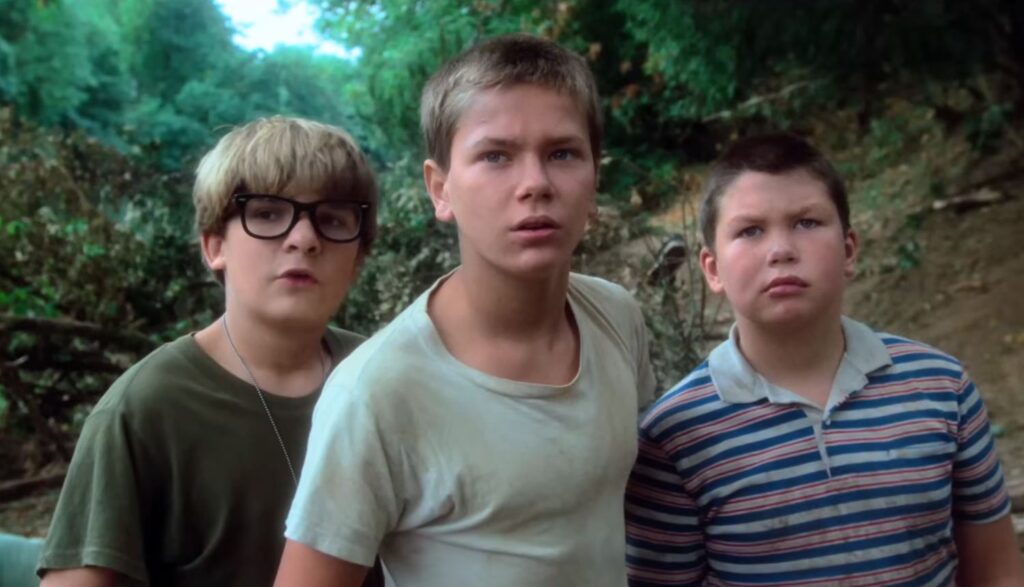
Four young friends decide to embark on a 30-mile trek to see a dead body. 1986’s Stand by Me is well thought of as an emotional coming-of-age tale. And the kid actors are solid. But the film is profusely profane and somewhat bloody. And it portrays parents and other adults as uncaring and hurtful.
Vern has always had a habit of being in the wrong place at the wrong time. And when he overhears his older brother, Billy, talking about a Buick that he and his pal have boosted, Vern just wants to hold his breath and stay as quiet as possible. He doesn’t want to hear anything, see anything or be seen as he sits under their family’s front porch. Vern definitely doesn’t want to get pounded by a pair of teen thugs today.
And yeah, Billy is very much a thug, just like his whole gang of teen Cobras. They’re all public menaces, especially crew leader Ace. However, when Vern hears his brother’s conversation turn to Ray Bower’s body, he can’t help but sit up a little straighter and listen more closely.
Ray Bower is the kid that went missing a little while back. His face is all over the news. And wouldn’t you know it, Billy and his partner-in-crime, Charlie Hogan, have seen the boy’s body. But they can’t tell the authorities because, well, if they let that fact spill, it will connect them to the boosted car.
When Billy and Charlie take off, though, Vern is beyond excited. He knows the place where Billy said the boy’s battered body is located. It’s, like, 30 miles outside their little town of Castle Rock. But more importantly, this choice piece of news could change everything for Vern. For the first time, he won’t just be chubby friend Vern, but Vern, the cool guy who knows where the missing Bower kid is!
Vern crawls out from under the porch and hustles his bulk over to his friend’s tree house. Through gulps of air, he spills the beans to his friends—calm and level-headed Chris, wild-eyed and crazy Teddy and their group brainiac, Gordie. But instead of excitedly slapping Vern on the back and walking with him to the police station, the guys suggest a completely different tack.
They’ll tell their parents that they’re camping out at each other’s houses. They’ll hike the 30 miles together and bring back the body so they can all be received as heroes. Billy had made it sound like Ray Bower had probably been hit by a train. Who wouldn’t want to see that firsthand?
Well, Vern for one. But he is quickly outvoted.
This will be the coolest thing they have ever done together on a summer break. Chris puffs his cigarette and smiles calmly. Gordie begins concocting the logistics: how they’ll get there, what they’ll tell everyone and what they’ll need to take with them. Teddy jumps around excitedly, acting like a wacky soldier heading into battle. And Vern? He stands there wearing a crooked smile and a layer of nervous sweat.
They are going to do this. Their names will likely go down in Castle Rock, Oregon history. This will be an adventure like no other. It’ll be daring, exciting. And though they don’t know it, the next two days will shape who this quartet of 12-year-olds will come to be.
Stand by Me is narrated by “The Writer,” the grown-up version of Gordie. He recounts the story and talks about the value of the friendships the four kids had. And we see their shoulder-punching, teasing and name-calling comradery play out onscreen.
Gordie and Chris have a special bond. They understand one another and talk through painful memories and difficult situations. For instance, when the pair brings up the subject of moving into junior high in the coming school year, Chris mentions that the quartet will likely break up because Gordie will be going on to college prep classes while the others will be relegated to shop classes. Gordie vehemently refuses to leave his friends behind. But Chris talks about the opportunities that Gordie can’t pass up. And he declares that he will support Gordie and push him to do the best thing for his future, even if Gordie’s parents won’t. Chris also comforts a weeping Gordie when Gordie proclaims that his father hates him.
In turn, Gordie is there to stand by Chris’s side to encourage him when he reveals an emotionally painful moment from when a trusted teacher betrayed him. Gordie puts himself in danger and stands up to overpowering bullies who want to physically harm Chris.
The friends calm Teddy when an adult says something tactless and hurtful about his father. Teddy apologizes for his outburst and ruining their fun together. “We’re going to see a dead kid,” Gordie notes. “Maybe it shouldn’t be a party.” They all agree and soldier on.
Later on, we find out that Chris worked hard and eventually enrolled in college along with his pal Gordie.
A store owner talks to Gordie about his brother’s death. (Gordie’s brother had died just a few months prior.) He tells Gordie that the “Bible says that in the midst of life we are in death” (an ancient Latin prayer that isn’t actually in scripture). Someone says, “Father, God and sonny Jesus.”
Chris praises Gordie, telling him that he believes “God gave you something, man.”
The Cobras talk crudely about the sexual expectations guys can have when dating either Catholic, Protestant or Jewish girls.
The Cobras toss around crude statements about the girls they know and the sexual interactions that they’ll agree to. The quartet of 12-year-old friends get a bit crude, too, discussing the breasts of a young woman on TV.
All of the guys trade sexual gags and jibes of one sort or another.
The boys wade through a swamp and then realize they have leeches all over their bodies. They strip down to rip the worm-like creatures off. And one boy realizes he has a leech attached to his genitals.
We eventually see the boy who was hit by a train. He’s partially covered by a bush, but the camera examines his twisted, bloody and glaze-eyed form. While crossing a long train trestle that spans a river, Gordie and Vern get caught mid-bridge just as a train approaches. The train comes chugging up, whistle blaring, with no indication that the driver intends to stop. The boys struggle to make it off the bridge, and they narrowly avoid getting hit. In another scene, Teddy decides to face an advancing train, standing firm on the track and jumping off at the last second.
The Cobras are a violence-focused crew. They carve their group’s name in each other’s arm with switchblades. They smash mailboxes with a bat while hanging out of a moving car. While racing another car, Ace plays chicken with an oncoming cargo truck, causing the truck’s driver to veer off the road and into a ditch. Ace also steals Gordie’s hat—given to him by his deceased older brother—then pins Gordie to the ground, threatening him with the lit end of a cigarette. Ace declares he’d kill members of his own crew if there was enough money involved.
Teddy’s ear is badly scarred, caused by his drunken and enraged father in the past. Teddy opines that a story should end with someone killing their father.
The boys believe that a junkyard owner trained his dog to sic trespassers’ most vulnerable nether regions. Gordie ends up running from the charging dog and barely manages to climb over a fence and escape.
When the boys get covered with leeches, Gordie reaches into his shorts to remove one from his genitals, and his hand comes out bloody. He then faints at the sight of his blood.
Chris steals his father’s pistol and takes it on their trek for protection. All the boys get a chance to hold the weapon. When a thug threatens one of them with a knife, Gordie holds the guy at gunpoint to protect his friend. We’re told that someone got killed while valiantly trying to stop a knife fight.
We find out that Gordie’s older brother died in a terrible car accident.
There’s an unexpected torrent of profane language and crudities in this movie’s dialogue mix—made all the more wince-worthy because most of it is delivered by the four preteen leads. That list includes 10 f-words, 25 s-words, 10 uses of “a–,” and several uses each of the words “h—,” “b–ch,” “retard,” “f-gg-t” and “p-ss.”
In a story about a man nicknamed “LardA–,” the name gets repeated dozens of times.
Both God’s and Jesus’ names are misused more than a half-dozen times each (six of those instances combining God with “d–n”). There are also more than a dozen crude references to different male and female body parts.
The kids and the teens all smoke. In fact, the younger boys take the time to relish the experience, since their supply is limited. “I cherish this moment,” Teddy sighs during an after-meal smoke. The older teens drink beer (sometimes while driving).
We see flashbacks of Gordie interacting with his beloved older brother, Denny. Denny’s death not only emotionally devastated Gordie, but it left his mother despondent and his father angry. Gordie dreams of his father saying that it should have been Gordie who died instead of Denny.
Ace Merrill and the Cobras are a terrible group of destructive punks. They steal a hat from Gordie that was a gift from Denny. And they are unrepentant in their corrosive, bullying ways.
The four 12-year-olds are constantly launching demeaning taunts at one another—which often include insults directed at their mothers. An adult torments Teddy by calling his jailed and abusive father a crazy man. Teddy flies into a rage, proclaiming that his father “stormed the beach at Normandy.” We hear that a teacher betrayed one of the boys by lying and stealing.
Gordie tells his friend a story that he made up about a pie-eating contest (which is depicted onscreen). And we watch the story resolve with literally everyone in a crowd projectile vomiting on one another.
Boys do dumb things. It tends to be part of our DNA.
Of course, way back before there was anything like the internet or Wi-Fi, they didn’t do eyeroll-worthy nonsense online with their noses buried in a phone. No, they vented their simple-mindedness outdoors: jumping out of the way of moving trains; tramping through mucky, murky woods; and climbing over fences marked “No Trespassing.” You know, crazy things just for the harebrained joy of it.
I know, because I was one of ‘em.
And that’s why Stand by Me—a film about bored kids in the ‘50s spending a couple days jawing, laughing and trekking forth on the promise of seeing something gross and horrific—is considered by some to be a quintessential coming-of-age story. Writer Stephen King captured that slice of nostalgic adolescence in his novella The Body, and director Rob Reiner translated it into this film.
On the plus side, the kid actors here are impressive—with young River Phoenix delivering a breakout, top-shelf performance. The movie has tense, iconic cinematic moments. The film explores the profound but often temporary nature of childhood friendships. And Stand by Me deftly navigates the young protagonists’ transitions from a place of quasi-childhood innocence to their recognition of the mean and sometimes foul realities of adulthood.
However—and this is a Hollywood sign-sized however—even though this is a film about 12-year-olds, I wouldn’t let a 12-year-old anywhere within a 450-foot train trestle of this pic.
The language in the dialogue is profanely foul. Not sure where these cig-puffing tweens were supposed to have learned their foul-mouthed ways, but the adult writers should have dialed it back.
Oh, and speaking of adults, nearly every grown-up seen or heard of in this flick is abusive in one form or another. Each of the young central characters has been deeply hurt by some idiotic adult or parent in his life. And the kids wear their emotional (and sometimes physical) scars openly as adults blather thoughtlessly around them.
In fact, between uncaring dads, beer-bellied bubbas in the community and the detestable older teen misanthropes portrayed in this pic, Stand by Me paints an almost laughably one-dimensional portrait of toxic maleness.
So, yeah, there are some interesting moments in this film, but it can also be a problematic trek down the tracks—one that I personally wouldn’t call quintessential.

After spending more than two decades touring, directing, writing and producing for Christian theater and radio (most recently for Adventures in Odyssey, which he still contributes to), Bob joined the Plugged In staff to help us focus more heavily on video games. He is also one of our primary movie reviewers.