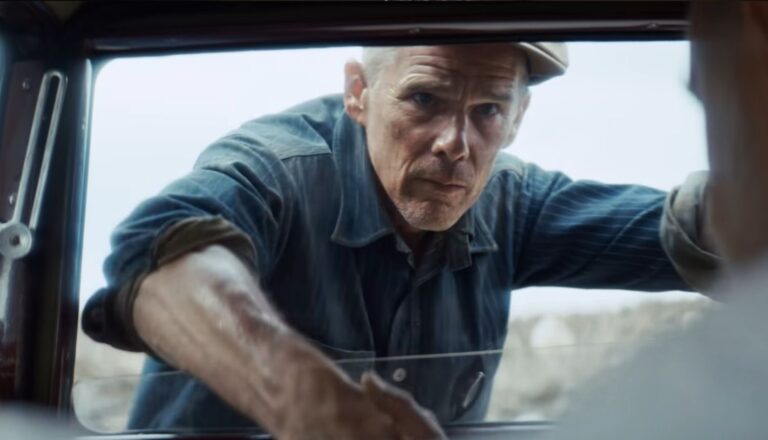


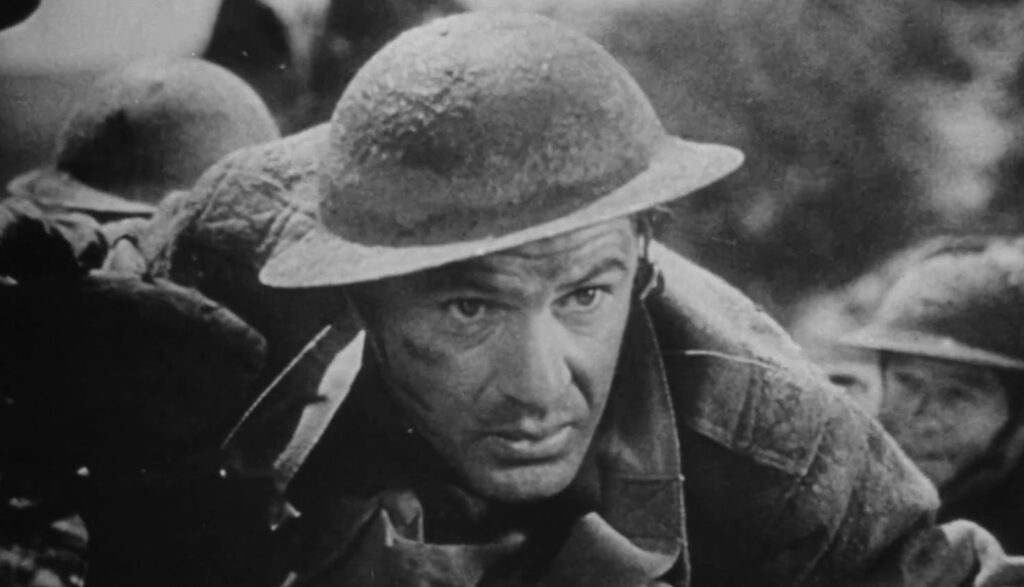
Sergeant York tells the remarkable true story of Alvin C. York—a World War I hero and incredible example of God’s transformative power. The film has a bit of black-and-white war violence and depictions of drunkenness, but its spiritual messages and redemptive storyline make this classic flick a cheer-worthy watch.
Alvin York would’ve been the last person anyone expected to become a churchgoing fellow. He was a hard man who lived a hard life, who spent his days tilling miserly farmland and his nights drinking and fighting.
But after a near chance with death, a churchgoing fellow is what Alvin became—an honest-to-goodness man of faith.
From that point on, Alvin would do his best to walk the straight and narrow path, to obey God and follow His commands. All of them.
That newfound conviction would be put to the test. On April 6, 1917, the United States joined World War I. Men from every corner of the country registered to fight. But not Alvin. He requested an exemption on religious grounds. After all, the Bible says, “Thou shalt not kill.” Alvin intended to follow that command to the letter.
Except his exemption was denied. Alvin would have to go to war. To fight. Maybe even to kill. All while enduring the scorn of his fellow soldiers for his identification as a conscientious objector.
Alvin York would’ve been the last person anyone expected to become a war hero.
But, as Alvin often reminds himself, “The Lord works in mysterious ways.”
The first major shift in Sergeant York’s story is Alvin’s conversion to Christianity. From that moment on, we see a myriad of positive changes in the man’s life as he earnestly conforms to biblical teaching without reservation. His behaviors instantly change: In place of wrath, he seeks to forgive—and to be forgiven. In place of drunkenness, he pursues solace in God. And in place of self-pity, he chases healthy responsibility and self-sacrificial love.
Alvin’s betrothed, Gracie, also has a positive influence on his life. Early on, when Alvin roughs up a rival suitor, Gracie makes it clear that’s not the way to win her affection. When they do decide to get married, Alvin is desperate to acquire a piece of fertile farmland to give Gracie a better life, but Gracie tells him that her only marital expectation is for him to love her.
Pastor Pile, the local minister and shopkeeper, helps Alvin when Alvin seeks an exemption from military service, standing with the younger man every step of the way.
Despite Alvin’s objection to the war, he takes his duty seriously and behaves valiantly. When later given an opportunity to profit from his brave deeds, Alvin declines, feeling that his duty “isn’t for buying and selling.”
The film is dedicated to the hope that “a day will come when man will live in peace on earth.”
Alvin does some good things prior to his faith conversion. For instance, he works hard to support his widowed mother and younger siblings. But he is also consumed with destructive habits that, as Pastor Pile wisely notes, will lead to both his physical and spiritual destruction.
As mentioned above, Alvin’s conversion changes every aspect of his life—a powerful picture of the transformative power of Jesus Christ. And it’s not that his life gets easier: Alvin still faces plenty of setbacks and challenges, but he approaches them with a newfound trust in God. He takes his commitment to nonviolence very seriously, striving to become a peacemaker as Jesus describes in Matthew 5. When it seems he will be forced to join the army, he is resistant, saying, “War is killing, and the [Bible is] against killing.”
Though Alvin deals with some mistreatment from his fellow soldiers due to his status as a conscientious objector, there are others who sympathize with him—most notably, his commanding officer, Major Buxton. Buxton is also a devout Christian, and the two engage some good discourse on “whether a man should fight for what he believes is right.” The major gives Alvin the opportunity to discern God’s prompting in the matter, even offering to grant Alvin’s exemption should he still feel that God does not want him to fight.
Alvin wrestles with what initially seems to him as two conflicting commands: to obey God or to defend his country. Eventually, Alvin chooses to stay in the army and comes to believe that God placed him in the war so that he could save lives rather than take them. (Though, as I’ll note below, he is forced to take some lives, however reluctantly.) Alvin also states that the “Good Lord” was protecting him during a battle.
Pastor Pile serves as a spiritual lodestar for Alvin’s backcountry community. He is both wise and kind, ready with spiritual guidance and practical action. He encourages Alvin to turn to God, telling him that “A fellow [has] got to have his roots in something outside [himself].” He also tells Alvin that there is a difference between praying with belief and without it.
Alvin teaches children at his church about Cain and Abel. He tells his young audience that “nothing written in the [Bible] ain’t the truth.” Congregants sing hymns in a church. A pastor gives a sermon on Luke 15. A man kneels before the pulpit during a makeshift altar call. People pray. Others talk about God’s providence and protection. A song mentions Saints Paul and Silas, as well as the prophet Daniel. A man reads passages from Scripture. Some characters’ folksy phrases include spiritual references.
Sergeant York is, in part, a romance between Alvin and Gracie. They share a few kisses throughout the film and discuss their eventual marriage. Someone else asks Gracie to go on a date. (She politely declines the offer.)
A man drunkenly admires a “big woman:” He says she’s “three women in one” and that the man who married her “would be a bigamist.” Alvin shares a flirtatious glance with a woman in a saloon.
Considering Sergeant York is a black-and-white movie from the 1940s, the violence found here isn’t really comparable to what we would see in cinemas today. However, one particular sequence, which details Alvin’s involvement in the Meuse–Argonne offensive, could upset younger viewers. Soldiers are killed in a hail of bullets and by exploding artillery. One man gets shot in the eye, and another bleeds from the mouth as he expires. Alvin kills several German soldiers himself. (Though he is quick to accept his enemy’s surrender when it is offered.) All this violence is muted by the film’s monochrome palette—not to mention more than a few melodramatic deaths—but the battle can still be a bit intense.
The film has one other scene of serious violence (or, at least, the potential of serious violence), which occurs at the precipice of Alvin’s conversion. Having been cheated by a local farmer, Alvin braves some stormy weather with a rifle in hand, intending to kill his offender. He doesn’t make it, though; on the way, he is nearly struck by lightning. The bolt destroys his gun instead, and Alvin takes the near-death experience as a sign from God to change his ways.
Other instances of violence are more comedic in tone. Alvin initiates a drunken brawl in a saloon, and many of the patrons join in the fight. People wrestle and crash to the ground. Others get punched. One man has his head repeatedly knocked against the floor.
Gracie shakes a knife at Alvin when he aggravates her. (The scene is played for laughs.) Superior officers tease their soldiers, telling them not to “murder” each other with their guns. Men fire their guns in a bout of drunken wildness.
A turkey is killed in a shooting competition, and we briefly see its carcass.
There are a few uses of “d–n,” including the phrase “I’ll be d–ned.” A few turns of phrase use the word “h—.” The word “queer” is used here, but it refers to things that are odd or strange, not people who identify as LGBT.
German soldiers are given derogatory nicknames like “Heinie” and “sauerkraut.”
Alvin’s main vice early on (besides his wrathful temperament) is liquor. He drinks himself into a stupor a few different times at a local saloon, and each time, his drunkenness culminates in violence or the intent to commit violence. He and his friends talk about how much they’ve drank and how the only thing they’re “against” is “getting sober.” (Though ironically, Alvin indeed “gets sober” after converting to Christianity.)
People talk about Alvin and his friends being “in their liquor” and “drunk as the devil.” Someone smokes a pipe. A soldier asks for a cigarette.
At least for a time, Alvin equates his personal worth to the quality of land he owns. He wants to own a more fertile piece of farmland to better support his future family.
Sergeant York was a major success when it was released in 1941, topping that year’s box office and earning Gary Cooper an Academy Award for Best Actor. Oddly enough, the film, which is set in a time when America was still teetering on the edge of World War I, came out even as the nation drifted toward World War II: Japan’s attack on Pearl Harbor occurred while Sergeant York was still in theaters.
So, does the film hold up? Or does its inspiring source material and patriotic themes have movie buffs elevating it through rose-colored (or maybe red-white-and-blue-colored) glasses?
Happily, I believe Sergeant York tells a powerful story and tells it well (even when taking a few creative liberties into consideration). Alvin York’s heroism in World War I stretched believability. He, along with the few other uninjured men in his unit, captured 132 German soldiers during the Meuse-Argonne offensive.
A different film might have made that remarkable event the movie’s primary focus. But not so here. Director Howard Hawks was just as interested in the making of the man who would do something so brave—and shows us the reason for that courage.
As the real Alvin York said when recounting his actions: “A higher power than man guided and watched over me and told me what to do.”
Scripture tells us that “nothing will be impossible with God.” Alvin York’s story is an extraordinary example of that. But that’s not all: It’s a potent reminder of God’s redeeming power. Just like Alvin York, God seeks to transform each one of us, to make us into the men and women we are meant to be.
Sergeant York takes pride in showing us not only the physical victory of Alvin York, but his spiritual victory through Jesus Christ. And the former, the film tells us, could not have happened without the latter.
Sergeant York is a classic film about redemption, faith and courage. It’s equal parts patriotic and spiritually resonant. If you happen to be looking for a film to commemorate the United States’ 250th birthday, Sergeant York would be a winning pick.

Bret loves a good story—be it a movie, show, or video game—and enjoys geeking out about things like plot and story structure. He has a blast reading and writing fiction and has penned several short stories and screenplays. He and his wife love to kayak the many beautiful Colorado lakes with their dog.