



Content Caution

HeavyKids
HeavyTeens
HeavyAdults

Credits

In Theaters

Cast

Home Release Date

Director

Distributor

Reviewer

Kennedy Unthank

While offering an entertaining premise, Netflix’s The Rip finds its biggest content concern via its crude language: More than 300 uses of the f-word, along with dozens of other profanities, will find their way into viewers’ living rooms by the movie’s end. Some deadly violence occurs in this story about police corruption, too.

  • Previous
  • Next

Movie Review

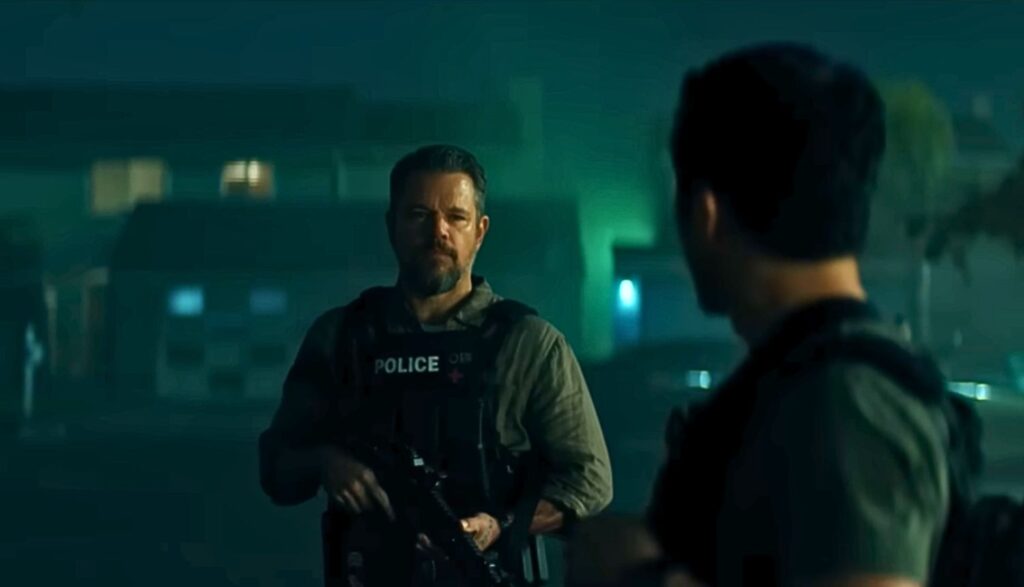
Corrupt cops are nothing new, according to Hollywood’s offering of movies and TV shows: Police officers seemingly regularly abuse their power to supply themselves with cash. And with the murder of Miami’s police captain, Jackie Velez, the FBI suspects that corruption festers in her precinct.

Velez commanded the Tactical Narcotics Team, a quintet of officers who searches Miami homes for drug cartel money to confiscate. That particular job seems rife with abuse—it’s not too difficult to “lose” a dollar or two and report a lower cash find to the feds. And when that greed influences a cop, it’s typically not long before they or someone they work with faces the consequences. So the FBI investigates to ensure Velez’s death was circumstantial rather than intentional.

Detective Sgt. J.D. Byrne takes offense at their accusations, though. He trusts his whole team, and he knows everyone is devastated by Velez’s death. Yes, it’s true that, with her death, Lt. Dane Dumars got to move up into her authoritative position—but J.D. is adamant that Dane deserved the promotion. J.D. doesn’t deny that corruption exists in the police force; he only denies it exists in his precinct.

And so, their team is cleared to move on with its investigations. Dane leads the officers as they search yet another home suspected of hiding drug money. Dane tells J.D. that the anonymous tip they received said there was $300,000 inside.

They find $20 million instead, stashed in buckets behind an attic wall.

With internal affairs and the FBI keeping a close eye on them, Dane is adamant they do things by the book. Despite the massive sum, not a dollar will go missing. They’ll count the whole thing, per standard, inside the home—even as the cartel threatens to kill them if they don’t just leave.

But some things aren’t adding up. From the moment Dane sees the money, he begins acting strange. He forces everyone to give up their phones, for instance, allegedly for security purposes. He chooses not to inform the higher ups about their find. And when J.D. asks to see the anonymous tip, Dane says that he doesn’t have it on him. It seems the man is up to something.

J.D. doesn’t deny that corruption exists in the police force—but he’s beginning to suspect that it may exist in his precinct.


Positive Elements

Team members face serious temptation to pocket some of the money. After all, the authorities were only expecting to find $300,000; it’d be easy to make a few grand of the $20 million they actually find “disappear.” But some officers won’t entertain the thought, refusing to abuse their authority for a cash payout. That positive element is amplified when one police officer discusses her salary, showcasing just how little she gets paid to put her life on the line during these busts.

Spiritual Elements

We are told that Velez believed in witches and spirit animals. When someone suggests Velez may be helping them from beyond the grave, someone else responds that Velez “had that whole witch thing” about her.

Someone describes a move as a “hail Mary.” We hear about Catholic priests.

Referencing the money they’ve found, a woman says that we’re told to leave things like financial worries in God’s hands. “But God isn’t going to make the mortgage, is He?” she also adds.

Sexual & Romantic Content

A man takes off his shirt. Flashbacks imply that Jackie and J.D. were romantically involved. A woman suggests that someone has a “side piece.”

Violent Content

A couple of people die via gunshots to the head. Others get hit with bullets in the leg, ear or arm, bleeding from those wounds. People engage in firefights and fistfights alike. A car crashes. Many people sport bruises and cuts by the movie’s end.

Crude or Profane Language

We counted roughly 325 uses of the f-word, which includes 10 instances paired with “mother.” The s-word is used upwards of 60 times. The c-word is used six times. Other crudities include “a–,” “b–ch,” “d–n,” “p-ss,” “d-ck” and “h—.”

God’s name is used in vain about 13 times, including six instances paired with “d–n.” Jesus’ name is likewise used in vain five times.

Drug & Alcohol Content

People reference the Colombian cocaine drug trade, but we hear about other drug cartels, too.

People drink beer. Someone smokes a cigarette.

Other Noteworthy Elements

Within the story, we hear about and see police officers abusing their power.

Someone references a 10-year-old boy’s death from cancer.

Conclusion

Netflix’s The Rip offers an action mystery involving a quintet of cops who find themselves doubting each other’s motives after they uncover a large sum of cash.

The movie comes with some twists and turns. It also carries a few big names: Matt Damon, Ben Affleck, Teyana Taylor, Steven Yeun and Néstor Carbonell with a small cameo, too.

The Rip has some violence, though admittedly less than what I expected from the get-go. Still, when people get hit with bullets, there’s nevertheless a decent splatter of blood.

But what truly earns the film its R rating is the language: There are more than 300 instances of just the f-word scattered throughout the hour and 52-minute film (roughly one use of the word every five seconds). If variety is the spice of life, then The Rip’s word choice is unseasoned, boiled chicken.

Kennedy Unthank

Kennedy Unthank studied journalism at the University of Missouri. He knew he wanted to write for a living when he won a contest for “best fantasy story” while in the 4th grade. What he didn’t know at the time, however, was that he was the only person to submit a story. Regardless, the seed was planted. Kennedy collects and plays board games in his free time, and he loves to talk about biblical apologetics. He’s also an avid cook. He thinks the ending of Lost “wasn’t that bad.”