


Artists draw inspiration from a lot of interesting sources. Henry David Thoreau was known for writing about the woods. Salvador Dalí, Rembrandt and Renoir all used their wives as models for their paintings. And Taylor Swift has made a name for herself singing songs about her ex-boyfriends.
Sam Anselm’s muse is herself.
Well not herself, per se. More like the ghost of her former self? But that’s not quite right either. …
You see, Sam is angry—or, at least, she was angry. Years ago, she helped launch the global superstar known as Mother Mary to fame. With her designing genius, Sam created the gowns and trademark halo headbands that helped form the onstage Mother Mary persona.
But when Mary had the chance to thank Sam—to tell everyone who was behind her unique look—she stole the credit instead, informing reporters that Mother Mary was her own creation, and a reflection of herself.
That, of course, didn’t sit well with Sam. In reality, it was she who had imbued bits of herself into the designs that Mother Mary wore. Mary had undoubtedly collaborated with Sam, but she wasn’t responsible for the religious imagery.
That betrayal haunted Sam for years. But it also helped her find a new muse. When she was finally ready to let go of her anger, it extracted itself from her in what she describes as a ghost-like apparition. Sam was finally free, and that sparked new inspiration.
Unfortunately, Sam’s clarity came at the cost of Mary’s.
Somehow, it seems, the ghost of Sam’s anger has made its way to Mary. It has completely possessed her. And Mary feels like the only way to free herself of this burden is to confront its origin.
Mary needs to make things right with Sam. She needs Sam to design a dress that makes her feel like herself again—even if that means she might lose Mother Mary along the way.

Mary and Sam do seem to reconcile their differences, with Mary apologizing for the hurt she caused.
The ghost of Sam’s anger seems to be a mix of the metaphorical and literal. Sam describes the apparition as the color—the feeling—of red. We see it depicted as a floating piece of red cloth (fitting, given that Sam is a designer). But while Sam says she believes in ghosts, she admits that it’s unlikely anyone but her could see her red visitor.
However, Mary insists that she has seen Sam’s red ghost—indeed, that she’s been possessed by it. In flashback, we see Mary participate in a séance with a Ouija board. She and the medium chant together in a foreign language, asking any nearby spirits to reveal themselves. One of these spirits indeed appears to possess the medium (though Mary’s friends speculate the woman might be faking). Her body contorts in unnatural, bone-cracking ways. And she slices open Mary’s palm with a sharp pendant—after which Mary’s friends abruptly end the proceedings. Later on, when nobody is around, the red ghost hovers above Mary and tries to enter her body through the open wound on her hand. The ghost fails at that interval, but it follows Mary for weeks, haunting her until it eventually finds a way in.
It becomes clear that nobody can see the red ghost but Sam and Mary. (It takes possession of Mary during one of her performances, before a crowd of thousands. Nobody sees the apparition but her. And later, when she watches videos of the show, she admits there’s nothing to be seen.) Sam seems to think that the ghost is a manifestation of their shared subconscious. But it’s clear that the red spirit has a profound effect on the women, negatively impacting their mental health.
To release the spirit from Mary’s body, Sam decides to conduct another sort of séance. She draws a chalk circle on the floor, lights some candles and employs “totems” to focus their “energy.” She tries to speak to the red ghost, perhaps even praying to it, but Mary says the ghost can’t hear. You forgot something, Mary says, a way out. And with that, she takes a pair of scissors and makes a deep cut on her chest (nothing life-threatening). Sam then gently pulls the red cloth of the ghost from the wound until it has been exhumed completely from Mary’s body.
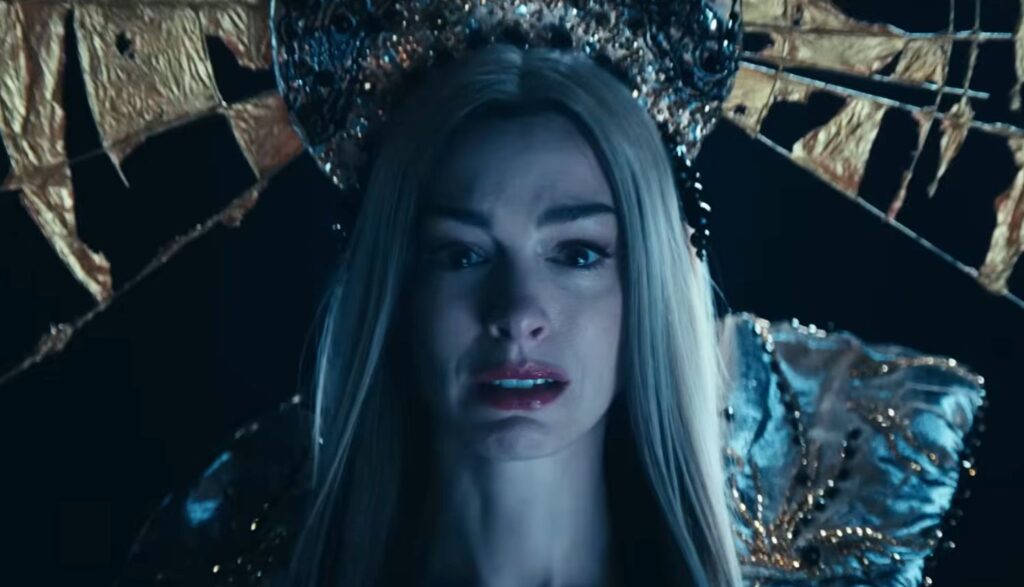
Mother Mary’s entire persona is built on religious imagery. All of her costumes feature halos, for instance. (We see that the first halo she ever wore was made of nails.) Most of her songs have spiritual undertones, including one titled “Holy Spirit.” Sam compares her to Joan of Arc. And when Mary sings, she frequently presses her palms together as if in prayer.
Someone compares a Mother Mary concert to a religious experience: “like going to church, but in a good way.” Sam appears to somehow sense Mary’s arrival before the pop star shows up on her doorstep. Sam mentions spilling wine on herself during her first communion.
It’s never verbally confirmed, but the film seems to suggest that Sam and Mary were romantically involved before their fallout. Even now, Sam sometimes caresses Mary’s face and gets intimately close.
During the séance with the medium, the medium nuzzles her face against Mary’s neck, sometimes pressing her lips to Mary’s skin. Elsewhere, Mary performs a sensual dance with a female partner.
Mother Mary almost exclusively wears leotards that bare her legs and cleavage for performances. Mary lifts her shirt to show her midriff so a designer can take her measurements. Sam notes that Mary once wore nothing but “freshly poured honey” on the red carpet. She describes an idea for a gown that would essentially result in Mary standing naked onstage.
We see Mary’s back and shoulders as she showers. Similarly, when she takes a bath, the murky waters cover everything but her shoulders. When she gets out of the tub, we see her exposed rear and the outline of her breasts, but flashing lights and shadows obscure most of her body.
Sam and Mary discuss an up-and-coming artist who has apparently posed provocatively for billboard ads.
Mary is confronted by the red ghost during a concert, when she’s on an elevated platform above the crowd. Frightened, she tries to back away but accidentally steps off the platform. Although Mary experiences this as a slow-motion fall, to the crowd (and viewers of this film) it looks much, much worse: She’s caught by some sort of cable, presumably a safety harness, but the angle of the camera makes it look like she’s hanging from her neck. We hear that everyone wonders whether she tripped or jumped.
Two different women appear to become possessed at different points. One immediately contorts her body in bone-cracking, painful ways. The other performs a dance in which she repeatedly throws herself to the floor, worrying an onlooker.
A medium cuts open Mary’s hand during a séance with a sharp pendant. Later, we see Mary unwrap her bandaged hand and dig a finger into the wound. In another séance-like setting, Sam repeatedly pricks her finger with a needle. Mary uses scissors to cut the skin down her sternum. Sam then reaches into Mary’s wound to pull out the red ghost. (We later see Mary with stitches over the cut.)
Sam recounts how the red ghost first manifested, saying that it took root in one of her wisdom teeth. She yanks out the tooth with a pair of pliers—but then the film flashes forward, and she reveals that she actually had a dentist remove the tooth. However, as she continues to recount the tale (all of which is portrayed onscreen) she wakes up to find blood dripping from her mouth. The blood is smeared from her pillow to the foot of her bed, where a red blob (the red cloth ghost) has pooled.
When Sam makes a joke about stabbing someone with a pair of scissors, Mary flinches. Mary collapses on a set of stairs, but her friends help her back up.
We hear six uses of the f-word, once interjected in Jesus’ name. Jesus’ name is abused once elsewhere, as well, and God’s name is taken in vain with the word “d–n.” There are also two uses of the s-word and one of “t-ts.” A picture shows Mary displaying her middle finger.
When the red ghost begins haunting Mary, she suffers a mental break and begins a regimen of “who knows how many” pills to help her continue performing. Someone pops some pills before lying down in bed.
The rift between Mary and Sam is pretty intense. Both women experience severe mental health problems as a result of their broken relationship—and neither handles it in a healthy manner.
Sam can be controlling and possessive—although this is likely due to the fact that Mary took credit for Sam’s work all those years ago. Mary claims that Sam is detrimentally persistent. Sam alleges that Mary draws people close to her, making them care about her, before writing them off.
The people who work for Mary seem more concerned with making sure that Mother Mary performs every night than they do about the woman’s wellbeing.
If I were to hazard a guess, Mother Mary is supposed to be an artistic interpretation of what happens when two people allow their hatred to fester instead of finding a way to confront and forgive each other.
Unfortunately, the metaphor here is lost on many a viewer. And to quote Mary herself: “These metaphors are exhausting.”
Mother Mary is beautifully filmed. Anne Hathaway and Michaela Coel each get to exercise their acting chops. But beyond that, it’s not really any good.
For starters, the film was borderline blasphemous with séances, pseudo hauntings and a Taylor Swift-like pop star who favors religious imagery for her acts. Sexual undertones between the two leads and foul language further sullied the story. And besides all that, I could barely comprehend the plot.
As far as psychological, spiritually tinged thrillers go, Mother Mary should be an easy pass for discerning viewers.

Emily studied film and writing when she was in college. And when she isn’t being way too competitive while playing board games, she enjoys food, sleep, and geeking out with her husband indulging in their “nerdoms,” which is the collective fan cultures of everything they love, such as Star Wars, Star Trek, Stargate and Lord of the Rings.