

When a famous real estate agent’s “Little Brother” shows up out of nowhere, it adds a lot of stress to his already stressful life. Netflix’s Little Brother shares some nice messages about how our families can have a positive impact on our mental health. But foul language, drug abuse, graphic sexual discussions, nudity and more make this raunchy film unwatchable.
Growing up in the shadow of your big brother can be tough. When Rudd Landy was a kid, he did everything he could to earn the respect of his big brother, Josh, but it never seemed to be enough. Josh was just smarter, stronger, cooler.
As an adult, Rudd is still struggling to escape Josh’s shadow. Most everything he does is an attempt to measure up to Josh: He donates a lot of money to charities; he spends a lot of time in his home gym; he uses a lot of primping products, such as jade face rollers, under-eye patches and red-light masks; and he puts everything else into his real estate business.
In fact, he’s managed to make something of a name for himself in the real estate biz. A popular reality show called NYC Hustlers is even considering adding him to their cast of competitive realtors. But the producers of the show are far more intrigued by Rudd’s familial relations. They’re only considering Rudd because of his connection to Josh.
That fact alone is enough to get Rudd’s blood pumping through his ridiculously veiny muscles. But adding to his stress is the unexpected arrival of his “Little Brother” Marcus.
Marcus isn’t Rudd’s actual little brother. When Rudd was in high school, he signed up for the Big Brothers, Little Brothers program (certainly a play on the real-life Big Brothers Big Sisters of America mentorship program), and Marcus was assigned as his “Little Brother.” Rudd admits he only volunteered because he thought it would look good on college applications: He barely hung out with Marcus.
But that’s not how Marcus sees it.
Marcus’ upbringing was really rough. He was shuffled between 16 different fosters homes. He faced abuse and the loss of his own real-life brother, Manny. When he became an adult, he struggled with his mental health and even checked himself into a clinic when things got really bad.
But through all the ups and downs, Marcus always felt like he had Rudd by his side. Even though they hadn’t seen each other in years, he just had a feeling that Rudd cared and would always have his back.
So, Marcus reached out to Rudd, emailing him for advice.
… And that email got a response.
That correspondence carried on for quite some time before Marcus finally decided that talking wasn’t enough: He wanted to see his “Big Brother” in person.
Unfortunately, Marcus’ timing couldn’t be worse.
Rudd wants to impress the TV executives on NYC Hustlers. If he makes the cut, Rudd believes the show will finally allow him to eclipse Josh. Meanwhile, his marriage to his wife, Deirdre, is suffering as a result of his obsession. And his teenage sons, Cory and Shane, are beginning to pick up on their dad’s insecurities.
The last thing Rudd needs is his unstable, hyper-sexualized, weird Little Brother showing up to stir the pot—especially since Rudd has no idea Marcus is coming: Turns out Rudd’s assistant, Mia, is the one who’s been corresponding with Marcus.
Looks like both brothers are in for quite the surprise.
[Spoilers are contained in this section.]
Despite Marcus’ difficult childhood and mental health struggles, he tries to maintain a positive attitude. He’s kind and encouraging to those around him and loyal to a fault. I say to a fault because Marcus’ dedication to Rudd blinds him to the fact that Rudd wants nothing to do with him.
Of course, that changes as the film progresses. Perhaps predictably, Rudd eventually snaps and lashes out at Marcus, deeply hurting Marcus’ feelings. After all, Marcus is lonely: All he really wants is a family. Afterwards, Rudd goes back and reads through all the emails that Mia had exchanged with Marcus. He realizes that Marcus is actually a pretty cool dude, and he even comes to understand just how much the two “brothers” could support one another.
Rudd tracks down Marcus and apologizes for his words and actions. The two make amends and start to build a real brotherly bond.
Mia also apologizes for lying to Marcus. Truth be told, she had developed a bit of a crush on him during their email correspondence, which contributed to the ongoing deceit. And Marcus, being the kind person that he is, easily forgives her.
Marcus helps Rudd in other ways, too: At Marcus’ urging, Rudd finally communicates his insecurities to Josh. Josh is shocked when he learns the truth; he’s always been proud of his little brother, and he’s even envied Rudd for his beautiful wife and children. Rudd and Josh forge a new path forward, one based on mutual support rather than petty jealousies.
Marcus also offers up some marital advice to Rudd and Deirdre. (Turns out that spending so much time in therapy over the years has allowed him to recognize when others are struggling.) His intervention helps Rudd realize how poorly Rudd has been treating his wife and kids. Rudd apologizes to all of them.
As a result, Marcus finally gets the family he always wanted. Deirdre, Josh, Cory and Shane welcome Marcus with open arms from the start, but once Rudd gets onboard, they truly become one big family unit.
Deirdre pours herself into many different charities as a professional fundraiser. She says that she wants to find a way to truly help others and make a difference in the world. She fosters a disabled dog while a shelter finds it a safe home because the dog was on a “kill list.”
After a serious car accident, Marcus asks the hospital to call Rudd as his emergency contact. When Rudd shows up, Marcus worries that Rudd might be an angel sent to help him “cross over.” Someone compares an uptight man to a teenage nun.
As mentioned, Marcus can be hypersexualized. That’s because he brings up the topic of sex in nearly every conversation he has. Even when the topic has absolutely nothing to do with sex, he’ll find a way to include it somehow.
And sexual topics truly run the gamut here: We hear graphic comments and jokes about different types of sex, masturbation, arousal, genitals and climax. There are countless double entendres and euphemisms. These aren’t winking nods either—or, at least, not all of them are—they’re incredibly crude and detailed remarks intended to make the viewer cringe. A few of these crudities are said in front of Rudd and Deirdre’s teenage sons, and it’s clear that the teens are uncomfortable with hearing about this stuff.
We also see quite a bit of sexual content. Rudd gets woken one night because Marcus is noisily having sex with a woman in Rudd’s home office. We don’t see them in the act onscreen, but when Rudd investigates, Marcus opens the door in the buff. From the front, the lower half of his body is offscreen, but we see his fully exposed rear end. Behind him, a naked woman sits on Rudd’s desk, covering herself with her limbs. A second man then walks around the corner (the woman’s boyfriend, we’re told), and we see his bare rear as well.
The threesome leaves the house shortly later, fully clothed. But as Marcus is kissing the woman goodbye, they begin having sex on the hood of Deirdre’s car. Once again, we see Marcus’ exposed bottom, and though the woman is clothed or otherwise obscured, we see them fully engaged in the act as the woman’s boyfriend films them on a phone. (Neighbors witness the act, too, and an elderly couple makes some suggestive comments before presumably running off to act on those suggestions.)
Marcus gets the sense that Rudd and Deirdre’s marital struggles may stem, at least partially, from their lack of marital intercourse (which turns out to be true). Deirdre follows Marcus’ advice to take the lead. She massages Rudd’s shoulders one evening and kisses his neck, but Rudd asks her to stop since he’s not in the mood. In another instance, when Rudd is acting uptight, Deirdre orders him to stop the car and pull over. When he does, she starts kissing him and reaches for his belt buckle. Then she surprises him by flipping him over and doing something to his bare backside with her mouth. (We don’t see the act onscreen, but earlier conversations confirm that it was something crude suggested to her by Marcus.) Rudd and Deirdre’s sons drive by and see Rudd hanging out of the car. They seem to know that their parents are engaged in a sexual act, but they’re unsure what it could be. Marcus, who’s riding with the teenagers, sees it too, and he makes some winking remarks.
When a nurse removes a catheter, we briefly see a man’s genitals. Marcus bathes in the sprinklers of a golf course. We see his bare rear (though the golfers on the course likely see much, much more). We see graffiti of male genitals on a poster. Rudd and Josh are seen shirtless in a hot tub. Several female characters wear plunging necklines or form-fitting outfits.
Marcus’ roommate in the mental health clinic carries around a rock that he has painted a woman’s face onto and named Matilda. He says Matilda is a “generous lover.” Later on, after Marcus leaves the place, the roommate says that Matilda has dumped him, but that he has moved on to someone else. That someone else turns out to be a dummy that the man made out of deli slices to look like Marcus. When Marcus comes back to the clinic and sees the deli dummy, his roommate informs him that he gave the dummy female genitals.
In a moment of desperation, Marcus begs a male therapist to help him, offering to perform oral sex on the man. (The therapist declines.)
Two teenage brothers get into an argument over which one of them a girl likes better. Rudd tells them after one such argument that his own brother used to have sex with the girls he brought home. We learn a woman’s father left her mom for a much younger woman. Couples kiss.
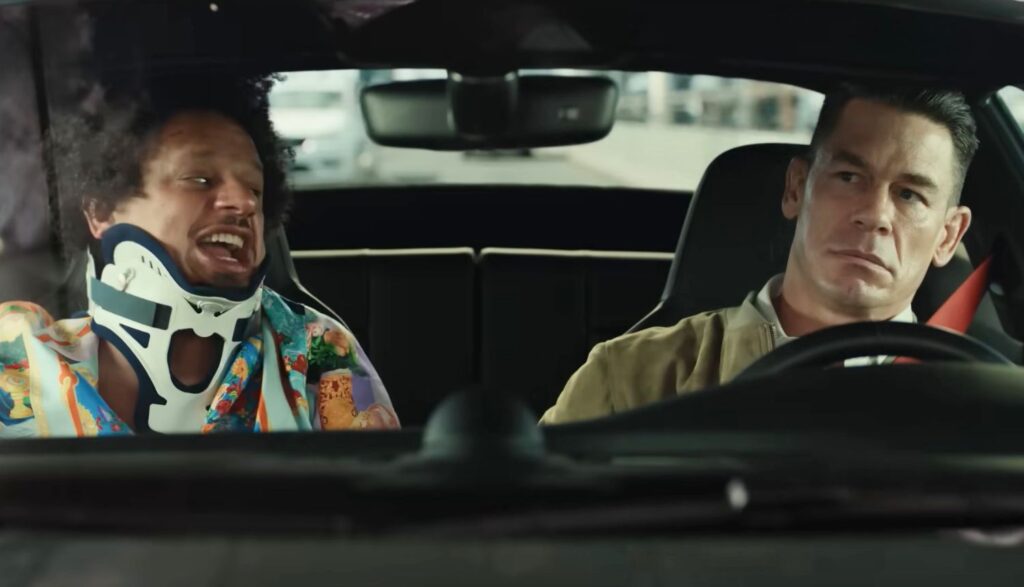
Marcus stops in the middle of an intersection because some kids are crossing the street. Unfortunately, while he’s waiting for the kids, a truck careens through the intersection, T-boning his car. We later see Marcus in the hospital with a neck brace, leg cast and multiple bandages. A doctor notes some skull damage, but Marcus explains that the injury occurred when he was a child: One of his foster fathers allegedly got inebriated, put Marcus into a washing machine and then pushed the appliance down a hill.
After this initial car crash, Rudd attempts to carry Marcus up the stairs of his house. They fall down the stairs several times, often with Marcus sustaining more injuries in the process.
When Marcus leaves the car door of a parked car open, a speeding vehicle hits the door, tearing it off. As Marcus examines the damage, a motorcycle hits him, knocking him off his feet. The cyclist speeds on, showing no remorse. When Marcus stands up, blood spurts from a deep cut on his head, and a bystander says she can see his brain matter.
Those accidents don’t really feel like Marcus’ fault, but the man is incredibly prone to injury. On two separate occasions, while climbing through some air ducts, he falls through the ceiling. He leaps out of a two-story glass window. As a kid and as an adult, we see him throw a basketball at a hoop only for the ball to bounce off and smack him in the face and groin. (When it happens to him as a kid, he sports a bloody nose after.) He nearly falls asleep at the wheel while driving, and he almost starts a fire at Rudd’s house.
Rudd charges at Marcus and Josh when he believes the two are conspiring behind his back. Unfortunately, he’s intoxicated at the time and trips on a wire, knocking Josh off a balcony. Josh lands on the ground below, and while the fall didn’t cause too much damage, he begins choking on a hunk of food he had been chewing. Marcus is able to perform an emergency tracheotomy (there’s quite a bit of blood) and save Josh’s life. We later see Josh with bandages on his throat and using an electrolarynx to talk.
Marcus tries to convince some doctors that he’s mentally unstable by breaking a window and then holding one of the window shards to his neck.
Cory and Shane, Rudd’s teenage sons, sometimes get into scuffles together. We hear that somebody died in a casino fire.
There are more than 50 uses of the f-word alone, including a few pairings with “mother.” The s-word is used 25 times, and we also hear “a–,” “a–hole,” “b–ch,” “d–n,” “d–k,” “h—,” “p-ss” and “p—y.”
God’s name gets taken in vain about 30 times, five of which are joined with either “d–n” or “d–mit.” Jesus’ name also gets abused about nine times.
At a party, Josh invites Rudd, Marcus and a realtor named Kieran to do some drugs. He pours several white tablets out of a bottle and crushes them up, then offers a metal pipe to his guests to snort the stuff. He teases Rudd, believing his little brother to be too “good” to partake. Rudd snatches the pipe and inhales the entire pile of powder. Josh then admits that he was never planning to use the stuff and that he was warned to only snort a small amount. (He’s not even sure what it is, only that it allegedly helped a popular celebrity to write a song for the Trolls movie.) Marcus and Kieran decline to take any.
Well, Rudd starts to hallucinate and act erratically. His eyes glaze over, and he sweats profusely. There’s a joke about someone dying of an overdose.
Many people drink throughout the film.
Marcus is a desperate, confused, lonely person. We see that, over the years, he has cut out pictures of himself and pasted them onto photographs of Rudd with his family. He says that getting shuffled around the foster system—being repeatedly abandoned by people he should have been able to trust—caused him to doubt his self-worth. At one point, he admits, when things were particularly bad, he started feeling like he might do something drastic. So, he checked himself into a clinic so he could get the help he needed.
He has a change of heart, though. He attempts to break out of the clinic, causing significant property damage. The staff later informs him that he never had to break out: Because he was voluntarily admitted, he could leave whenever he wanted. Later on, he attempts to “sneak back in,” causing even more damage.
Rudd’s self-esteem, like Marcus’, is incredibly low. We see this play out in how he acts around his own brother, Josh. But it’s also obvious in how he complains to Deirdre and even how he takes care of himself: At home, he’s constantly either working out or doing a variety of skincare routines.
Marcus lies to Rudd and Rudd’s family. It appears that Marcus steals someone’s car when he sneaks out of the clinic.
TV producers use artificial intelligence to create a promo video of Rudd, using the technology to test out different things they’d like the real Rudd to say. They later tell Rudd that they use AI all the time to superimpose celebrities’ faces onto body doubles. (And we see them attempting to do the same to Marcus and Rudd in order to get the shot they want.)
At one point, Rudd instructs Marcus not to leave his car (because he’s worried Marcus will embarrass him). It’s a hot day, and Rudd only cracks a window for Marcus. Unfortunately, Marcus eventually needs to urinate. He initially tries to pee through the cracked window, but he winds up spilling urine all over himself and even gets some in his mouth. Marcus says he has a medical condition that causes his sweat to smell like cat urine.
Josh sometimes gives Rudd backhanded compliments, making Rudd angry. A man tries to get attention by claiming it is the anniversary of his father’s death. The same guy tries to pit Rudd against Marcus. A woman essentially catfishes someone—though her intentions were altruistic.
Little Brother is a weird movie. For all of its content concerns—of which there are legion—the film shares several nice messages about family and the powerful impact our loved ones can have, especially when we’re working through mental health struggles.
But those content concerns, man. You just can’t get around those.
With John Cena and Eric André leading the cast, it’s probably no surprise that this movie is as raunchy as it is. Those two are not exactly known for their modesty or decorum.
As such, any potential viewers will be bombarded with foul language, fouler sexual content (including sex scenes and some nudity), nonchalant drug abuse, tons of gross-out humor and, frankly, jokes that are rather insensitive.
There are many wonderful mentorship programs out there. And there are certainly many people who have benefited from those programs. But Netflix’s Little Brother doesn’t do them justice. Rather, it almost seems to mock those programs even while expounding on the positive impact they can have.
So instead of plowing through all the salaciousness of Little Brother, do yourself a favor and just go watch or read about some of the heartfelt impact stories of those programs. You’ll get a lot more heart for a lot less ache.

Emily studied film and writing when she was in college. And when she isn’t being way too competitive while playing board games, she enjoys food, sleep, and geeking out with her husband indulging in their “nerdoms,” which is the collective fan cultures of everything they love, such as Star Wars, Star Trek, Stargate and Lord of the Rings.