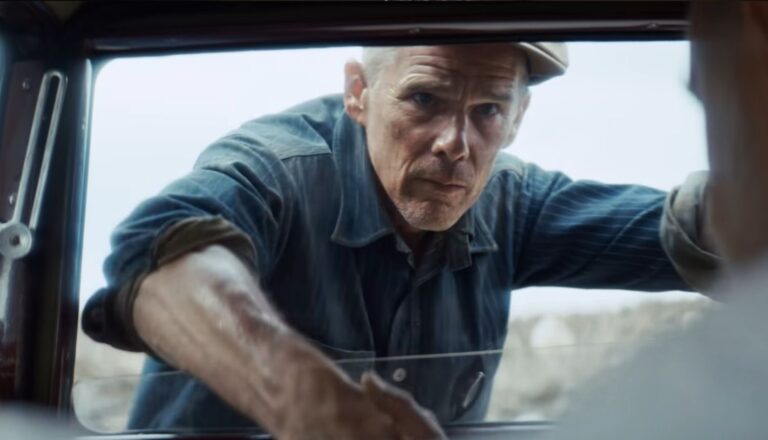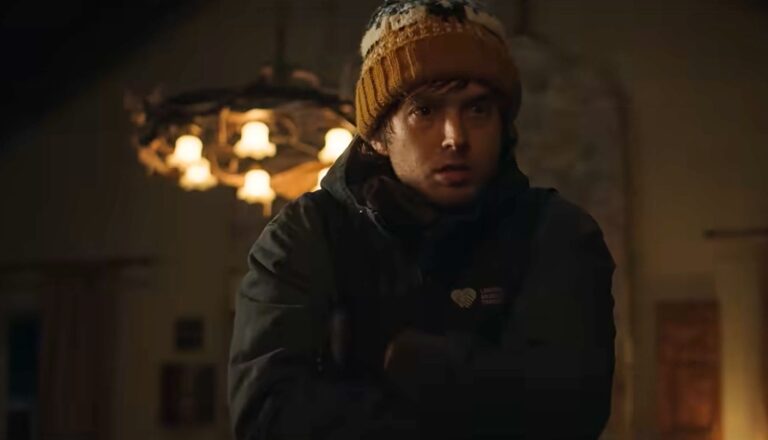


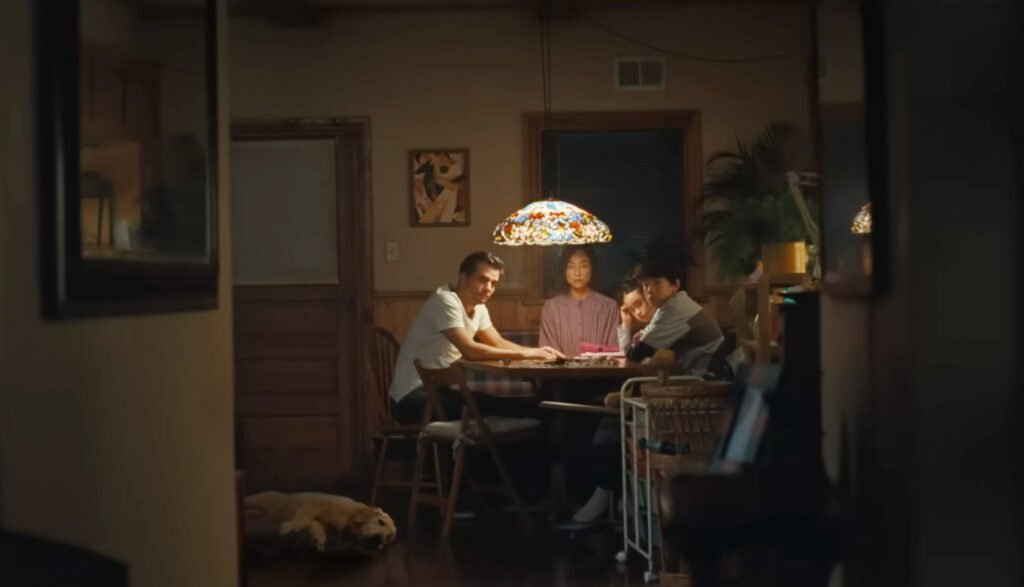
A very strange rain brings about a soggy apocalypse, trapping a family of four inside their house. But it’s not all bad: They have each other, after all. The movie has a small amount of swearing, a bit of drug use and plenty of peril. But the family message at the heart of The Last House may help improve its standing with parents.
The Delgados are homebodies. They have no choice.
One sunny Sunday morning, a storm came in. And while rainstorms are not particularly unusual in the Seattle area, this one came with a special, apocalyptic wrinkle: The rain, somehow, formed an unbreakable membrane around manmade structures. In other words, everyone who was inside is now sealed inside. Doors won’t open. Windows won’t break.
This sudden forced staycation comes with advantages. Jason Delgado, an unemployed engineer who’s all too used to seeing “past due” notices land in his mailbox, suddenly can’t get to the mailbox anymore—and no one seems able to send him bills anyway. His wife, Ann, has a chance to get creative with her cooking. The Delgado kids, 13-year-old Graham and 8-year-old Ruth, certainly can’t go to school these days. And the whole family gets the chance to spend a lot of time together.
But as the days stretch to weeks, the threat of running out of food begins to grow. While power and water are working for now, who knows how long that’s going to last.
It’d be nice to get outside. Grab some groceries. Take a spin around the block. Take stock of the soggy new dystopia the world hath wrought.
But even if the Delgados could get outside, they might not want to. Something—several somethings, in fact—is hovering around the neighborhood, looking for a treat.
Yes, staying inside for weeks or months or maybe even years gets old. But there are worse things. Much worse.
“The outside world had become strange and dangerous,” the narrator for The Last House tells us. “Inside, people found what they needed. Inside, they were free.”
Well, free may be a stretch. But the Delgado family does indeed find a level of peace and safety and love in the confines of their creaky old house. And that’s because they have each other.
Family forms the emotional cornerstone for The Last House. And while the Delgado family was doing just fine before the disaster, familial bonds grow far closer afterward. Ann and Jason push their kids to keep to a schedule—be it school work or exercise or basic family chores. Because the internet’s down, they’re forced to play family games, and Jason introduces his kids to what he considers all-time classic music. Ruth and Graham pick up new hobbies, and (in what might feel to some parents like the movie’s most outlandish twist) they aren’t constantly bickering.
Jason especially finds purpose in this new reality. Ann tells him that he seems to like dystopia. “It’s like in a weird way, you’re happier in here, with us,” she tells him. And that seems to be true. No longer an unemployed engineer, Jason feels like he has purpose: providing for and protecting his family, no matter what. And while that eventually comes with a downside, the early benefits are real, too. It’s likely that the family would’ve indeed perished without Jason’s creativity, drive and just plain stubbornness.
Ultimately, you could say the same thing about every member of the family, though. Each brings a unique set of skills to the table, and most put his or her neck on the line for the sake of the family.
One final note here: The family’s survival ultimately relies on an act of unlikely mercy. And while that merciful act feels a bit unlikely, given the context of the rest of the movie, it’s a nice message.
While The Last House is, in some ways, a celebration of family, this is a largely faith-free family. The Delgados do celebrate Christmas (complete with a makeshift tree and a rather sad exchange of gifts), but we don’t hear any prayers or see them lean on God at all.
We hear a reference to the leviathan of biblical fame and the kraken from classical mythology. We learn that the creatures came from the ocean.
Ann and Jason have a “date night,” wherein they watch Air Force One while high. Jason says he found the marijuana joint on the bottom of their “sex drawer,” which we’re told is filled with toys and lubricant from a past Valentine’s Day. The two kiss passionately and cuddle during their date night, but the romance goes no further.
The married couple kiss elsewhere, too, and it’s obvious that they’re quite committed to each other.
Jason and Ann communicate with their neighbors via signs held at the windows. They read that one of their neighbors was involved in a “one-night stand” when the rain trapped them inside. “What’s a one-night stand?” 8-year-old Ruth asks. Jason says it’s an adult sleepover. Ruth asks what makes an adult sleepover different than a regular sleepover, but the family is interrupted before Jason needs to answer.
When people encounter the mysterious, tentacled creatures outside, things typically do not go well. We see a blood-covered, knife-brandishing woman dragged screaming into the bushes by one. Other people are flipped around and thrown into walls. But at least one of the unwelcome visitors suffers as well. It’s shot several times, harpooned and set on fire.
We also see the demise of a number of small mammals (and at least one bird), too—victims of some ingenious devices that Jason creates to go “chimney fishing.” The critters are trapped (sometimes painfully) and pulled down through the chimney and into the house, where they’re killed (if they’re not dead already), cooked and eaten. None of these fishing expeditions are bloody, but we do occasionally see the traps close on the animals and hear some squeals of fright and pain. Someone is bitten by one of these fur-draped foodstuffs. We see the bloody wound, which becomes seriously infected. The family apparently kills and eats their pet fish, too.
And the Delgados are in far better shape than most. We’re told that most people starved to death or simply gave up. Through a window, we see one of the family’s neighbors collapse. Her body is later tended to by her loving but equally doomed husband.
Dead bodies are seen. A crab scurries out of the mouth of a mostly decomposed corpse. We hear quite a bit about foundation issues in the Delgado home, and at times, bits of brick or drywall or even metal fall, threatening family members. The family watches a movie where someone’s pushed off a plane.
[Spoiler Warning] Cassidy, the family dog, runs out of her heart medication and becomes seriously ill. Jason euthanizes the animal by shooting and killing it. He and Ann have a discussion about whether to cremate the body or butcher the carcass and freeze it for food. Ultimately, Jason does chop the family pet into pieces, and while we don’t see him in the act, we do see the aluminum-wrapped bits of meat in the freezer and watch as Jason washes off a bloody knife. (Cassidy’s meat is ultimately used as bait for other critters.)
One use each of “d–n” and “h—.” We see 8-year-old Ruth flip a couple of middle fingers in frustration. God’s name is arguably misused about five times.
As mentioned, Jason and Ann share a marijuana joint. About a week into the disaster, Jason jokingly asks, “When do we start the drinking around here?” Ann jokes back, suggesting 10:30 or 11 a.m. (We don’t see either of them actually drink, though.)
As you might imagine, tensions can run high in the Delgado abode at times. Kids are not always very respectful to their parents, and a frustrated Graham lashes out at his father for working on a car they might never get to drive.
Jason’s own frustrations come out in other ways: While he seems to relish his role as family protector, it becomes his only role, and that becomes an issue. He grows increasingly dictatorial and, sometimes, frighteningly desperate.
“I have one job,” Jason tells Ann, “one job only, and that’s to keep you guys alive!”
“This is not just your problem to fix,” Ann tells him. “The kids miss their father. And I miss my husband.”
The Last House is a dystopian survival story that bears some resemblance to the far superior A Quiet Place. This is not a movie you want to think too much about, lest all the plot holes come to attack. And while its maker seems to want to drive at a deeper point, it’s hard to say exactly what that point might be.
Is it a critique on how little we know our neighbors? About over-fishing? About the curious upsides of having a house with foundational issues? The jury’s still out. Add to that plenty of peril, a bit of drug use and a smattering of profanity and The Last House comes with some unwanted content in its soggy closets.
But while this Netflix film has some weaknesses, it has some definite strengths, too.
As outlandish as the movie can be, it’s still a taut bit of storytelling with a tight-knit family at its core. Indeed, the Delgados are forcibly pushed into a lot of practices that we’d laud at Plugged In: They steer clear of social media. (Because what choice do they have?) They keep their screen time to a minimum (because they only have two movies to watch). Moreover, they spend a ton of time together as a family—and they kinda learn to love it.
It reminds me of how close I felt to my own family when the power would go off in our own home, and we’d be forced to read or tell stories by candlelight. I owe some of my favorite childhood memories to our small town’s faulty electrical system.
The film gets that families can be beautiful, powerful and, indeed, life-saving institutions—especially when they’re filled with a little structure and a lot of love. And that’s a nice message, all things considered.
This horror story does come with a PG-13 rating, so The Last House probably shouldn’t be your first choice for family viewing. But if you’re looking for a scary movie to stream, you could do worse.

Paul Asay has been part of the Plugged In staff since 2007, watching and reviewing roughly 15 quintillion movies and television shows. He’s written for a number of other publications, too, including Time, The Washington Post and Christianity Today. The author of several books, Paul loves to find spirituality in unexpected places, including popular entertainment, and he loves all things superhero. His vices include James Bond films, Mountain Dew and terrible B-grade movies. He’s married, has two children and a neurotic dog, runs marathons on occasion and hopes to someday own his own tuxedo. Feel free to follow him on Twitter @AsayPaul.