



H is for Hawk

Content Caution

HeavyKids
HeavyTeens
MediumAdults

Credits

In Theaters

Cast

Home Release Date

Director

Distributor

Reviewer

Paul Asay

After the loss of her father, Helen Macdonald tries to get over her grief by buying and training a goshawk. Based on a real story (by a non-binary author), H is for Hawk deals with grief and depression. And it comes with ratings-pushing language issues. Thematically, it’s for adults, not for kids.

  • Previous
  • Next

Movie Review

Goshawks are not particularly lovable creatures. They won’t purr if you pet them. They won’t wag their tails when you come home from work. And you certainly would never, ever cuddle up with them to watch a movie. That’s a good way to lose an eye—and they wouldn’t even feel bad about it.

Goshawks are killers. Pure, beautiful killers. They fly low to the ground in pursuit of prey: rabbits, squirrels, pheasants. Then, swick! A flex of the talon and the prey is no more.

They operate, in a way, like death itself sometimes does: Fierce. Sudden. Certain.

Helen and her father used to watch the hawks play in the British sky—circling, soaring, spinning. They shared a love of birds, just as they shared so many things. But no more. One day while working, Alisdair Macdonald collapsed, and death carried him away.

Helen feels lost. Alone. So many moments were filled with her father. So many memories play out unbidden: The battle with his backyard trees. His glee when Helen became a fellow at Cambridge. His stubborn refusal to slow down—“What would be the point?” he’d say.

There’s a void in Helen’s life. She aches with emptiness. And so she turns to that thing she and her father so enjoyed together. She turns to the hawk.

“I want a goshawk,” Helen tells Stu, an old falconer friend of hers. “I think I need one.”

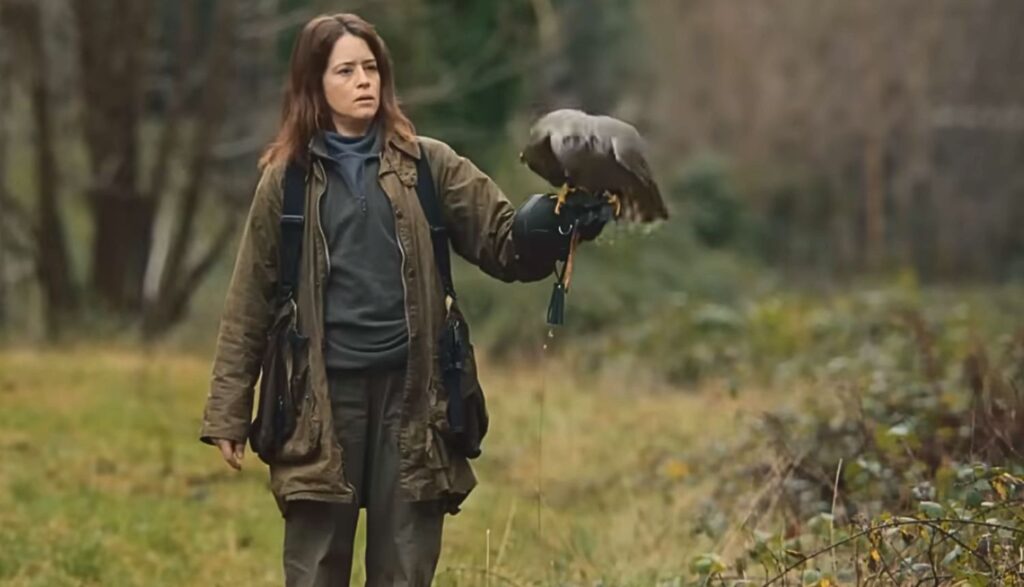
She buys a beauty—cold and proud and ready to hunt.

Goshawks are not particularly lovable creatures. But Helen loves this one anyway. Perhaps she loves it too much.


Positive Elements

H is for Hawk features a bevy of flashbacks between Helen and her father, and we see how close the two are.

When her father passes, Helen feels very alone. But she’s not: Christina, Helen’s best friend, steps into the breech and proves to be the greatest friend Helen could ask for. She helps Helen through the initial grieving process. When Helen’s frantic over the fact that her bird (which she names Mabel) won’t eat, Christina stops by to keep the two of them company—despite her obvious terror of being so close to the hawk.

When Helen’s grief morphs into debilitating depression, Christina never stops trying to enter into her friend’s ever-shrinking world. She goes to Helen’s favorite bookstore to pick up a book they can enjoy together. When Helen pretends she’s not home, Christina sometimes sits on her stoop until Helen answers the door. Christina suggests that Helen’s growing obsession with the goshawk may be getting a wee bit unhealthy—a suggestion that Helen rejects out of hand. But when Helen’s life truly begins to unravel at almost every point, Christina’s there to help tie what she can back together.

Spiritual Elements

The funeral of Helen’s father takes place in a church, and Helen and the rest of her family talk with the minister about the service within its sanctuary. Helen’s mother selects some of her husband’s favorite hymns (including “Jesu Joy”) to be performed at the service.

Pictures of Alisdair hang from the steeple of Salisbury Cathedral. Helen works at Jesus College in Cambridge. We hear some references to evolution and a joking one to reincarnation.

Sexual & Romantic Content

Helen has a sexual encounter with an art dealer she meets on Twitter. The two kiss, and later, we them in bed together: He’s shirtless, while she’s still wearing a modest top. When the guy spots a book about grief that Helen’s been reading, she quickly takes it away—unwilling, it would seem, to bring the mood down and talk about her father. Helen instead tells the man that she may accept a job in Germany, and she invites him to come with her. There’s a reference to décor feeling “a tad fetish dungeon.”

While there’s no hint of this in the movie itself, the real Helen Macdonald (who wrote the originating book H is for Hawk) claims to be nonbinary and prefers the pronouns “they” and “she.”

Violent Content

“You know the trick for a well-behaved gos[hawk]?” a bird seller asks Helen. “Murder. Calms them right down. Get her home as quickly as you can and let her kill a lot.”

Mabel does her share of killing in H is for Hawk. We see at least two of her hunts onscreen—emphasizing the goshawk’s beauty, grace and power and minimizing the actual kills. Only one hunt is completed onscreen, and the strike is filmed at a significant remove.

We do see Mabel eat her prey, though, tugging meat from the carcasses of birds and squirrels. We’re told that the small feathers around a goshawk’s head have evolved to catch blood and let it dry quickly. Helen spends time plucking feathers out of Mabel’s prey, prepping them to cook and eat.

When Helen gives a lecture showing her own work as a falconer with Mabel, a student is appalled. “How can you justify killing for fun?” he asks (and later wonders why Helen can’t just feed Mabel birdseed). Helen says that the hunt is not fun, but it is necessary. Everything about goshawks are designed to hunt and kill. “I have a responsibility to let her be a goshawk,” Helen says. And to not allow Mabel to follow her nature would be akin to “not letting a child play.”

But keeping a goshawk is dangerous business. Stu—Helen’s falconry friend—describes the species as a “perfectly evolved psychopath.” Helen and others treat Mabel with respect and, at times, a touch of fear. In one scene, a young visitor notices Helen’s cut, bloodied forehead, and she asks if Mabel’s the “bird that cut your face.” (Helen admits it was, but Mabel didn’t mean to do it.)

We don’t see Helen’s father pass away, but we do see the man’s corpse later. Helen notices a scabbed-over wound on his arm, and she recalls him telling her that he got the injury while trimming a tree. There’s a joke about beheading. In flashback, Helen watches her father get uncharacteristically emotional as he remembers Tommy, Helen’s twin brother, who died when he was just a few hours old.

Crude or Profane Language

One f-word and about 15 s-words. We also hear “h—,” along with British crudities such as “bloody,” “s-d” and “f-g” (the latter referencing cigarettes). God’s name is misused about 10 times, while Jesus’ name is abused twice.

Drug & Alcohol Content

Helen smokes cigarettes. And her usage grows alongside her own melancholy. When her family stops by her flat, they’re appalled by the smell of smoke. She shares a cigarette (or possibly something stronger) with a date.

Helen and Christina order wine with dinner. Wine is served at other meals, too. Helen’s mother says that she and a friend “had a glass of wine and watched a film on television,” which was a nice escape from grief for a while. Helen leads her students to a pub for class.

When Helen takes Christina along to buy her goshawk, they meet in a deserted parking area. “This feels like a drug deal,” Christina quips.

Other Noteworthy Elements

Mabel defecates on occasion. Helen explains to her niece that goshawks have two different stomachs and, as such, expel two different types of waste: Helen shows the girl a pellet that Mabel spits out and says how lucky they were to see her do so.

Someone tells Helen that Mabel has a “very distinctive aroma.”

Helen sinks into deep depression, and her life consequently spins out of control. She stops answering the door, forgets or ignores important duties and spends one night sleeping in a large cardboard box.

Conclusion

Mabel may not be a particularly loving creature. But for a while, the goshawk seems like just the tonic Helen needs to deal with the loss of her father. Helen is thrilled when Mabel first eats in front of her. She’s over the moon when Mabel completes her first successful hunt. Helen stops smoking quite as much and feels reinvigorated after a season of darkness.

“She’s certainly good at taking your mind off things,” Helen’s mother tells her. But she offers a word of caution, too: “Just don’t get lost.”

Trailers for H is for Hawk make the goshawk look like a godsend—and the movie would seem to be a straightforward bonding between woman and bird that slowly washes away grief.

But the movie’s message is more complex, just as Mabel herself is. She’s a beautiful, incredible creature who lives in a state of reserve. And while the goshawk is a catalyst for Helen’s healing, she becomes a life-sapping obsession, too. And for all the bird’s beauty and power, Mabel is unable to pull Helen from a state of depression that slowly folds over her.

As mentioned earlier, H is for Hawk is based on an autobiographical book by Helen Macdonald (a self-identified nonbinary person), and it embraces the not-so-neat complexities of grief and mental illness—and the things we may grasp at to help those things go away. While the film is rated PG-13, its profanity and, most especially, its mature themes move it outside of a family friendly space.

H is for Hawk has its moments of beauty and inspiration and happy resolution. But it, too, perches at a reserve—at times beautiful, at times hard and cutting. This film is not to be cuddled, and it holds no easy answers.

Paul Asay

Paul Asay has been part of the Plugged In staff since 2007, watching and reviewing roughly 15 quintillion movies and television shows. He’s written for a number of other publications, too, including Time, The Washington Post and Christianity Today. The author of several books, Paul loves to find spirituality in unexpected places, including popular entertainment, and he loves all things superhero. His vices include James Bond films, Mountain Dew and terrible B-grade movies. He’s married, has two children and a neurotic dog, runs marathons on occasion and hopes to someday own his own tuxedo. Feel free to follow him on Twitter @AsayPaul.