

Before parting for college, two friends are pulled into a mystical land of demons and lies. They must not only find a way home, but make sure their friendship comes back intact. There are nice messages here about the benefits of loving friendships. But there are scary demons, potty giggles and a bit of language to deal with here, too.
You may think that life in the Philippines is a lot more exotic and strange than life in America. But while there are differences, there are a lot of similarities, too. Filipino kids have families and friends. They go to school and kinda hate homework. And when they become best friends with one another, it’s serious business.
That’s the way it was for Jo and Raissa, anyway. When they met—while waiting to be disciplined by the school principal—the two tweens took an instant liking to one another. A paper wing-clad Jo leapt up on a chair next to the bookish Raissa and asked, “You wanna be best friends?” After an initial shock, Raissa smiled and agreed.
Right then and there, Jo pulled out a knife, cut off her hair ties and made matching bracelets to commemorate the decision.
Now, you may be wondering why a middle schooler might have a knife. But in a way, that’s part of the reason why Jo is waiting to be “talked to” by the principal. Jo doesn’t hold back in anything! She doesn’t hesitate to bring a knife to school, openly speak her mind or share wince-worthy stories. And that’s especially true when she recounts any tales told to her by her grandmother, Lola.
Jo’s favorite is a story linked to Filipino folklore. Lola claims that, as a young girl, she found a magical sand dollar that opened a portal to the mystical island of Nakali. It’s a place filled with strange creatures and odd demons. And the one creature that Jo was most captivated by is a vampire-like being called Manang—which Jo describes in a school report as a “merciless murder machine that divebombs its prey.”
Of course, murderous descriptions during class aren’t necessarily appreciated by Jo’s teacher. And when a kid scoffs at the story, Jo soundly bops that kid in the face. That’s frowned upon, too.
However, those misfortunes all lead up to Jo and Raissa’s newfound friendship, so it’s all good as far as they’re concerned.
We watch their friendship blossom over time in a needle-drop montage of fun experiences and crazy activities that the two friends memorialize with charms they stick on their matching bracelets. However, before you know it, those bestie middle schoolers have grown into bestie high school grads. And big change is on the horizon.
Jo doesn’t have a lot of great plans for her life after school, but Raissa announces that she is heading off to Caltech in America. That hits Jo like a blow to the solar plexus. But while the pals are getting ready to say their tearful goodbyes on the local beach, something unexpected happens: Jo discovers Lola’s fabled sand dollar and the friends find themselves transported to that oft talked about mythical island.
The pair then wake up, tattered and dazed on a beautiful beach of Nakali. But there are obvious signs that they’ve been there longer than they think. The fact that Raissa has lost the whole right side of her hair is one big clue. Meeting a chummy teen weredog name Raww—who seems to know all about the friends—is another. But somehow, Jo and Raissa have lost all memories of what may have happened to them between the time they entered the portal and the time they woke up on the beach. And they can’t remember where the magical sand dollar went either.
They’ve got a lot to do and a lot to figure out if they want to get home. And, hey, Raissa still has a flight to America to catch.
Jo and Raissa are the best of friends who hold each other dear. And the movie points out that these two friends, growing from girls to young women, have improved each other’s lives through their enduring friendship and love.
At one point, Jo makes a bad choice out of fear of losing that close relationship. When it’s discovered, though, Jo apologizes and she steps up to make a self-sacrificial choice for Raissa. Ultimately, the two hold fast to their friendship into adulthood. “Without you, I’m nothing,” Raissa tells Jo. “You don’t drag me down; you make me soar!”
Forgotten Island makes a subtle point that when people forget the good, positive things that have happened in their lives (or, in this case, are stolen away), that emptiness can have a negative impact and change people for the worse. The film encourages viewers to consider those positive things more closely and cherish the good times: “Your lives are like an all-you-can-eat buffet of experiences,” someone notes to Jo and Raissa, “but you take them for granted!”
When Jo worries about her crumbling family relationships, her grandmother, Lola, reminds the young girl of her love and tells Jo that good friends can be family, too. Lola passes away early in the film, and the girls memorialize her life by adding a special charm to their bracelets.
When the girls tumble into a magical portal, they’re sucked into what appears to be another dimension. And, in fact, the mystical island of Nakali appears to be a colorful, magical place. But this isle is, frankly, a land filled with lies and demons. It’s stated that, “When mortals cross over into the forgotten land, they lose memories.” And that’s exactly what happens to Jo and Raissa, who both have memories stolen away from them.
The demons, spirits and mutant creatures of Nakali are often presented in a colorful, cartoonish light—but they tend to be deceptive, angry or out-and-out scary. Much of the above-mentioned memory loss, for instance, comes from the manipulations of a memory demon named Batiba. This agoraphobic creature makes trades for memories, imbuing the memories in objects that belonged to the victims. In this way, Batiba fills her empty, isolated life with memories of experiences she never had.
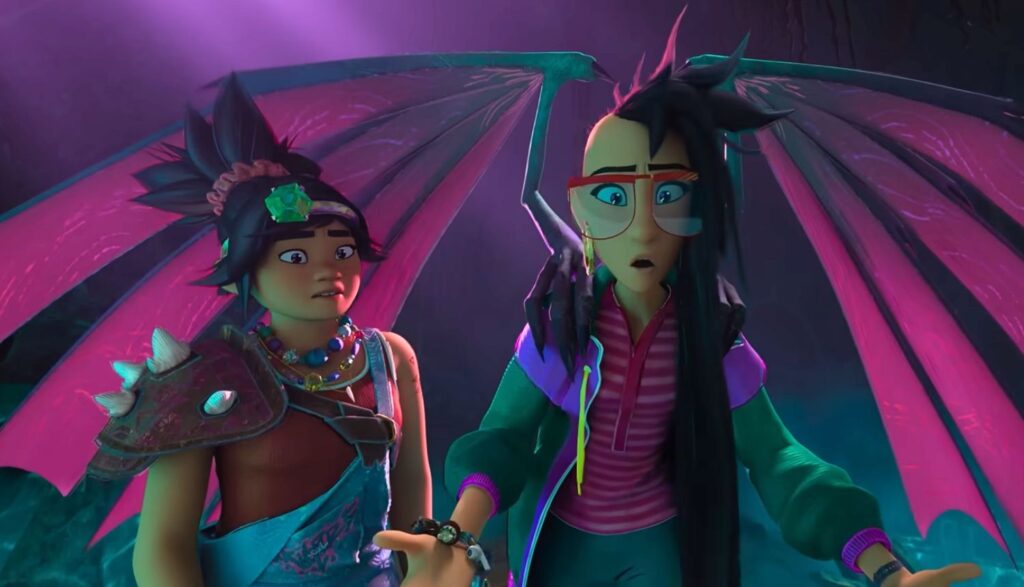
Despite these deceptions, Batiba appears to be an oversized, furry, cat-like demon, almost cuddly. Whereas Manang, Jo’s favorite Nakali native, is flat-out nightmare material. Jo calls Manang a vampire, but Manang is as darkly demonic-looking as it gets. The pitch-black, winged creature is large, muscular and terrifyingly agile. She glares at her victims with glowing eyes, breathing fire and slashing with sharp talons and fangs. And she also has the ability to separate her torso from her legs and reassemble at will.
Raissa ends up stealing Manang’s wings (though she doesn’t remember doing so). The wings seem almost sentient, clinging to her shoulders with a pair of gnarly, clawed hands.
In addition to these creatures, Jo and Raissa meet the weredog Raww (who transforms back and forth between a dog and a human boy), a merman, a large blue three-eyed “baby demon,” a tribe of small, angry mushroom warriors, a giant bird monster and a number of other creatures based on Filipino folklore.
Jo’s obsession with Nakali comes from her grandmother Lola’s colorful descriptions of the place. A neighbor, overhearing Lola’s descriptions of the mystical island, berates Lola for “corrupting children.”
During Raissa’s going-away party, her family hangs a picture of Jesus over the buffet table. Jo walks up to the table and quips: “What’s up, Jesus? Have you seen Raissa?”
The merman that Jo and Raissa meet starts out as a shriveled, dehydrated husk in a locked chest. Then, when he’s rehydrated, he swells up into a large, muscular creature with a bare chest and a fishtail for his lower half. He wears a rope-like covering, and sentient starfish cover his nipples. And on that note, Jo wakes on the Nakali beachfront wearing a “crown” that turns out to be a giant’s pierced-nipple ring.
The merman admits that he always thought Manang was “hot.” Jo creates a comic that depicts Raissa as the love interest of both the merman and the weredog Raww (both of whom are drawn with exaggerated muscles).
Early on, when Jo and Raissa meet, Raissa states that she was impressed with Jo’s story about Manang in class. “You had me at dismemberment,” Raissa proclaims. Jo pulls out her knife and declares that they should make the friendship official. Raissa balks and says, “I can’t do a blood oath.” Jo says that won’t be necessary: She’s just using the knife to cut off her hairbands.
On that storytelling front, Jo likes to regale her classmates with stories of Nakali, with particular emphasis on Manang, the scary vampire. Jo and Raissa do a stage presentation at one point, depicting Manang’s deadliness, and they splash the audience of adults with an explosion of fake blood.
Of course, the reality of Manang’s deadliness is nothing like the girls imagined. At times, Manang rips her own body in two before reassembling herself. She snarls that humans are far too fragile: “Funny thing about mortals,” Manang snarls threateningly, “when you rip them apart, they don’t go back together.” She attacks and chases the girls on several occasions. And we hear many stories about how she has tormented the inhabitants of Nakali for years, killing any who displease her.
Someone gets a “burned tushy” when Jo consumes food that causes her to spout flames from her mouth. Manang sends fireballs at several victims throughout the film. At one point, she knocks Raissa (who is using Manang’s stolen wings to fly) out of the air. Raissa lands in water, but Manang then sends an even larger burst of flames at her. Raissa ducks beneath the waves and nearly drowns, though somebody rescues her.
When Jo and Raissa first meet the weredog Raww they tie him up, covering his ears with duct tape. They then proceed to painfully rip off the tape and large amounts of fur each time they want him to hear what they have to say.
It then becomes a running gag for Raww to repeatedly get thumped around throughout the film. For instance, Raww talks about a game that involves kicking people in the groin area. Soon after, Raww winds up on the receiving end of the game’s action. Jo’s knife gets jammed into the doggy dude’s leg at one point. Etc.
Upon meeting a large baby demon named Bungi, Jo and Raissa ask for his help. But Bungi can’t leave his demon mother’s side unless his umbilical cord is cut. So his mother grabs a knife to make it happen (off screen).
The merman is hit in the face with a truth potion, that forces him to admit the many times he’s lied. But it also leaves shards of the broken glass bottle sticking out of his face.
A demon talks of feasting on corpses and bathing in blood of victims.
There really isn’t any need for foul language in this pic, and early on, it appears that it will be clear sailing with the PG-rated Forgotten Island. That is … until it isn’t. We hear uses of “d–n,” “h—” (and a variation of the word), “heck,” “frickin,” “flipping,” “crap,” “dang,” “nards” and “bunghole.”
We also hear and see a couple unfinished inclusions of “Son of a …” in a clip from the movie Predator.
Jo and Raissa discover that they traded highly caffeinated energy drinks to a group of pixie-like creatures in an island market. The drinks make the creatures frantic and buzzed, and the pixies quickly trade a bunch of potion bottles for another can of caffeine—locking down their stall for a flashing light party.
Raww is supposed to add slapstick giggles to this bestie tale. But his pee-on-everything actions and other doggy choices trend toward the potty or gross side of any humor ledger.
As Jo and Raissa retrace their steps from their forgotten first night on Nakali, they realize that they consumed intensely hot food at a market stall. Afterward, Jo begins to vomit huge blasts of flames. (Passing gas also causes a fiery expulsion.) One belch of fire singes away half of Raissa’s hair. And then a fiery expulsion from Jo’s other end sets a passerby on fire.
During Raissa’s going away party, her mom projects childhood pictures of Raissa. One of them shows her sitting with a bare backside on a toilet. There are jokes made about gas passing in the wind.
A guy named Reynoldo is a bully who taunts Jo and Raissa during their school years together. Eventually, the now-teen girls ransack Reynoldo’s car in payback, stealing pieces from it to build a homemade rocket. (Lola assists them in this endeavor rather than preventing it.)
On the island of Nakali, lying seems to be a way of life. Nearly everyone the girls meet lies to and/or betrays them. Though to be frank, the girls sometimes lie to each other as well.
When Raissa laments leaving her good friend for a college so far away, her mom says, “You’re a rocket. She’s like a rock.”
Jo makes some selfish choices. She and Raissa fight when those choices are revealed. Raissa accuses Jo of being willing to sacrifice someone else’s dreams because she doesn’t have any of her own.
Forgotten Island is one of those kids’ pics that may surprise you in both good and not so good ways. It’s a colorful, rambunctious movie that joyously throws a touching story, ‘90s music needle drops, bizarre creatures, campy jokes, some Filipino folklore, an exotic adventure and different styles of animation at the screen with the whirling speed of a Tasmanian Devil.
The movie’s story suggests that memorable experiences with friends can shape us into better people. The movie also takes time to focus on girls and women and the positive, formative nature their young relationships can have.
Despite all of the color, frenetic actions and positive relational messages, however, the simple truth is that most parents may still want to keep their tween-and-under kids very far away from this film.
That may sound like an odd statement to make since Forgotten Island is seemingly designed for a kid crowd. But the movie’s Filipino folklore backdrop packs this pic with three-eyed demonic entities, monstrous spirits and dark, sharp-clawed creatures. Some of those are winked at and kept cartoonish, but the vampire Manang is something straight out of nightmares. (Or straight into them.)
When you also add in a smattering of bad language, lots of character bumping and thumping and a bunch of dog-focused potty giggles, you’ll end up with some frowning parents who might wish they hadn’t spent so much on popcorn. The kids? They’ll be talking about the scary bits.

After spending more than two decades touring, directing, writing and producing for Christian theater and radio (most recently for Adventures in Odyssey, which he still contributes to), Bob joined the Plugged In staff to help us focus more heavily on video games. He is also one of our primary movie reviewers.