

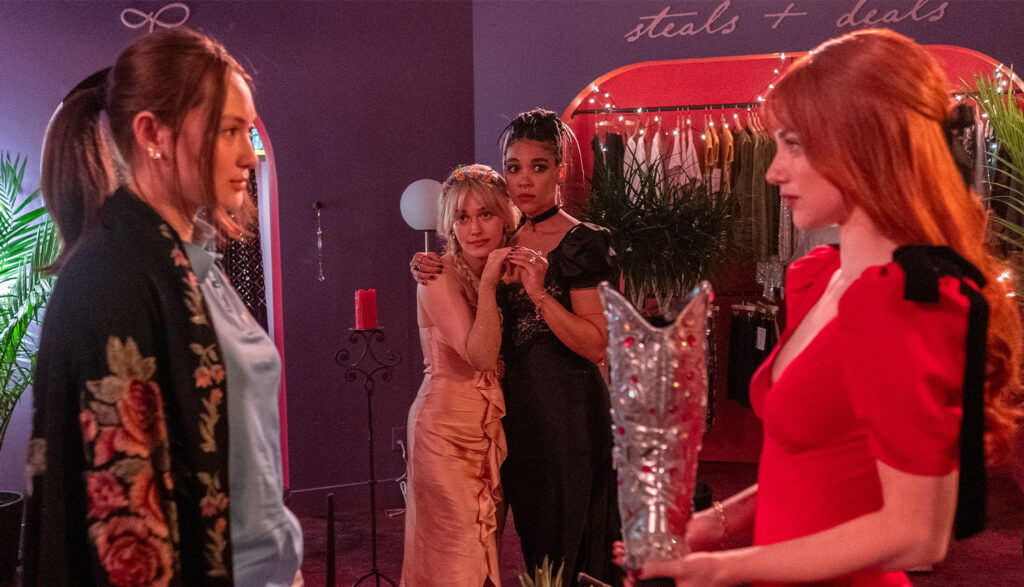
In Forbidden Fruits, a coven of witches begin questioning their sisterhood when a newcomer shines a light on their leader’s manipulative behavior. The film wraps witchcraft, foul language, suicide, murder, sex and nudity together into a package of what I would call chaotic, narcissistic feminism.
Sugar and spice and everything nice …
That’s what they say little girls are made of. But ask the women who work at the mall’s trendy (and expensive) boutique Free Eden, and they might say it’s actually “goat’s milk, thigh gaps, rose petals, bone casts” and a bunch of other witchy-sounding stuff that somehow rhymes.
Why? Well, because they’re witches.
That’s right, Free Eden employees Apple, Fig and Cherry—known as the “Fruits” by their fellow mall colleagues—are all part of a coven. And new girl Pumpkin, who works at the Sister Salt’s pretzel shop in the food court, wants to join that sisterhood.
But having the name of a fruit (which, apparently, pumpkins are) isn’t enough to join the Fruits. First, you have to impress Apple, the self-appointed leader of the coven. Then you need to get a job at Free Eden. And after that, there’s a ritual involved—one that involves drinking bodily fluids and confessing your “sins” to the “ultimate femme martyr,” Marilyn Monroe.
Pumpkin’s game, though. After all, she’s not looking to join the Fruits for the employee discount at Free Eden or the free lunches at the food court: Pumpkin wants to become a Fruit to get closer to Apple.
Because underneath Apple’s long, red locks and perfectly painted pout, she’s harboring secrets from her coven sisters—secrets that could poison their friendships forever.
A couple of people seem to see through Apple’s façade and are working to bring her to justice.
Apple tells Pumpkin that the Fruits became witches for the sense of sisterhood. She created “Paradise”—really just the upper floor of Free Eden where their coven hangs out and performs spells—to support that sisterhood. However, as the film progresses, it becomes very clear that Apple abuses her influence and manipulates her so-called friends.
For instance, Apple has created three rules for the witches to follow: 1) They embrace the “Shine Theory,” which states that all women have an inner glow and should surround themselves with other women so they can all shine brighter. It also demands that they never do anything to dim another woman’s “light.” 2) They banish all “vindicars,” demons that derive pleasure from other people’s pain and misery. Though in reality, vindicars seem to just be the people who don’t kowtow to every whim of the Fruits. 3) “We only text boys using emojis.”
Failure to adhere to any one of these rules results in the offending Fruit getting sent to “confession,” where she prays to the spirit of Marilyn Monroe for forgiveness.
The Fruits perform a ritual to induct Pumpkin into their coven. They pour a blood-like substance—Pumpkin asks if it’s blood, but we never get a clear answer—into a bedazzled boot, followed by a recitation of the coven rules. Then, the witches each remove their underwear from beneath their clothing and wring the garments into the shoe. (Nothing comes from the wringing, so it might merely be a symbol of their womanhood.) After that, they chant as they pass the boot around in a circle, someone sheds a tear into the footwear and, finally, they order Pumpkin to drink from it—which she does.
Elsewhere, Apple orders the Fruits to perform a hex. Cherry initially asks if they could do some “cute dark magic” instead, such as a spell for eternal dandruff. Fig voices her concerns with the spell, too, since it seems have rather serious consequences. But Apple insists on the hex. The women wear all black, light black candles and chant the spell together, essentially cursing anyone who has done them wrong.
Now, it’s unclear whether any of this hocus pocus actually does anything. Pumpkin learns that the last time the Fruits cast this spell (before she joined their coven), somebody who threatened to break up their girl group wound up in a coma—but circumstances suggest that he was incapacitated through nonmagical means. After performing the spell this time, a woman who had previously been part of their coven meets her doom. But again, the suggestion is that her death was not mystical so much as tragic. Other disastrous happenings, while very conveniently coinciding with the timing of the hex, seem to be just that—coincidental.
That said, the magical links here should not be dismissed. Even if the Fruits aren’t performing real dark magic, they certainly think they are. The Fruits call themselves witches. They talk about forethought and say things like, “Thank goddess.” They believe Pumpkin’s arrival is a “cosmic” occurrence. And they celebrate the winter solstice.
Apple says she has studied the occult, alchemy, astrology and astral projection. Dialogue suggests that Apple might believe she is some sort of reincarnation of Eve (from Genesis). And her license plate reads “Lilith,” a demonic being/goddess in many pagan religions.
Apple sometimes folds her hands in a prayer-like pose. She likens smoking marijuana to prayer. People talk about astrology, talismans and burning sage. Someone says a woman wearing a shawl looks like the Virgin Mary. A pentagram hangs in the Free Eden store. Fig sometimes wears a cross necklace. A song in the background blasphemes Jesus Christ.
Modesty does not seem to be in the Fruits’ vocabulary. Pretty much every outfit these women wear reveals cleavage, bellies and more. A few scenes show even more skin as they change clothes (there’s brief partial nudity). Fig even says that one of the reasons she started working at Free Eden, which supplies their questionable wardrobes, was so she could “wear lingerie as a summer dress.” (The film leans into this element early on, playing a song titled “Scantily Clad Women” in the background.)
We learn that Apple’s dad (who is deceased) had an affair and abandoned her and her mom—and that someone else in the group had a similar experience. As such, Apple believes that all men are vile and unfaithful. When a man walks into Free Eden by himself, Apple calls him a “perv” under her breath. (The store only sells women’s clothing.) The man’s wife and daughters soon follow, but Apple simply shifts her perspective, suggesting that he probably got caught cheating and was buying them off with expensive gifts.
It’s unclear what Apple’s own sexuality is, though. During an argument, for instance, she kisses one of her friends on the mouth (the woman immediately shoves Apple away), but it’s unclear if this was a sexual act or just a way to get her friend to stop talking. Elsewhere, when one of the witches cuts her hand, Apple licks the blood from the woman’s wound—though whether this is sexual or a witchy proclivity is left to the viewer.
Apple stipulates when the Fruits are allowed to have sex. Confusingly, given her disdain for men, someone tells Pumpkin that Apple would be upset to learn that Pumpkin is a virgin—suggesting that Apple isn’t wholly against having sex with guys, just guys of a certain ilk or on certain days of the week.
Cherry, we learn, is having sex with just about every guy who works at the mall’s food court. A montage shows her sneaking these men into dressing rooms to copulate. People remove clothing and the bare rears of a couple of guys are shown. In one scene, Cherry’s dress covers most of the man’s body, but we still see their sexual movements.
After Pumpkin barges in on one of these encounters, Cherry starts changing clothes as the guy runs out of the room, exposing her bare chest. Later in the film, she wonders if men only use her for sex.
We see a former member of the Fruits making out with a guy in a dressing room. The couple gropes one another and begins to undress before the camera cuts away. We see other couples lock lips a few times. People working at the mall whisper about how “hot” they think the Fruits are: One guy says he wishes he was Apple. Another voices a desire to have the Fruits spit in his mouth.
When a guy checks out Apple in a parking lot, she responds with a crude hand gesture encouraging the man to masturbate. He complies, and while the action is kept just out of frame, we still see some motions and hear him moaning. Given that Apple hates men, this feels out of character, but …
… Apple then proceeds to throw hot coffee on the man’s exposed genitals. We don’t see anything explicit, but the guy screams in pain.
A woman stands outside the Free Eden store, hitting her head against the glass window repeatedly. We see her hitting her head against glass objects elsewhere, too, even cracking a mirror. Pumpkin learns the woman began suffering from severe mental health problems after an experience with the Fruits. Tragically, the woman eventually takes her own life onscreen, jumping from a balcony. We see her body on the ground, surrounded by a pool of blood.
Three other women endure horrific deaths, too, though not by their own hand. One woman gets trapped on an escalator—first by her shoe and then by her hair—and the exposed gears of the machine grind her to a pulp. Another woman’s head gets split in half by a falling shard of glass. And the third woman is strangled and left face down in a fountain.
We learn that two different people were purposely poisoned. One wound up in a coma. The other perished.
Unfortunately, the instances of self-harm and other horrific injuries don’t end there: A woman pours alcohol on her neck and nearly sets it aflame with a lighter. A guy takes a meat cleaver to the neck and face. (It appears he survives.) A woman loses a tooth after tripping face-first on an escalator. Another woman hits her head on a marble floor after slipping on someone else’s blood. Someone tears off her own fingernail, which we see in a bloody close-up.
Two women tackle each other in a fountain, and one hits her head on the stone edge. (She bleeds from her wound but seems to be OK otherwise.) A woman accidentally slices her hand open with a box cutter. Someone gets hit upside the head with a blunt object. Another person gets slapped in the face—though it should be noted that she requested the slap.
Characters accuse each other of murder. One woman sharpens a knife to intimidate her friends. She later says they must sacrifice someone’s pet cat (though that never happens). Elsewhere, someone else threatens to pour hot tea on the same cat, but that doesn’t happen either.
Apple alleges that Marilyn Monroe was killed after having an affair with the president because she “knew too much.” We hear that someone’s entire family died in a fire.
There are roughly 40 uses of the f-word, 10 uses of the s-word and one use of the c-word. We also hear several instances of “a–,” “b–ch,” “d–k,” “h—” and “tits.” We hear many of these same profanities in the lyrics of background songs, including one song that repeatedly uses “p—y.”
God’s name is misused 15 times.
The Fruits enjoy imbibing whenever they hang out in Paradise. All except Cherry, who we’re told is a recovering alcoholic. Cherry tells Pumpkin that Apple helped her get sober, but when Apple’s manipulations come to light, Cherry begins to doubt whether she ever had a drinking problem at all. Cherry breaks her sobriety, drinking small bottles of liquor in the Free Eden dressing room as she tearfully “confesses.”
At Pumpkin’s initiation ceremony, Apple offers up a joint of marijuana, telling her friends to “blow me.” Fig demonstrates, taking a puff of the drug and then blowing it into Apple’s mouth. Pumpkin hesitates, stating that she doesn’t smoke, but Apple insists so Pumpkin complies.
Cherry, while snacking on gummy bears, says she thinks the treats are making her high. The Fruits all appear to take a drug during a night in Paradise, but their experience is revealed to be a placebo effect.
Loneliness is a key theme in Forbidden Fruits—and a key reason why the Fruits formed a coven. For instance, one woman’s entire family perished in a fire. She admits that without the Fruits, she would not have any sense of self-worth, but she also wonders whether people are using her.
Another woman joined the coven because she had had a difficult time making female friends, and without the sisterhood, she fears she won’t reach her full potential.
Apple, for all her flaws, seems to truly long for female companionship, too—for friends who will stick by her through thick and thin and encourage her. Unfortunately, Apple is keeping a lot of secrets from her friends, hidden things that reveal ulterior motives. She’s controlling and manipulative. And when Pumpkin—skeptical of the coven’s “girls supporting girls” mantra from the start—shines a light on Apple’s behavior, it tears the sisterhood apart.
We learn that after someone committed a crime, her mom essentially disowned her—though the main reason she broke the law was to save her mom from a guy who was using her. The daughter is living out of her car now and has serious trust issues.
Characters lie, spy, cheat, manipulate, control and insult each other. People are generally rude to each other, even toward people who are supposed to be their friends. The Free Eden employees frequently markup items in order to make larger sales. A woman states that if she had children, she wouldn’t ever consider their needs.
Someone vomits onscreen. Someone else spits out her food after hearing something shocking. A woman says some soft pretzel bites look like feces.
Forbidden Fruits is based on a play by Lily Houghton called “Of the woman came the beginning of sin and through her we all die.” And the gist of that show is much like what we see here: The employees of a women’s clothing boutique form a coven of witches because they want to create a space where “women support women,” where they won’t feel so alone.
Instead of sisterhood, they get chaotic, narcissistic feminism.
It’s sort of like Mean Girls if the Plastics were into witchcraft. But even that wouldn’t account for the sheer amount of violence, foul language and sexual content on display here. F-bombs are frequent. Sex is graphic, with partial nudity. Violent deaths, including a partial depiction of suicide, are practically commonplace.
Maybe it was the witchcraft. Somehow dark forces don’t exactly scream “sisterhood” to me. And granted, we never actually learn whether the magic we see is real or just the result of crazy coincidences. But I think it’s safe to say that if the Fruits hadn’t delved into the dark arts, maybe they could’ve found the companionship they sought.

Emily studied film and writing when she was in college. And when she isn’t being way too competitive while playing board games, she enjoys food, sleep, and geeking out with her husband indulging in their “nerdoms,” which is the collective fan cultures of everything they love, such as Star Wars, Star Trek, Stargate and Lord of the Rings.