


Enola Holmes 3 sees the eponymous young detective finally marrying her beloved Tewkesbury, whom she’s been in love with since the first film. But a kidnapping interrupts Enola’s nuptials. Intimate moments between the betrothed couple and some scenes of violence (mostly against our female protagonist) cause some disturbances in this otherwise fun mystery tale.
Every good story begins with a wedding, right?
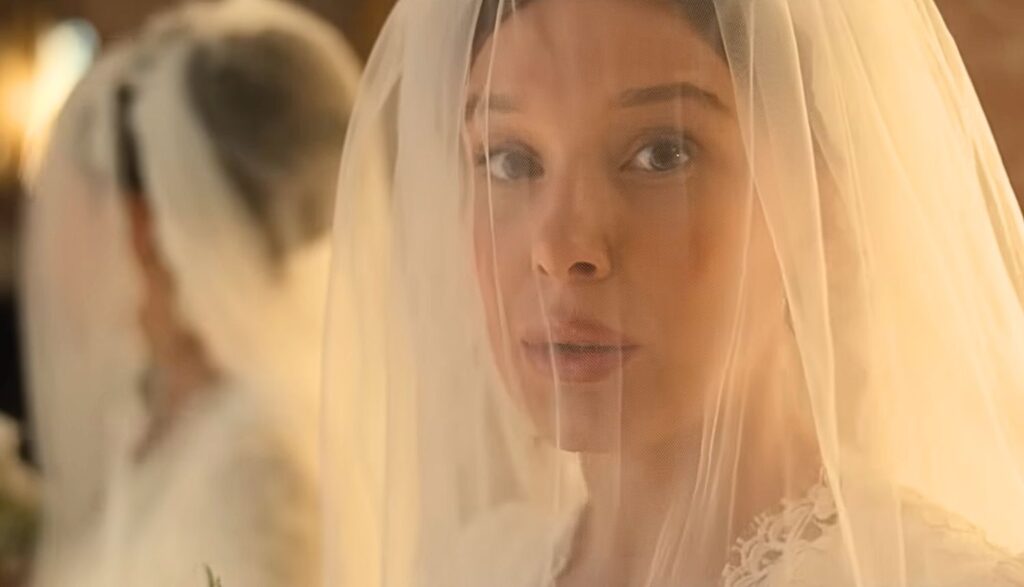
That’s what Enola Holmes has been told, at least. Of course, Enola never thought she’d be walking down the aisle herself. After all, her mother, Eudoria, very pointedly named her Enola because it’s the word alone spelled backwards.
But it’s not just Enola’s first name that’s causing trepidation the morning of her wedding: It’s also her last name.
Enola has spent the last few years trying to live up to family name. She’s managed to earn the respect of her brother Sherlock, the renowned detective, and the siblings have even worked a few cases together. If Enola gets married, she’ll have to give up the name Holmes and take on her husband’s.
But Enola loves Tewkesbury (yes, he has a first name, much to Enola’s surprise, but she prefers to call him by his surname only), and she wants to spend the rest of her life with him. Perhaps she’s making a bigger fuss about the name change than she needs to.
If only Tewkesbury wasn’t a nobleman. Sure, he’s done some great work since taking his seat in Britain’s House of Lords, fighting for those less fortunate, but certain societal expectations come with being the wife of a lord—expectations that Enola’s not sure she can fulfill.
What Enola really needs right now is good mystery to distract her from all these worries.
I suppose it’s curiously fortunate that Sherlock manages to get himself kidnapped mere hours before Enola’s nuptials.
It’s not much of a spoiler to say that Enola’s wedding day is rather spoiled by the disappearance of her famous brother. But Enola’s failure to even make it to the church hurts Tewkesbury rather badly. Enola recognizes this and apologizes profusely; she never meant to hurt him.
Tewkesbury isn’t necessarily quick to forgive. Still, he doesn’t abandon Enola. He understands that Sherlock’s life is in danger, so he volunteers to help. His actions throughout the film demonstrate just how deeply he cares for Enola. And even when Enola causes Tewkesbury embarrassment, he never judges her. He only ever encourages her to be herself.
And that’s probably a good thing since Enola really can’t help but be herself sometimes: a kind, talented young woman always ready to help those in need and willing to risk her life to protect the ones she loves.
Yes, Enola can also be impulsive, short-sighted and easily distracted. Those qualities cause her to make mistakes, and she’s rather hard on herself for those errors. But Enola is at her best when she stops trying to fulfill the expectations of others and simply focuses on doing what is right. She thinks clearly and quickly, she acts kindly but decisively, and she stops someone she loves from making a terrible, life-changing choice. Moreover, the people she loves the most reassure her that her self-doubt is unwarranted: They all believe that she is extraordinary.
A young man learns that his late father wasn’t the “good man” he always believed him to be, and it challenges his self-worth since he had always tried to live up to his family’s name. However, another man steps up as a sort of mentor and friend in that moment. He explains that he had a similar revelation about his own father. And he encourages the young man that they don’t have to be the men their fathers were: They can choose to be better men.
Enola and Tewkesbury both use their positions in society to help those in need. Reparations are made to some countries that were wronged by the British crown. When a man and woman get rescued from a deadly situation, the man insists his rescuer aid the woman first. Elsewhere during their captivity, he asks his assailants to show mercy to his female cohort.
Priests and wedding guests wait in a church for a wedding ceremony to begin.
Enola and Tewkesbury are very much a young couple in love. Montage moments in the film show them play fighting, cuddling, hugging and kissing (some of which are flashbacks to the previous films). We see them lock lips a couple of times in this film, too.
In one scene, Enola and Tewkesbury go into a bathing cabin—a sort of Victorian wooden shack where women could change into swimming clothes—by the sea. They remove each other’s neckties slowly before chastely turning their backs to finish disrobing. They’re both wearing Victorian undergarments (an undershirt and long shorts for Tewkesbury, a corset over the same for Enola). Tewkesbury helps Enola braid her hair, showing off her slightly exposed shoulders. And then they go into the water to swim, playing together and holding each other in their arms. Afterward, they cuddle up next to each other as they warm up by a fire. The whole scene is very above-board by today’s standards, but almost certainly would have caused a scandal in their own time if anyone had seen them. (We see them in the water on one other occasion, kissing. Enola breaks the fourth wall, splashing at the camera as if to shoo it away, and it tilts down below the water’s surface, showing that the couple is once again in their Victorian undergarments.)
Elsewhere, just after their wedding gets ruined, Enola and Tewkesbury sit down on a bed to talk. They both glance at the bed during the conversation and note that this isn’t how they pictured the day going. Later in the film, when a few men enter Enola and Eudoria’s tent to discuss their strategy for an upcoming fight, Eudoria makes a suggestive comment about having handsome men in their tent: “Aren’t we lucky?”
Enola wears one dress that shows off some cleavage. Elsewhere, she wears a gown that bares her shoulders.
Two people get shot in cold blood by an unseen figure as Enola chases them. They both die. A shootout occurs between two groups of people, and several people get shot and killed.
Sensing an intruder in her room, Enola arms herself with a candlestick and hits her would-be assailant on the nose with it. The victim’s nose bleeds from the blow. In a similar situation elsewhere, Enola arms herself with a sharp hairpin, grabbing the intruder in a chokehold and threatening him with the pin. They wind up in a fistfight, with Enola getting knocked around quite a bit by the man. But she ultimately gains the upper hand, pinning him to the ground and choking him for information. (She releases him after realizing they’re on the same side.)
At one point, someone wraps a noose around Enola’s neck, cackling maniacally. However, Enola is released since her attacker needs information from her. They exchange brief fisticuffs before Eudoria arrives and shoots at the attacker. The person escapes after using explosives to blow a hole in the wall.
Enola chases a woman on horseback, leaping off her own horse to tackle the woman to the ground when she catches up. They punch and kick each other for a while before the woman draws a short sword. Enola gets knocked down at one point: Her lip is bleeding, and she seems on the verge of passing out. However, she rallies, disarming and knocking out her opponent.
Two people get kidnapped, dragged from their rooms in the middle of the night. Throughout the film, we see flashes of the kidnapping scenes. Both victims get chained up when they reach their destination. One victim, a woman, is denied water: Her kidnapper pours a flask of water on the floor before her eyes.
Early on, a man on horseback pursues Enola’s carriage. Believing the man to be a highwayman, Enola climbs atop the carriage and aims a rifle at him. Before she can fire, the carriage hits a bump in the road, and Enola is thrown to the ground. She hits her head, but she’s ultimately OK—and the man turns out to be her friend, Dr. Watson.
Someone purposely sets a hotel on fire. Tewkesbury, unable to find his mother, stays behind to search for her as the flames and smoke grow. When Enola arrives on the scene and realizes he’s still inside, she rushes in to save him. Watson later treats Enola for smoke inhalation and a cut on her arm.
Several characters get threatened at gunpoint. A couple of men talk about the brutality of war, with one man noting that he took bullets during battle. A man gets knocked unconscious offscreen, and we see Enola drag him into a room. Later, when the man awakens, Eudoria picks up a large book and walks offscreen to render him unconscious once again.
Flashbacks throughout the film show some of Enola’s physical altercations from the first two movies. (We see a few flashbacks of Sherlock fighting, too.) They also show how her mother employed explosives in her campaign for women’s suffrage.
Sherlock and Enola investigate a disappearance, and Enola finds clues that their missing person was hanged, not kidnapped. (Illustrations show the noose and the victim’s kicking legs.)
Enola and Tewkesbury are set to get married in Malta, which, Enola tells us, has been the site of many battles throughout history. Several Maltese revolutionaries wish to end British rule in Malta because they’re tired of Maltese soldiers being used in British wars. We hear about one battle that took place in Afghanistan that resulted in the unnecessary deaths of many Afghan and Maltese soldiers.
Eudoria charges Enola to “make h—.” Sherlock describes something as a “bloody affair,” though it’s unclear if he means this literally or if he’s using the British expletive. Enola calls her brother a pig during an argument.
People drink alcohol at a dinner party.
In the film, Malta is under British military rule, and we see examples of British nationalism and high-handedness. For instance, Enola gets detained by Maltese police after she’s found at the scene of a crime. The British governor scolds the sergeant questioning Enola, informing the man that as a British citizen, Enola is his “better.” Enola disagrees with this assessment, but there’s nothing she can do to remedy the situation. Elsewhere, a Maltese man who is assisting Enola pretends to be her manservant and walks several paces behind her since it would be considered improper for a man of his nationality to walk beside a woman of her nationality.
Because of this, several locals have formed a resistance called the Partito Anti-Riformista. They wish for Malta to be free of British rule. We hear that the British military has frequently denigrated Maltese soldiers, blaming their own shortcomings on them. One contingent of Maltese soldiers was even falsely accused of mutiny. We also learn some British soldiers stole from a religious shrine in Afghanistan because they were under orders to reduce costs (since war is expensive) by whatever means necessary.
A nobleman offers to free a dangerous prisoner in exchange for her help in reclaiming a lost treasure: He stages it to look like she escaped. When the woman discovers that the lost treasure is connected to the people who put her in prison, she plots and manipulates to get revenge and reclaim the gold.
Enola loves her family, but she’s often frustrated by its members. For instance, she notes that due to the Explosive Substances Act of 1883, her mother is a “fugitive of the first class” and will not be able to attend her wedding, lest Eudoria get arrested. Enola also laments that while Sherlock has agreed to walk her down the aisle, he’ll do so “curmudgeonly,” with a lack of elegance or “sense of life behind his eyes.” She doesn’t even invite her other brother, Mycroft, to her big day.
Someone teases Tewkesbury for marrying a woman of lesser social status. Several people must come to terms with their family histories—namely, that their “noble” families did not earn their status or riches through noble means. One woman laments the hypocrisy of it all.
Eudoria has always embodied a unique brand of feminism. In the previous Enola Holmes films, she’s resorted to violent means to achieve her ends. Though we don’t see that extremism in this film (other than a couple of flashbacks), it’s clear Eudoria still holds to those beliefs. When Enola asks her mother if she enjoyed being married, Eudoria states that she didn’t because she married the wrong man. (However, she also reassures Enola that she thinks Tewkesbury is a better match for Enola than her own husband was for her.) [Spoiler warning] When she “officiates” Enola and Tewkesbury’s wedding at the end of the film, she finishes it with “I pronounce thee woman and husband. You may now kiss the husband.”
In Netflix’s Enola Holmes 3, Enola is finally forced to answer the question that’s been building up the last two films: Will marrying a lord in the Victorian age prevent Enola from having the career she’s always wanted?
It’s a fair question. The Victorian setting of the Enola Holmes films has aided in creating stories that are relatively light on content: Foul language is minimal, and sensual moments have been limited to kissing. (Violence crops up quite a bit, but more on that in a moment.) However, it also means that women aren’t always given a fair shake in society.
Enola has had to work extremely hard to earn the respect of her colleagues in the detective world; she doubts even her brother Sherlock truly takes her seriously. But marrying a man—and a nobleman at that— and taking his name may mean giving up her autonomy. As the wife of a lord, it wouldn’t be proper for Enola to trudge through the gritty streets of London, solving mysteries and brawling with bad guys.
And that’s what drives much of the story here: Will Enola give up everything to be with the man she loves? Or will she take Sherlock’s advice and her feminist mother’s teachings to lead a life, as her name suggests, alone?
Enola’s journey to a fulfilling career and marriage doesn’t follow a path lined with flowers. She makes mistakes. She hurts people she loves. But through it all, she realizes that she is not alone: Enola has friends and family who love and support her. Moreover, she’s not beholden to the expectations of others. Enola is free to choose her own path.
Now, parents should note some less traditional feminist messages here: For instance, at a wedding, Eudoria (Enola’s mother) pronounces a couple woman and husband rather than man and wife. And if you’re familiar with the previous films in the franchise, then you know that Eudoria has previously employed violent methods (mostly bombs) in the name of women’s suffrage.
Eudoria doesn’t blow up anything in this film, but there’s still a fair bit of violence: People get shot and killed. Enola doesn’t get beaten up by as many men in this film, but she does engage in a pretty serious—and nearly lethal—fight with a deadly female opponent.
And while the film keeps in line with its Victorian setting, Enola and Tewkesbury have several suggestively intimate moments together before their wedding. (They kiss a few times, and one scene has them swimming in their Victorian undergarments.) And that’s just something for parents of impressionable teenage daughters to keep in mind.
Enola Holmes 3 is still a fun and mostly navigable film to watch though. And it contains some inspiring messages about leaning on the people around you for support rather than constantly trying to forge your path alone.

Emily studied film and writing when she was in college. And when she isn’t being way too competitive while playing board games, she enjoys food, sleep, and geeking out with her husband indulging in their “nerdoms,” which is the collective fan cultures of everything they love, such as Star Wars, Star Trek, Stargate and Lord of the Rings.