


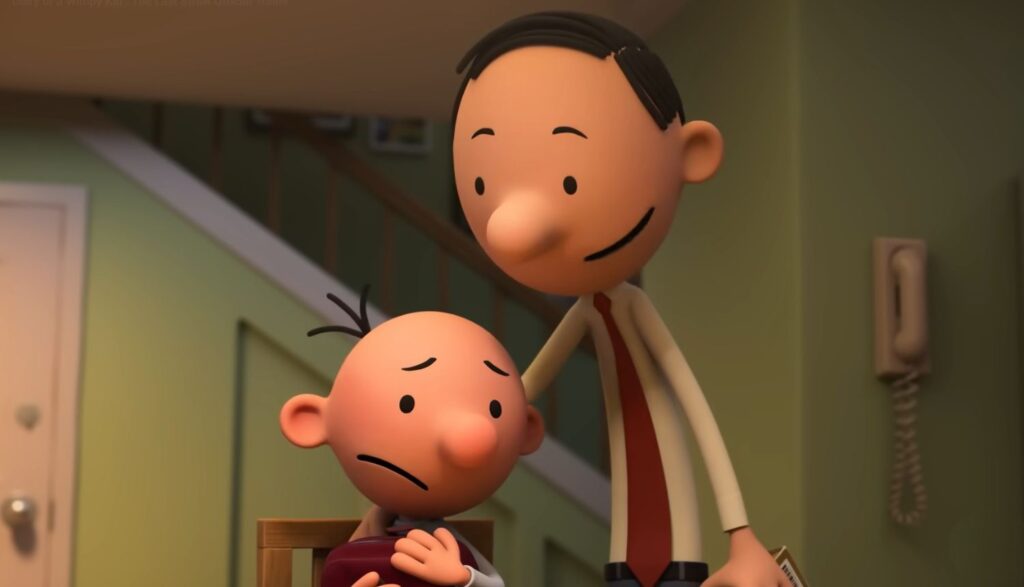
Frank Heffley has had it up to here with his chaos-causing son, Greg. But when they get involved with a sort of wilderness troop, they discover, much to their surprise, that they kinda like each other. Diary of a Wimpy Kid: The Last Straw is predictably filled with slapstick violence and grossout gags, but it comes with some very sweet messages, too.
Young Greg Heffley is nothing like his dad. Nothing.
Frank Heffley is mature. Responsible. Appreciates the value of hard work. And Greg? Well, why work hard if you can work smart? Or find nice, easy shortcuts? Or get someone else to do the work for you?
That’s Greg’s way. The middle schooler never met a chore he couldn’t shirk, an assignment he couldn’t forget, a class he couldn’t doodle his way through. He does like earning money, though—especially if he can convince his best friend, Rowley, to help him.
And that brings us to the lawnmower.
One does not have much use for lawnmowers in the middle of winter in Greg’s hometown of Plainview. But when he and Rowley decide to start a snow-shoveling business, Greg learns that actually shoveling snow is hard work. (Especially when one of your shovels is a rake.) So he peeks into his first client’s garage, hoping to find a snow blower, and he spies her lawnmower instead. Greg figures that they’re pretty much the same thing: They both operate outdoors. They both suck up and shoot out the stuff they run over. Why not run the lawnmower over his client’s driveway? He and Rowley will be done in no time.
One broken lawnmower, a terrified dog and several destroyed garden gnomes later, Greg learns that his bright idea maybe wasn’t so bright. Indeed, it’s just the latest disaster in a winter full of them. And for Greg’s father, it’s just about the last straw.
And then, out of nowhere, Lenwood Heath shows up. That’s right, the Lenwood Heath, one of Plainview’s most notorious bullies—the same Lenwood Heath who used to TP the Heffley house every week without fail. But that was years ago. This version of Lenwood Heath fixes the broken lawnmower (and the rest of the property, too) in seconds, no questions asked. I’ve changed, Lenwood says. And he owes that change to the Spag Union Military Academy.
Oh, and incidentally, Mr. Heffley, they’re taking applications right now, he says. Might he know someone—someone in his very own home, perhaps—who could benefit from some rigorous discipline and character-building trauma?
Frank Heffley’s mightily tempted to sign up Greg. Mightily tempted indeed. But Greg’s mom, Susan, suggests a different way forward: Why doesn’t Greg join the Wood Chippers, a Boy Scout-like organization that teaches boys important skills and grows their character? And why doesn’t Frank help Greg earn his merit badges—and shower a bit of fatherly wisdom upon his son along the way?
Greg can think of plenty of things he’d rather do than spend a winter with his dad. They’re nothing alike, after all. But if it keeps him out of Spag Union, he’ll suffer through. And as for those merit badges? Well, Greg’s sure he can find some brilliant shortcuts along the way.
The Wood Chippers hold just about as much appeal to Frank as they do to Greg. Frank’s own childhood memories of the Wood Chippers are less than, um, chipper: He’d much rather spend time working on his Revolutionary War dioramas. But he makes the sacrifice for his son.
And in the course of doing so, both Frank and Greg experience something wholly unexpected: They start having fun. In fact, they start having fun together. Crazy, right? And as they spend time with each other—filled with successes and failures and stories—Greg realizes that he and his father may not be that different after all.
It’s not always easy, of course. Greg joins an indoor soccer team to earn his Wood Chipper physical fitness badge, but the coach refuses to start him. The coach doesn’t want to put the unathletic Greg in a “position to fail,” he says. A doubt-riddled Frank wonders whether pursuing these merit badges may indeed be forcing a lot of unwanted failure on Greg.
“Our boys aren’t going to be successful in everything they do, Frank,” Susan reminds him. “If they’re not failing, they’re not growing.” And when Frank wonders what lessons Greg’s learning from soccer if he never gets to play—whether it’s pointless to keep going to these games at all—Susan again has some wise words:
“He’ll see that his father keeps showing up for him no matter what. That he’s his biggest fan. And there is no better lesson than that.”
It’s important to note that Frank’s dalliance with Spag Union isn’t so much about Greg as it is about how Frank perceives his own shortcomings as a father. “I feel like I’m failing him,” he admits to Susan. So when Spag Union comes along and promises to “make up for your parenting deficiencies,” Frank is tempted. He wants the best for his boy. Who can blame him for exploring every option to help his child succeed?
By the end of the film, of course—and through some truly staggering failures—both father and son succeed in ways they never would’ve guessed. And both are part of a life-risking moment of heroism.
Diary of a Wimpy Kid: The Last Straw begins during Christmas, when the Heffley family is trying to get to the Christmas church service on time. They’re all supposed to be decked out in their Sunday best, with big brother Rodrick wondering why “fancy clothes” are a requirement: “Who are we trying to impress?” A series of mishaps leads to a very late departure, and some fellow congregants chastise Frank for his subsequent hasty, dangerous driving. “Way to spread the holiday cheer,” someone mutters.
The Heffleys do make it inside the church eventually, where we see a priest in robes, stained-glass windows and decorative angels everywhere (including a massive one near the pulpit). We briefly hear a religious carol or two. The church’s organist collapses at one point, and when she revives, she asks, “Is this heaven?”
Greg’s snow-shoveling business is named “Beefcake Snow Removal.” Greg’s hand-drawn flier features both he and fellow shoveler Rowley shirtless, displaying an impressive array of muscles. (When one would-be client turns them down, Greg wonders aloud, “Maybe I should’ve made my biceps bigger.”) After their first job goes seriously awry and Lenwood Heath shows up, the home’s elderly female owner looks out the window and says, “Now, that’s a beefcake!”
We see Greg after a shower, wrapped in a towel. When Frank considers sending Greg to Spag Union, Greg’s first concern is bathroom usage. “That place probably has open showers!” he says. “I can’t do open showers!” We see characters in their underwear.
Mishaps are drawn to Greg like rabbits to a carrot garden. As such, The Last Straw overflows with slapstick violence and moments of peril—even though no one suffers so much as a paper cut.
That said, one character might catch the sniffles after falling into a wintery mountain stream. He goes under the water and nearly careens down a waterfall before he’s rescued.
Greg’s lawnmower incident is wildly unsafe: The unloosed mower not only decapitates the aforementioned garden gnomes, but it nearly claims the life of a yappy dog. The pooch (Puddles) watches the lawnmower fly over his head—the blade inches away from him. He’s accidentally tossed about 50 feet into the air, too—causing at least one reviewer to wonder whether Puddles might be part cat, complete with its nine lives. The canine’s own thirst for blood and violence, however, remains unsated: It chomps on Greg’s rear and holds on for dear life as Greg tries to rein in his galloping mower.
Greg goes airborne himself once or twice during the film, and he gets seriously entangled in a string of Christmas lights. Frank can drive with reckless abandon. Fregley, a classmate and neighbor of Greg’s, makes some seriously creepy snowmen. A bunch of kindergarteners run amuck on a construction site. A soccer player makes a hard tackle on an opponent, earning a disqualifying red card from the referee. Characters slip on rocks and fall. Several people are knocked down and out during a chaotic incident at a health club. An incorrectly pitched tent sends stakes flying and causes some clothes to catch fire. We hear about a time, years ago, when a Wood Chipper stirred up an underground wasp nest. Raccoons attack.
During a Wood Chipper campout, a father tells a story about a disembodied hand that is said to haunt the forest. Just as he dismisses the tale as legend, he’s “attacked” by a hand: his own. Later, a worried Greg tries to explain away his own fears regarding the hand. “How would it breathe?” he asks his father. “It doesn’t even make sense!”
We hear some name-calling and the use of the word “butt.” And when someone falls into a stream, he utters a couple of OMGs as the current carries him away.
None.
Let’s be honest: Greg can be a jerk. He tries to win a position on the student council by smearing his opponent. He hides the fact that he was sent to detention and suspended from his role as a student safety officer. He lies repeatedly. He tries to encourage his father to lie, too—asking Frank to sign off on his Wood Chipper merit badges when he hasn’t done the work. He buys a stack of “student of the week” stickers to boost his status with his mom and dad. Frank brags about Greg’s accomplishments—even buying a new car to display the sticker—and he’s naturally furious when he learns about Greg’s deception.
Greg accidentally sits on his younger brother’s chocolate Santa in the car, just as the Heffleys head off to church. Susan tries to wipe the chocolate off with some wet wipes, but fails. The family tries to hide the stain with a sparkly (and for Greg, embarrassing) wrap that looks a bit like a skirt—but that gets caught in a door. Naturally, the entire congregation ultimately sees the stain on Greg’s pants and assumes it’s … not chocolate.
Greg’s accused of terrorizing kindergarteners with worms (one of the few charges against him that isn’t true). Rodrick, Greg’s older brother, drinks straight from the milk jug. Characters talk about heading to the bathroom (or needing to use one). A school bully bets on a soccer game.
If you know anything about Jeff Kinney’s Diary of a Wimpy Kid books (or the movies based on them), you know that Greg Heffley is no role model. His 20-volume (and counting) diary is, practically, one long cautionary story of what not to do in pretty much any given situation.
But if Greg is slow to learn from his mistakes, many of us are far quicker on the uptake. And behind all the chaos and bad decisions we find in Diary of a Wimpy Kid: The Last Straw, we see a surprisingly touching story of a father and son trying—and ultimately succeeding—to bond.
To Greg, such a thing seems impossible at first. When Rowley talks about how much fun he has with his own father, Greg’s aghast. “You actually spend time with your dad?” He asks. “On purpose?” And maybe many a middle schooler (and father of a middle schooler) can relate: It’s not always easy to spend time with your parents when you’re 13; it’s not always easy to spend time with an eye-rolling 13-year-old. But the time investment you make pays exponential dividends.
Granted, you could definitely get those dividends without spending time with this movie. Diary of a Wimpy Kid: The Last Straw gives plenty of reasons why that time might be best spent elsewhere. The slapstick violence and gross-out humor will leave many parents rolling their own eyes.
But the film does stick to its PG rating, and—crass gags aside—there’s something sweetly old-fashioned about The Last Straw. Here’s a family that actually goes to church (and even dresses up, too). Father and son join a group (the Wood Chippers) that actively encourages its members to grow. And we’re reminded that, as exasperating as our children (or parents) can be, time is short. As one father tells Frank, “I don’t want to do anything to drive my boy away. We only get them for a little while.”
The Last Straw has some issues, sure. But it earns merit badges for its messages.

Paul Asay has been part of the Plugged In staff since 2007, watching and reviewing roughly 15 quintillion movies and television shows. He’s written for a number of other publications, too, including Time, The Washington Post and Christianity Today. The author of several books, Paul loves to find spirituality in unexpected places, including popular entertainment, and he loves all things superhero. His vices include James Bond films, Mountain Dew and terrible B-grade movies. He’s married, has two children and a neurotic dog, runs marathons on occasion and hopes to someday own his own tuxedo. Feel free to follow him on Twitter @AsayPaul.