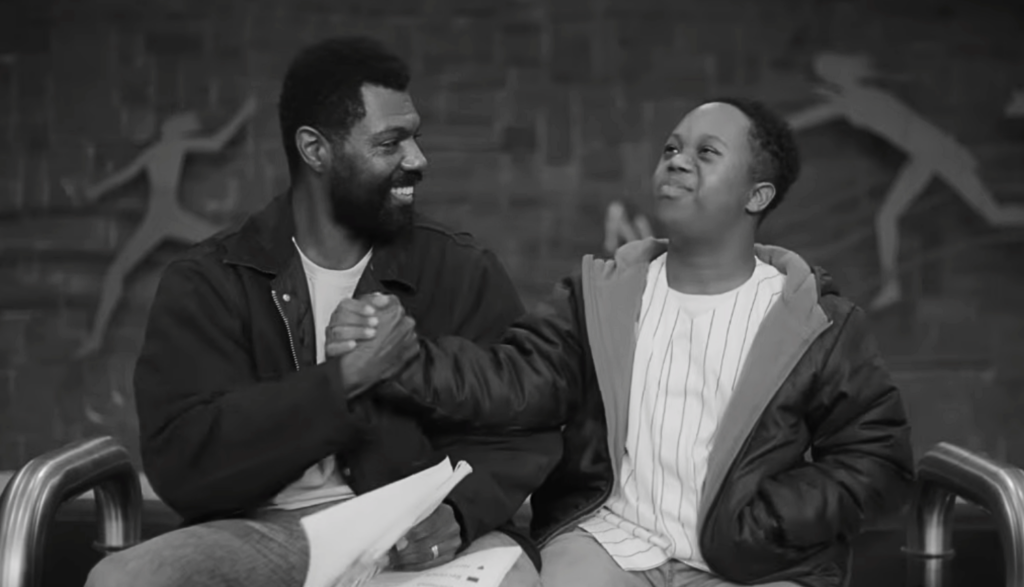
After the accidental death of his loving wife, a newly single dad must figure out how to navigate the challenges of caring for his son, who has Down syndrome. There are a number of quiet, thoughtful moments that consider the concepts of loss, grief and loving patience in this well-crafted and well-acted film. The only drawback is some off-color language that bleeds in around the edges.
Mason is 11 years old. But he acts and appears to be much younger because he has Down syndrome.
Even though Mason’s genetic condition can be a struggle, his dad, Lucky, kinda counts it as a blessing right about now. For Mason doesn’t fully understand death. Mason knows that his mom, Tammy, isn’t around any longer, but he hasn’t put all the pieces together about her disappearance.
Lucky, however, understands his wife’s death all too well. The widower wrestles with the car accident that instantly snatched this loving, beautiful woman out of their lives. And he feels her absence. Every. Single. Day.
Life, however, must go on. And one thing that Lucky understands is that for all of the grief and insecurity he’s feeling, for all the many ways he wishes that things could just change, Mason needs consistency. He needs Lucky to maintain routines as best as possible.
Sometimes that means walking Mason through prayers before dinner or bedtime. Other times that means helping the boy to dress on his own or clean his room. Sometimes Lucky needs to make sure that Mason is learning how to read. For instance, Mason has a pretty solid grasp on simple words such as “dog” or “car,” but multi-syllable words are tougher:
“Puh-ur-ple. Say it with me Mason. What’s the ‘P’ sound?”
As Mason struggles on, Lucky contemplates the bond he has with his son, their efforts together. It’s both affirming and, frankly, exhausting. But he needs to push forward. He needs to purchase another used car. He needs to get a new, more flexible job. He needs to get Mason, and himself, out of the house.
Hey, this is about resistance. Survival. It’s one step at a time. Maybe Lucky can take Mason to his first Atlanta Braves baseball game. They’ll be able to do that, won’t they?
“OK, what’s this color again?” Lucky asks his son.
“Puh-ur-ple,” Mason replies. “Puhurple.”
“Good job!” Lucky cheers. “Now you’re getting it.”
Yeah, a Braves game sounds good. What could go wrong besides, well, everything?

Lucky’s love for his son is palpably evident throughout the film. Things get tense; they get difficult. But Lucky always tries to do his best with and for his son. Sometimes that means Lucky must rein in his anger and find a new way to navigate their path together. But each small teaching moment or shared victory is a celebration. Lucky hugs his son and expresses his love. Others in Mason’s orbit take time to quietly encourage the boy as well.
In turn, Mason is positive and loving. Sometime he stands stubbornly, pushing back against a parental demand. But generally, the boy strives to make his dad happy and proud.
Lucky fondly remembers brief moments of his smiling, loving wife working and laughing with Mason.
At one point in the film, Lucky takes his son’s hand and declares that they need to run hard if they’re going to get where they need to go. “We’re gonna keep running. We’re not looking back,” Lucky says. And the film gives that statement symbolic significance.
Lucky and Mason pray together on several occasions before meals and bedtime. The prayers always include the sentence, “We love You, we honor You, and we thank You.”
While walking, Lucky and Mason pass a large sign for the Interdenominational True Church of Christ. During an outdoor funeral, a gathered group of friends share fond memories and prayers for a deceased loved one. They release balloons into the sky as a symbol of sending well-wishes heavenward.
None.
Lucky and his son go to a junkyard to pull Tammy’s belongings out of the trunk and glovebox of her wrecked car. (We don’t see the accident, but it’s implied that it was pretty bad.)
While traveling to a ballgame on a train, Lucky briefly drifts off. He wakes to see Mason on the platform, following a guy selling balloons. Lucky panics as the train pulls away, leaving Mason behind. After getting to the next station and rushing back, Lucky runs about, worrying over all the possible harm that could be done to his innocent child. Fortunately, Mason gets found by railway authorities and is unharmed.
One of the film’s only content issues is its inclusion of foul language in the course of two or three scenes. That dialogue holds five f-words and half a dozen s-words, along with a couple uses each of the words “h—,” “a–” and “d–n.”
None.
Lucky buys an old beater of a car from a guy who essentially rips him off. Soon after, the vehicle breaks down. Grief threatens to incapacitate Lucky at one point. (But he pushes through his sorrow for his son’s sake.)
Color Book isn’t large, flashy or loud. Rather, this movie is small, slowly paced and hushed.
Director David Fortune examines the piffling little things of life—the annoyances and small agonies that happen amidst our daily shades of gray. And to that end, he’s crafted this film in a beautiful black and white: a monochrome aesthetic that may instantly turn some viewers away.
However, it’s those blacks, whites and shades of gray that perfectly frame Color Book’s allure—its poise, its point. For it’s those slow, gray things, the movie tells us, that we should be paying attention to. We should relish and appreciate the mundane, wonderful moments around us while we can, no matter how difficult they seem to be.
There’s a key scene in this movie where Lucky, played brilliantly by William Catlett, is exhausted after a day that’s gone all wrong. Everything that he tried to do for his son, Mason, failed miserably. But then he notices Mason’s art book that the boy has been consistently coloring in all day long. And each part of the day that Lucky bemoaned has been rendered as a crayon-colored snapshot.
To Mason the day was an adventure. Something to be remembered in his art, not just endured. That’s the kind of story pigment that draws us in Color Book. This is a film about grief, failure, effort, prayer and patient love. And it’s quietly wonderful.
The only drawback here is the fact that this film also lets some off-color language bleed in around its edges. And that will, unfortunately, have to be endured if you want to see the otherwise compelling image at this movie’s core.
After spending more than two decades touring, directing, writing and producing for Christian theater and radio (most recently for Adventures in Odyssey, which he still contributes to), Bob joined the Plugged In staff to help us focus more heavily on video games. He is also one of our primary movie reviewers.