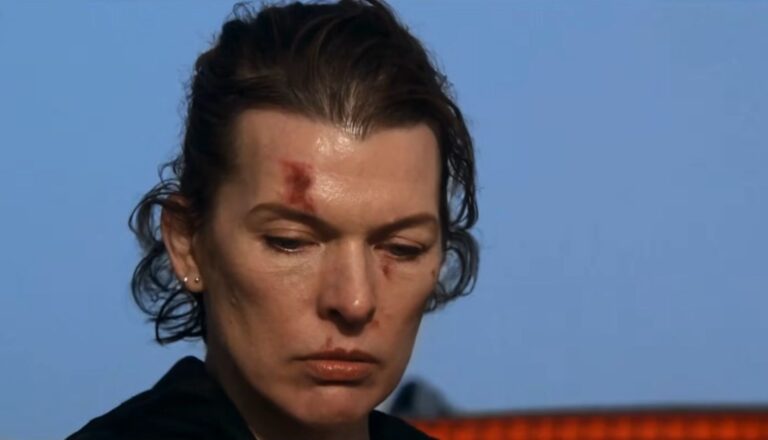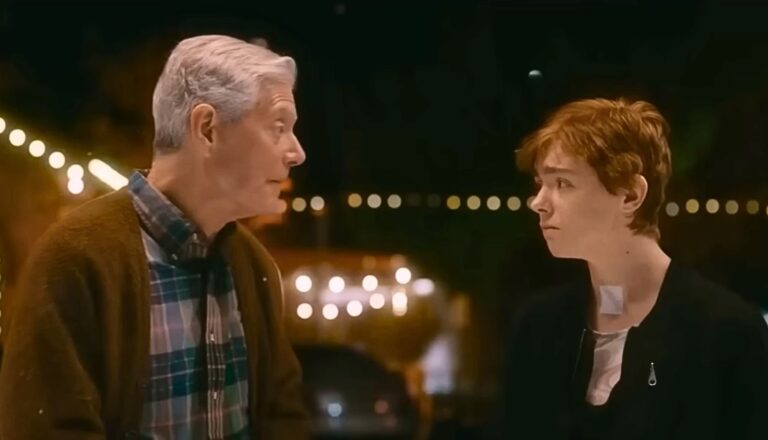



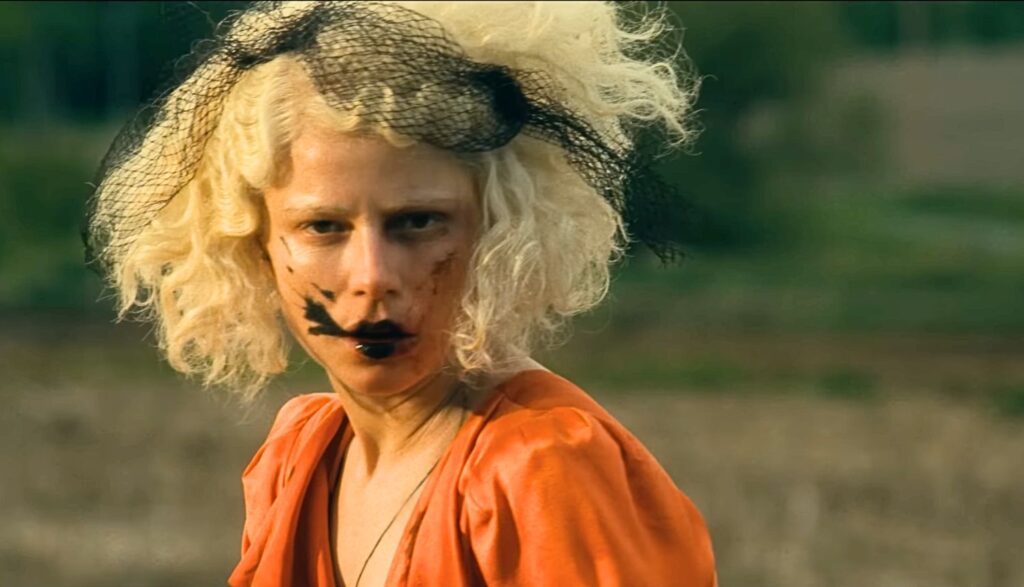
Mary Shelley’s classic monster tale is reimagined in 1930s Chicago as Frankenstein’s monster and his bride go on a murder spree. Jessie Buckley grabs attention with her take on the mentally disturbed Bride. But there’s little else worth noting here except for the messy gore, foul profanity, heavy drinking and randy sensuality.
Imagine, if you will, that the spirit of the much-admired writer, Mary Shelley, was still existing in the nebulous ether around us. And imagine further that she had one more monstrous story to tell, one last tale to tear free from her mind as you would a bothersome tumor.
It might look like this:
There is a woman in 1930s Chicago. Her name is Ida. And Ida has loose connections (as some gin-soaked clubgoers in the 1930s did) to the mob. Unfortunately for Ida, her mob ties and clubgoing ways soon lead to a fall down a steep flight of very hard stairs. Several crushed and snapped bones later, Ida is dead.
Meanwhile, a man called Frank—who sports a very peculiar, misshapen and roughly stitched-together physique—arrives in Chicago in search of Dr. Euphronius. She’s an author and scientist who has openly dabbled in the study of reanimating the dead.
It just so happens that Frank himself was once created from bits and pieces of dead human flesh. And he’s been walking the world for over a century now. Dr. Euphronius quickly sees the truth of that and wants to study the man. But what Frank wants is something completely different: He wants a companion. He wants someone who won’t run from his thick-stitched visage in horror.
Dr. Euphronius agrees, but she balks at the idea of piecing a creation together. Why not just reanimate a whole body? So she and Frank dig up a freshly buried woman—an unfortunate victim of a fall—and after some goopy liquid injections and massive electrical shocks, the “Bride” is … aliiive!!!
Of course, these are the 1930s, and the Bride isn’t keen on being called someone’s bride. Nor a mate, soul mate, fool’s mate, running mate, machinist’s mate, cellmate or sparring partner. (The Bride has a tendency to mentally run off in unexpected directions.) She will be her own. She’s no clone crone who’s flown home like a groaning Joan. No!
However, since she isn’t sure of her real name (Penelope sounds nice, pretty Penny?) or where she lives, she will go with Frank. Can they go get a drink, maybe watch a flicker?
Frank is, of course, ecstatic. Not only will he no longer be lonely, but he loves movies—especially those featuring the dancing and singing Ronnie Reed. If Frank could be anyone, he would be that handsome and light-on-his-feet marquee idol.
So this patchwork quilt of a couple sets off together. And Mary Shelley’s tumorous tale begins in earnest.
We see that Frank very much wants to turn from his “Frankenstein’s monster” past and enjoy life as peaceably as possible. He loves the idea of living with his new companion in a love-focused movie musical. The Bride is much more self-focused, but with time, she grows to care for Frank and even protects him with her own life.
A police detective named Jake Wiles gets assigned to a murder case involving Frank and the Bride. We find out that he knew the Bride back when she was Ida, and he attempts to protect her. Jake and his detective partner, Myrna Mallow, go out of their way to understand the plight of the Bride and Frank.
As the spirit essence of Mary Shelley narrates the beginning of The Bride, she’s in a parallel nether dimension of sorts. And Shelley also appears to spiritually possess Ida, causing a sudden split-personality attack that causes the woman to physically spasm and yell at people around her.
Mary Shelley proclaims, “Resistance to tyranny is obedience to God.”
Early on, Frank tells Dr. Euphronius, “There is a whole garden of pleasures that I have not yet had the honor of enjoying.” “Is this about sex?’ the doctor asks him. “Doctor, this is about loneliness,” Frank earnestly replies.
For the Bride’s part, though, it’s obvious that she wants unbound freedom to enjoy life and its lusty passions. That’s in evidence when she pulls Frank into a party with raucous couples who are dancing wildly, making out lustfully and writhing up against one another (many of them same-sex couples). The Bride jumps into their midst, letting people around her grope and touch her body. Frank sits to the side, drinking and admiring her voluptuous actions.
However, as Frank and the Bride leave, several men follow them out of the party wanting to have sex with the Bride in the alley. And we see this same sort of lustful reaction to the Bride repeated in other settings, including a traffic stop where a policeman physically molests her, rubbing himself against her backside. While at the movies with Frank, the Bride observers a nearby couple making out and caressing one another.
The Bride and Frank have a couple of sexual interactions. In one case, she kneels and tries to pleasure him orally before he stops her. In another interaction we see them both naked but in extreme closeup, the camera examining parts of their bodies as they make love. (We see a closeup view of the Bride’s breast.)
The Bride’s dress is often torn open at the neckline, revealing her bra. Frank strips down to his undershorts to retrieve coins out of a fountain. People make comments about the size different people’s sexual anatomy. The Bride occasionally unleashes firehose-like gushes of linked-together words and phrases, and she sometimes adds in crude sexual comments aimed at people near her.
Early on, Ida gets punched and manhandled by a pair of men. They slam her into walls and then push her down a staircase—the camera looks on in slow motion as various bones break, limbs twist and her neck snaps. Dr. Euphronius examines Frank’s bare upper torso, which is covered in stitches and open wounds. Frank bleeds profusely after getting shot on various occasions.
When men attack the Bride, Frank smashes one attacker repeatedly into a brick wall, gushing the man’s blood. He then pounds a second assailant to the curb where he crushes the man’s skull to mush. Meanwhile, the Bride pushes a man from a moving train, and he thumps his head on the train’s tracks. Another attacker she wrestles to the ground before biting out his tongue. A sizeable number of people, including a handful of cops, are threatened and then shot in the chest, abdomen and legs. Two different individuals get shot in the head, spattering brain matter.
A woman gets cornered and riddled with gunfire; she flails about from the large number of bullets striking her. Groups of women in the country are reportedly inspired by the Bride and her look when her deadly story gets released in local papers. They begin dressing up like her and joining public protests. We see these cosplaying women ganging up on a local mob boss and choking him with his own tie.
In a dream sequence, we see the Bride’s head in a jar as she talks with Mary Shelley. Elsewhere, when a guy starts getting physically aggressive with his date, the Bride stops him. A huge chandelier crashes down on a table. Someone demands that a woman’s tongue get cut out and added to his large collection of offending human tongues. (We see the ripped-out organs in jars on a shelf.)
The film’s dialogue is peppered with 30 f-words and a couple of s-words, along with multiple uses of “d–mit” and the c-word. There are crude references to breasts. And Jesus’ and God’s names are misused a total of five times.
People drink wine, champagne and other alcoholic beverages at clubs and a party. Some individuals appear quite inebriated. People smoke cigarettes throughout.
Jake Wiles and Myrna Mallow both make emotional choices that don’t line up with the law. The Bride/Ida vomits several times onscreen (once on a man’s chest). Early on, Ida has a spasming, split-personality mental attack, causing bystanders to physically restrain her. Those same mental breeches carry over into Ida’s new existence as the Bride.
Before watching Maggie Gyllenhaal’s new film, I had seen The Bride! described as a Bonnie and Clyde-like romance, only with monsters. And Gyllenhaal herself has referred to it in interviews as a feminist reimagining of the Frankenstein story.
While those characterizations both loosely fit—in the same way a stitched-together skin suit might hang over the outfit you’re currently wearing—they’re not exactly representative of the non-beating heart of this creature feature.
I mean, yes, there are lots of Mary Shelley name-drops here. We see gnarled flesh and bloody stitches aplenty. And the enlivened Bride verbigerates insanely while shaking a fist and proclaiming that she’ll tell her story her way!
However, those are all just pieces of this malformed creation. They’re fleshy slices sutured together without ever really making a dramatically satisfying whole. And every piece of it—every famous actor in the cast, every roughhewn stitch, every confused idea, every Frankenstein-monster wail of longing—is overshadowed by actress Jessie Buckley and her Bride character.
Buckley’s Bride is anarchy untethered by restraint. She’s phosphorescent chaos that draws all eyes. But dramatic wildfire doesn’t make a good film all on its own—nor does it give that film a reason for being. In this case, it just grabs attention while the two-hour-long movie splashes viewers with gory, crushed-skull murder, intense profanity and scenes of randy fondling.
If you want a good monster movie, let me suggest you turn instead to the classic Bride of Frankenstein. You might even find a thoughtful message or two to howl over.

After spending more than two decades touring, directing, writing and producing for Christian theater and radio (most recently for Adventures in Odyssey, which he still contributes to), Bob joined the Plugged In staff to help us focus more heavily on video games. He is also one of our primary movie reviewers.