

In Beyond Belief, a young would-be rock star begins hearing God speaking to him—quite literally. If he follows God’s call, it could mean upending his entire life … or saving it. This Christian movie, bolstered by the music from Petra, offers some strong messages and very, very few content concerns.
Run.
Andy Ellis heard the word plain as day. He was just minding his own business, playing a video game, when boom! Run.
If Andy was the protagonist of a Stephen King-esque horror movie, he’d know just what to do: He’d need to drop his controller and sprint out of the house as quickly as his legs could carry him.
But Andy’s not in a horror flick. He’s just an aspiring, Petra-loving rock star growing up and living life in a small late-1980s town. He’s a Christian, too—even if his faith has taken a few body blows.
Andy’s dad, Martin, died two years ago. A pastor, Patrick Ellis had been trying to help a drunken friend when he saw a car barreling down the road. Patrick saved his friend but couldn’t save himself. And why didn’t God save them both? Andy struggles to find the answer.
That struggle grows worse each day. The church Martin led is dying. Andy’s mom, Sarah, struggles to pay the family’s bills. Andy’s uncle, a real-estate mogul named Leo, offers economic salvation—but only if Sarah sells the church property to him. Sarah doesn’t want to. But as the “final notice” envelops stack up on the kitchen table, she may not have a choice.
Andy sees one other option.
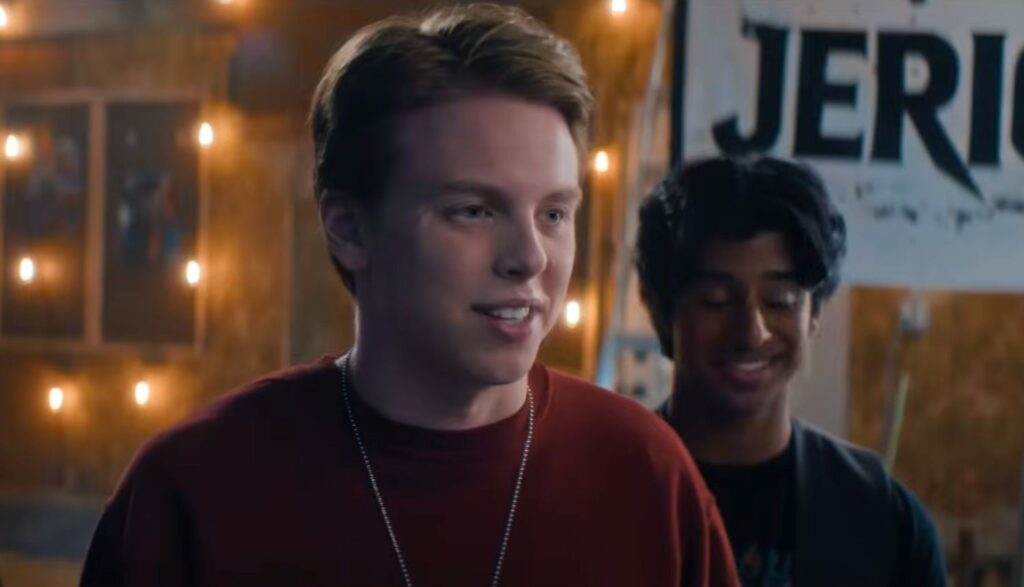
Petra—yes, that’s right, Andy’s very favorite rock band—is hosting a contest for the area’s fledgling Christian acts. The winner gets a record deal and a chance to open for the band on their next world tour. If Andy’s band, Jericho, managed to win, his financial problems would be over.
But now a weird voice is telling him to “run”? What does that mean, anyway? Run for office? Run away to Acapulco? That there’ll be a run on the local bank?
Or could the voice be telling Andy to literally run? Like, sign up and train for the local marathon?
Turns out, that’s exactly what the voice—God—is telling Andy to do. And perhaps that’s because running can be a great transformational catalyst.
When Andy turns to his grandfather, Jake, for help training, Jake initially waves him away. Running takes discipline, he says. “Discipline is like a carburetor,” Jake tells him. “If someone doesn’t have it, nothing works.” But when Andy tells him about the voice, Jake changes his tune: Perhaps this is God’s way of giving Andy the discipline he needs.
So Andy’s training regimen begins. Jake forces some unorthodox methods on Andy—but all with a primary and secondary purpose. One exercise might strengthen Andy’s balance, for instance, but secondarily improve his confidence.
“A marathon is not about speed,” Jake tells Andy. It’s about rhythm. It’s about integrating mind, body and soul in a singular direction for a common goal.” And when you think about it, that’s how success, however you define it, is often achieved.
Andy clashes with the rest of Jericho at times regarding Andy’s penchant for long, me-first guitar solos. “You don’t take the music seriously, OK?” says Phillip, Andy’s bandmate and the band’s de facto manager. “We’re never going to make it to the next level until you do.” But eventually, the two come to a better understanding: Phillip realizes that Andy’s guitar skills are a feature, not a bug, but Andy understands that his gifts need to be used to serve the band, not himself.
Sarah’s a loving, caring mom in spite of the stresses she faces. Jake’s a strict but loving taskmaster, forcing Andy to push himself for his own good. And even Martin, though two years gone, offers moral guidance and support through his recorded sermons.
A couple of other characters experience a radical transformation through a miraculous act.
[Spoiler warning] We learn that Martin’s seemingly senseless death had more meaning than Andy could’ve imagined. Ronnie, the man who Martin saved, had a massive drinking problem. But after the tragedy, Ronnie turned his life around. He turned away from booze and turned back to his family—even fathering another daughter. When Andy later meets Ronnie’s daughter (named Hope, perhaps not so coincidentally), she thanks Andy for Martin’s act of selflessness. “Your dad’s sacrifice changed my whole life,” Hope tells Andy.
In a flashback, we see Martin preaching to his congregation, using John 10:27 as a springboard for the greater message (and one that we read onscreen as the movie closes). “My sheep hear my voice,” the passage reads, “and I know them and they follow me.”
“Will you listen to His voice when He calls?” Martin asks his own flock. “Will you follow Him, no matter the cost?”
Beyond Belief is really about heeding God’s voice—a voice that we’re told can take many different forms: His Word. His creation. And in even more unexpected ways. “Your dad believed that God was speaking to us,” Jake tells Andy. “Through friends, trials, joy … and sometimes directly, as He’s speaking to you right now.”
The film acknowledges that following that voice can be challenging. In an opening narration, we’re told, “We all want to hear God’s voice. Until we do, and He asks us to do something impossible.” Andy is initially puzzled with how to follow that voice (or whether to follow it at all), but he sees other signs that point to the word “run” being a bona fide word from God. And once Andy’s convinced of that fact, he tries to follow that word as best as he can. He does so even though he harbors a lot of questions and a deep resentment over the fate of his father. But still, he follows. And in so doing, he becomes the catalyst for a couple of apparent miracles that save lives.
Throughout Andy’s training, Jake forces Andy to read the Bible. “After every training session, I want you to crack the Bible [to] Second Timothy,” Jake says. “I want you to read it slow and deliberate.” It’s no accident: The book grapples with the reality of suffering and death—trials that Andy is walking through.
There’s a moment that seems to wink at Acts 16:25-34, when a jail cell door miraculously opens. (The explanation here is more prosaic, but no less miraculous.) Other miracles appear to take place.
Andy’s uncle Leo desperately wants to buy the church property from Sarah for a sprawling development. The town’s mayor asks, “Does it bother you that it’s a house of worship?” The answer is not even a little.
The villains in Beyond Belief often have some sort of flame motif going on in the background, be it a guitar pick or a neon sign or an operational fireplace. All these, it would seem, would be the moviemakers’ efforts to show an infernal influence in those characters’ lives.
We hear snippets of several of Martin’s messages. We hear Petra songs—all of which talk about God and faith—throughout the film. Jericho and other bands also play Christian music. We hear references to several biblical figures, including Noah and Abraham. Characters pray to, talk about and sometimes shout at God.
If you were being wildly picky, you could say that some stage outfits hug the wearers’ bodies a bit.
Andy gets into a very brief fight with another guy: Andy gets punched in the stomach and his guitar and amp are both smashed.
As mentioned, a car hit and killed Martin two years earlier. We see the moments leading up to the tragedy—including Martin urgently shoving another man out of the way—but not the blow itself. Later, two more people are nearly killed by an onrushing car.
Someone nearly dies from a heart attack. Andy suffers some pain and exhaustion while running and training.
One of the bands competing for a record contract plays a song called “Heaven Yes, Hell No”, obviously a wink to a more profane usage of the word “hell.” (We hear the lyric repeated several times.)
Martin gets a call at home asking him to pick up his friend Ronnie from a bar. Once Martin gets there, he can see that Ronnie is drunk (after, it can be presumed, a long period of sobriety). “I’m having a bad day,” Ronnie says, and does his best to rebuff Martin’s efforts to help. Martin refuses to be dissuaded. And when Ronnie staggers onto a country road—one where a vehicle is currently barreling down—Martin pushes him out of the way.
Ronnie’s daughter later says that Martin “was my dad’s best friend. Alcohol was his worst enemy.”
Leo drinks what seems to be a glass of whiskey, though the beverage is never actually specified.
Leo is a ruthless and, at times, underhanded businessman. When Leo’s own selfish plans are threatened, he’s very happy to pull strings or achieve his ends through devious means.
He can be positively gleeful when he rips away properties from their longtime owners. For instance, a couple apparently sold their home to Leo, perhaps with the understanding that they could continue to live in the house as renters. But Leo wants to demolish the home, and when the couple protests, Leo tells them, “I bought your property. I now own your property. Now get off my property.”
He seems to have trained his son, Nathan, well along those lines. Nathan, whose own band is competing in Petra’s battle of the bands, has no issue cheating to win—and he attempts to destroy Jericho’s own hopes through treachery.
But Andy—who can fume against God and circumstances all he wants—makes a mistake, too. After his guitar gets smashed, Andy goes into a music store (owned by Leo) and tries to bargain for another on credit. The clerk says no, but then he leaves the storefront. Andy takes the guitar and leaves about $20 on the counter, writing an IOU for the balance of $150. This leads to some run-ins with the law and a stern talking-to from his mother, Sarah. “Your dad would be so disappointed,” she tells Andy. (He later apologizes.)
The word melodrama gets a bad rap.
You know a melodrama when you see it: Just think of a mustache-twirling bad guy tying a fair maiden to a set of railroad tracks just before the hero inevitably rides in to save the day. Melodramas feature unmistakable evildoers, clear moral messages and elevated emotionalism to work their magic.
No, melodramas are not subtle. But when you have a clear point to make—and many a faith-based movie has a definite moral to impart on its audience—they can be quite effective.
Beyond Belief is a melodrama with a simple story, heightened emotionalism, unabashed villainy and a clear, beautiful message at its core. Listen to what God might be telling you. Even if it’s strange. Even if it’s hard. Listen.
Anchored by the music of Petra and showcasing the musical talents of singer/guitar player Carson Lueders (who plays Andy), Beyond Belief embraces that message with gusto. It features some nice performances and strong moments. And it adds a bit of nuance to its melodramatic core: Andy’s no unalloyed hero, shaken as he is by doubt and anger. The movie’s bad guys might find redemption, rather than melodramatic comeuppance. And Beyond Belief certainly doesn’t turn a blind eye to the suffering that we can all encounter in this fallen world of ours.
And, as a guy who’s run a few marathons in my time, I resonated with the movie’s “running” theme, too. Distance running is, like life, filled with a lot of aches and pains. But it’ll certainly teach you a few things about how to navigate them, too—and build all that discipline that Grandpa Jake says it will.
Beyond Belief does not reset the Christian movie bar. This film is a solid effort, but it leans into its message at the expense of its art. And that’s just fine. For those who walk in for a nostalgic, musical return to the late 1980s and want to walk out with their faith bolstered and encouraged, Beyond Belief does its job well.

Paul Asay has been part of the Plugged In staff since 2007, watching and reviewing roughly 15 quintillion movies and television shows. He’s written for a number of other publications, too, including Time, The Washington Post and Christianity Today. The author of several books, Paul loves to find spirituality in unexpected places, including popular entertainment, and he loves all things superhero. His vices include James Bond films, Mountain Dew and terrible B-grade movies. He’s married, has two children and a neurotic dog, runs marathons on occasion and hopes to someday own his own tuxedo. Feel free to follow him on Twitter @AsayPaul.