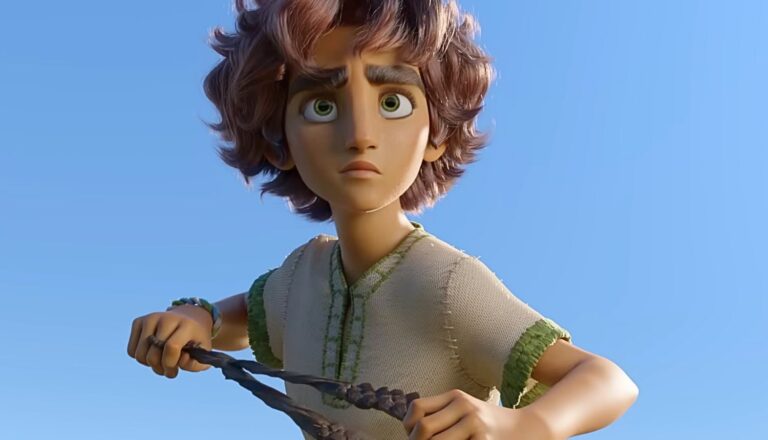



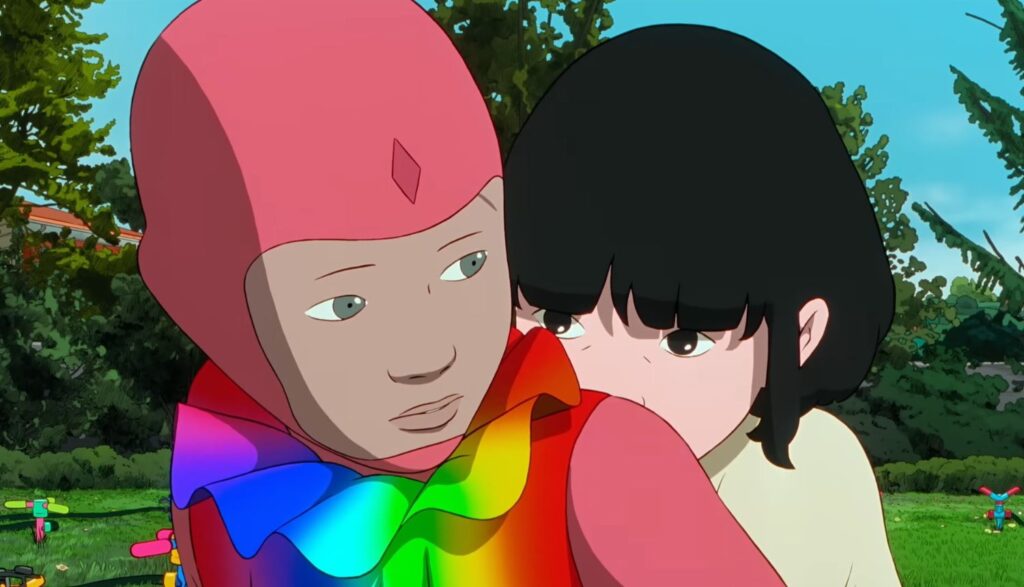
Arco, a rainbow-suited boy from the future, accidentally travels back in time to the year 2075, where he meets a girl named Iris. The film is a sweet and beautifully animated fantasy story that touches on climate change and the effects of technology. Though there’s some perilous moments, Arco should be pretty navigable for most families.
Arco wants to time-travel.
But he can’t—at least, not yet. You’re too young, his family tells him. You’ll have to wait. Every time his sister and parents don their rainbow robes and light-refracting crystals to soar through time, Arco is left behind to tend to their home, awaiting their return and stories of adventure.
Arco is tired of waiting. He wants to have his own adventures through time. He wants to see the dinosaurs.
So, he takes his sister’s rainbow cloak and special crystal and sets out in secret, launching from one of the many elevated platforms in the sky that humanity calls home.
Iris wants things to change.
When she’s not at school, she spends her days with her baby brother, Peter, and their robot caretaker, Mikki. Her parents work in a city far away—most of the time, she only gets to see them in hologram form.
Iris’ world is not doing well, either. Its deteriorating climate often forces humans to retreat into the protective bubbles that safeguard their homes.
Then, one day, Iris witnesses a brilliant rainbow streaking towards earth. Following the colorful and haphazard trail, she finds an unconscious boy about her age wearing a strange rainbow robe.
Arco.
He didn’t get to see the dinosaurs. In fact, the whole time-travel thing was a lot harder than he expected. He only made it back as far back as … 2075. That’s the distant past for Arco but the present for Iris.
Arco needs to get back home to his family, to his time. Iris agrees to help him.
Little do they know, their adventure will not only impact them but also greatly influence the world to come.
Iris is a compassionate young girl. When she finds an injured Arco in the woods, she doesn’t hesitate to get him the help that he needs. With Mikki’s help, she cares for her infant brother while her parents are away. And she commits herself to helping Arco return to his own time, even putting herself in danger to do so.
Arco is gentle and kind, showing care for people and animals. While the rest of his family is away traveling through time, he tends to the creatures left in his care. And although he disobeys his parents by taking his own time-traveling journey, he realizes that this was a mistake; he longs to return to his family.
Mikki, a caretaker robot, dutifully protects Iris, Peter and Arco. In the absence of Iris’ parents, it performs all the functions they would have done, including preparing meals, arranging medical appointments and playing with the children. The robot patches up Arco after he gets hurt. Though Mikki is a machine, it seems to have formed an emotional bond with the children.
Iris’ parents try to be present for their children while they are far away and working long hours, even if it’s only through virtual means. Still, the film emphasizes that the kids (especially Iris) need their parents to be physically present and engaged, and fortunately, the movie hints that things eventually trend in that positive direction.
Arco has a loving family that searches tirelessly for him after he gets lost in time. Characters make sacrifices for one another.
Iris asks Mikki if it thinks wishes can come true like in fairy tales. The robot replies, “What’s to stop you from trying?” Iris makes a wish and it seems to come true, though there is no implication that there’s any magic behind it.
A robot teacher tells a class of children that the universe is 13.8 billion years old and refers to the Big Bang. Futuristic classrooms contain simulations of past events and locations, and one such classroom shows dinosaurs roaming a prehistoric landscape.
Time travel isn’t explained in great detail, but the rainbow robes and light-refracting crystals donned by Arco and his family certainly must carry some magical or scientific properties. After Iris sees Arco fall from the sky, she speculates that he might be a “wizard or angel.” Another person asks Arco if he’s an alien or hails from the mythical city of Atlantis.
Arco and Iris share an innocent childhood crush. Iris gives Arco a quick kiss on the cheek at one point, and they hug.
An adult asks a child if he is “a little bit in love” with Iris. The adult says that he once loved a girl but never had the courage to admit his feelings. The man later opines that if you love someone, the “most important thing is making them happy.”
We see Arco’s parents sleeping side by side while hovering in a futuristic bed.
While not presented in a sexual way, there are a few moments that might give parents pause in Arco. One scene shows Iris playing in the bath with her baby brother, and her bare, undeveloped chest is visible. On a few occasions, Arco—having no other clothes of his own besides a conspicuous rainbow cloak—wears some of Iris’ clothes, including a dress.
Arco’s first attempt at flight stalls—for several tense moments, he plummets toward the ground, panicking, until he regains control. His landing doesn’t go so well, either. He crashes, receiving a gash on his forehead that leaks blood down the side of his face.
Earth’s environment seems to be in trouble: Violent storms cause massive damage. Children find themselves imperiled by a raging fire.
A trio of bumbling characters engage in a high-speed chase with the police and, ultimately, roll their van down a hill. The vehicle is ruined but the passengers are fine—it’s largely played for comedic effect.
Arco and Iris put themselves in some dangerous situations throughout the film. In one instance, Arco attempts to fly by jumping off the roof of Iris’ house. (While they’ve prepared a pillowed landing for him, it wouldn’t be something that viewers would want their kids to try for themselves.)
Iris flinches while watching Mikki stitch a wound, but the robot’s handiwork is not shown. Someone knocks a security guard unconscious with a sign. Characters fight a swarm of robots. A tree falls on a robot, causing it to power down and “die.”
Noticing that her parents aren’t around, Arco asks Iris if they died. (She tells him no, they just work a lot.) Arco says that his parents are going to “kill him” for traveling through time against their wishes. Another person talks about being “worried to death.”
Arco contains no profanity and only a handful of mild exclamations like “shoot” and “holy smokes.”
In one scene, Arco tries to teach Iris to talk in the language of birds. When Iris tries to repeat a sound, Arco laughs and tells her that she accidentally said something “not very nice” and “too gross” to repeat.
Someone references a wager, saying they’re owed a “bottle of champagne.”
Arco’s adventure starts with him disobeying his parents and stealing his sister’s rainbow robe and crystal.
Iris’ parents work long hours, only coming home to see their children in person on weekends. (And sometimes, they are too busy to do that.) Iris feels abandoned and gets angry at her parents for their absence.
Arco says that in his time (the future for Iris), the oceans have risen drastically, and humanity lives on elevated platforms in the sky to “let the Earth rest.”
Humanity seems to have developed an overreliance on robots during Iris’ time. Conversely, in the time which Arco lives, there are no robots to be seen—though some technology is still present—and humans appear to have a closer relationship with nature. (Arco can talk to birds and doesn’t consider it an unusual skill.)
When asking about the future, Iris wonders if the ice caps have melted. Arco tells her his home makes its own energy.
Mikki’s robotic voice is a synthetic blend of Iris’ mother and father. Iris lies to hide Arco’s presence. Someone mentions a “collective hallucination.”
If you didn’t know better, you might think that Arco was the latest effort from the acclaimed Japanese animation house, Studio Ghibli. It has all the hallmarks of a Hayao Miyazaki-helmed feature.
Appealing animation? Check. Precocious children in a coming-of-age story? Check. Topical depth with a gentle delivery? Check. Lingering shots of lushly drawn nature? You betcha.
Even the occasional piano notes played over the film bring to mind some of Joe Hisaishi’s Ghibli scores.
But Arco isn’t a Japanese production, it’s French. And not for nothing, it recently nabbed an Oscar nomination for Best Animated Feature.
Still, all of that doesn’t answer the question you might be asking: Is Arco any good? And is this PG-flick truly safe for families?
Arco is a well-crafted animated film with a lot of heart. It’s clean, too—there’s no profanity or sensual content here. And while there is some peril, Arco avoids any serious violence. (Save for one non-human “death” that may bother younger, more sensitive viewers.)
However, there are some moments that might give parents pause. While not distractingly blatant, the film’s focus on climate change and humanity’s relationship with nature will be hard to miss. (These aren’t necessarily bad things. God does call us to be responsible stewards of the Earth. But Arco doesn’t present these topics from a biblical point of view.) We hear about the Big Bang and an “old universe.” And scenes where Arco wears Iris’ clothing might strike some viewers as odd.
Many families will consider these potential issues as fairly navigable bumps in an otherwise sweet fantasy story. But others may decide to tell their kids the same thing Arco’s parents told him when he wanted to time-travel before he was ready:
You’re too young. You’ll have to wait.

Bret loves a good story—be it a movie, show, or video game—and enjoys geeking out about things like plot and story structure. He has a blast reading and writing fiction and has penned several short stories and screenplays. He and his wife love to kayak the many beautiful Colorado lakes with their dog.