Game Review
There’s been quite a bit of buzz in the gaming community about a new video game called Esoteric Ebb. This title is classified as a CRPG (computer role-playing game), and in this case
that means that it’s a dice-rolling, mystery adventure that focuses on dialogue and narrative—with a bit of baddie-battling tossed in on occasion.
Esoteric Ebb is an interesting construct. Think Dungeons & Dragons with a lot of political and social conversations woven through its dialogue. However, despite this game’s colorful, hand-painted appearance, farcical encounters and thoughtful play, there are problematic things here, too.
You play as a cleric named Ragn in the medieval fantasy town of Norvik. The cleric is a somewhat bumbling government investigator with a few magical abilities who wakes up in a morgue with amnesia after getting pulled from the local river. (It’s implied that Ragn had drowned but was brought back to life.) And now Ragn must piece together what his job was—and carry it out quickly.
Toward that pursuit, players start by building their helmeted protagonist with chosen proficiencies in the various categories of Strength, Dexterity, Constitution, Intelligence, Wisdom and Charisma. The numerical stat-distribution in each of those physical and mental areas is important, because they will all talk to Ragn as he proceeds forward—much like a gaggle of mini-advisers.
In other words, the abilities you verbally inform the cleric’s choices with their competing motivations and ideologies, and they impact the dice throws that the cleric makes for almost every interaction in the game. More importantly, those abilities (and the game itself) will subtly attempt to shape gamers’ opinions about certain social and political happenings in Norvik (more on that in the Content Concerns section below).
With time, Ragn realizes that he’s in town to investigate a mysterious tea-shop explosion that city officials are trying to sweep under the rug. But that mystery could impact Norvik’s first-ever democratic election that will take place in a few days’ time.
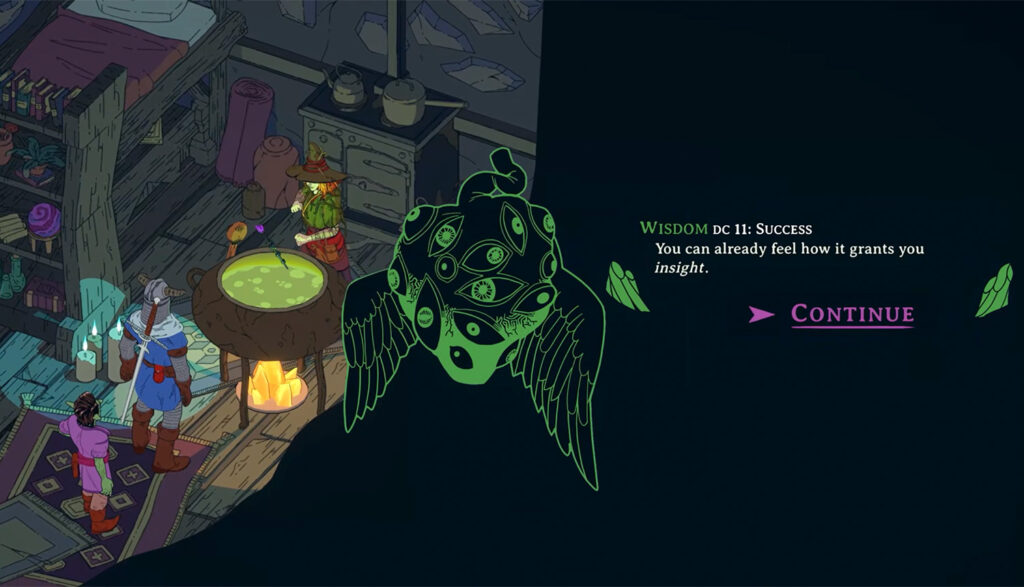
Within that period, gamers take on quests and investigate found clues. They interrogate everyone from a drunken guardian Sphinx to a multi-eyed angel. They flirt with a muscular female orc. They welcome some companions into their adventuring party and take on deadly foes in narration-based battles. And they even engage in thoughtful and sometimes satirical conversations about politics, faith, manhood and the social constructs of gender.
Esoteric Ebb is a single-player CRPG, with no multiplayer features. It can be played offline.
POSITIVE CONTENT
Gamers play as a local official who’s trying to solve a crime and facilitate a free election. (Though players can push his efforts in less-than-upright directions.) The game relies on charm and satire in its written dialogue.
Esoteric Ebb also challenges players to think about the political and social struggles in Norvik and compare them to those of the real world. …
CONTENT CONCERNS
… However, on this political and social front, the game leans in directions that some players may not appreciate.
For instance, the attributes of Strength and Wisdom are always at odds in their expressed opinions. Strength is said to represent the masculine point of view, and Wisdom, the feminine.
Esoteric Ebb makes it very clear that it prefers the empathy of Wisdom over the oppressiveness of Strength. Strength is regularly pooh-poohed for its “masculine” belief in government order and organized religion. It also advises the cleric to use physical force to get what he wants, and it demands he talk down to certain races. In fact, the game declares that “all men are trapped in a cycle of violence since the dawn of time.”
In that light, Esoteric Ebb also leans in favor of “fair” socialist sensibilities over the “rich, competitive and masculine” nationalist focus. And while there’s always some manner of choice in the mix, there’s a clear nod to which political and gender-norm choices the gamemaker believes are “correct.”
Players can die in battles with multi-toothed, sharp-fanged or weapon-swinging foes. It all comes down to a random roll of the dice. (However, the battles are not bloody, since they are all played out in narration.)
While Ragn can kneel and pray at altars and in churches, his “god” is said to have died some 30 years before. And faith is repeatedly questioned for its lack of impact or necessity. The cleric’s prayer is more often focused on learning new offensive and defensive spells to use in battle—blurring the line between religion and magic.
Ragn encounters an angel character who wears a halo made out of eyes. The game also incorporates zombies, a wizard king, hags, orcs, nymphs, shambling skeletons, vengeful vampires, raging werewolves, giants, dragons, a scarf with teeth and an alcoholic sphinx in its character mix. Ragn can invite some of these into his party of adventurers.
During the cleric’s conversations, the language can become rather raw, including uses of the f- and s-words. There are several female characters that Ragn can flirt with or ask out with intimate suggestions, even though he is repeatedly declared to be a celibate cleric.
GAME SUMMARY
Esoteric Ebb is a distinctive and ruminative game that has drawn a lot of attention. But parents should note that this CRPG has some issues that make it far less kid-friendly than it looks.