Game Review
Crimson Desert is a highly anticipated open-world adventure game that’s very difficult to describe in a few words. Adventure fans will make note of this game’s plucked-out inspirations from other open-world titles such as Red Dead Redemption, The Elder Scrolls V: Skyrim and The Legend of Zelda: Tears of the Kingdom.
And if you journey into Crimson Desert’s hundreds of hours of gameplay—with at least 50 hours in the central campaign alone—you’ll note that it’s packed to the brim with concerning content, overflowing with gaming mechanics and gameplay systems, and both impressively ambitious and tediously grinding.
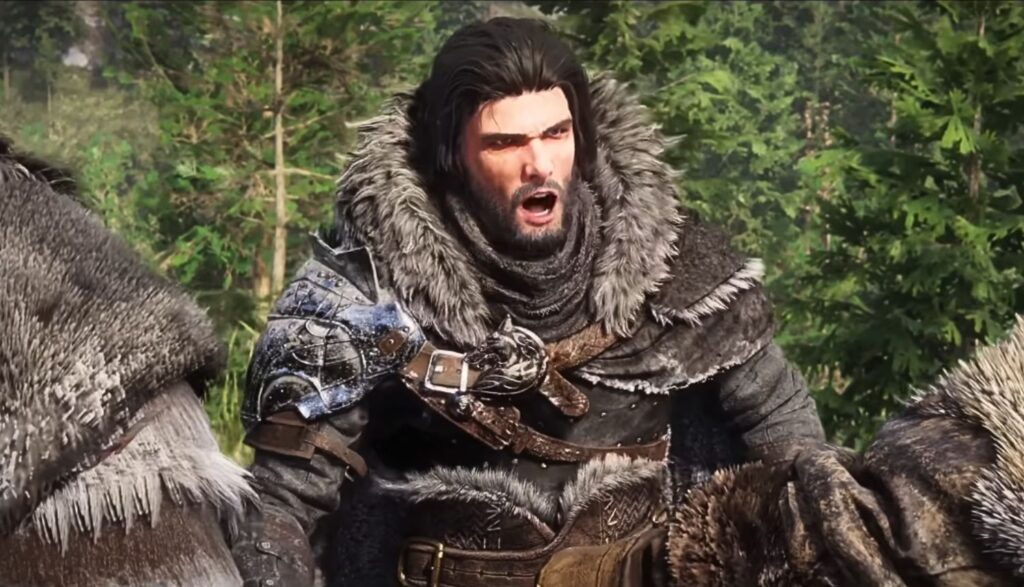
Players gallop into Crimson Desert as Kliff, a member of a company of soldiers called the Greymanes. This self-appointed peacekeeping crew is determined to protect their homeland of Pailune and defend the continent of Pywel—a medieval fantasy land filled with knights, witches, monsters, supernaturally empowered evildoers and dragons.
However, soon after meeting Kliff and his sword-swinging compatriots, we watch them get ambushed by a foul enemy. The Greymanes are scattered. Kliff is killed. But after our protagonist is slashed open and left for dead, he’s revived (otherwise it would be a very short game).
Supernatural beings resurrect Kliff and set him on a path to reassemble and heal his team of Greymanes. He must restore the cosmic balance between his realm and the mystical Abyss, and deliver the world from dark forces.
Players then set off to explore this massive fantasy world. They wander diverse, highly detailed regions ranging from snowy mountains and bustling castle towns to expansive deserts, floating ruins and coastal villages. There are more than 160 main story quests—with environmental puzzles to figure out; bounties to claim; political intrigues to resolve; and many, many battles to fight with sword, shield and magical blasts.
Frankly though, it takes some eight or more hours of play to get a handle on Crimson Desert’s slowly revealed working parts: the base building, mining, horseback riding, bounty hunting, crafting and gearing up side of play.
Eventually Kliff can gain special weapons and a dynamic set of stackable combat skills. He’s given an array of physical attacks and defenses with swords, arrows, guns and shields. He has grapple and teleportation abilities in his arsenal. And he can accent his physical attacks with elemental magic and telekinetic blasts. In fact, there are so many possibilities on that battling front that it’s sometimes difficult to remember all that Kliff can do or which buttons you need to push.
In all of the above areas, Crimson Desert gives you very little instruction or guidance. That can be exhilarating for those who enjoy exploring the enormous domain of Pywel and slowly building their avatar’s abilities in their own unique way.
However, the game’s sheer lack of narrative depth can leave some players feeling a bit emotionally disconnected, too—wandering a vast world of grinding upgrade goals and fetch-and-retrieve quests.
Crimson Desert is a single-player game with no multiplayer options. The game does not require an online connection beyond its initial download and validation.
POSITIVE CONTENT
Kliff and his Greymanes (there are two other Greymanes that gamers can occasionally control) are heroes fighting for the well-being of the world. They save the lives of many and push back against malevolent groups and individuals.
The Abyss is a mysterious realm of floating sky islands. Some of its inhabitants encourage Kliff to use his abilities to help those around him. When he does, he’s often rewarded. In fact, there’s a “contribution” system built into the game that gives gamers points when they pick up side quests to help local NPCs. Those points can be exchanged for special gear, and in turn, they entice players to be positive and helpful more often.
Crimson Desert is a well-defined, exploration-rich, open-world game. And many will simply enjoy the vistas of this title. When standing on elevated areas, it’s possible to see the world of Pywel in beautiful detail.
CONTENT CONCERNS
Despite the heroic actions of its protagonist, Crimson Desert is often a very bloody and foul-mouthed game.
The combat, against scores of bloodthirsty foes or huge creatures, often splashes gore about liberally. Enemies include groups of heavily armed thugs, wolves, huge crabs, rock snakes, giant worms, undead knights, superpowered humans, witches, dragons and robots.
People get hacked, stabbed and shot. The camera catches close-ups of slashed-open throats, vicious rapid-stabbing attacks, bloody axe blows and suicide. In all cases, the gory results splash the ground and scenery. Gamers can attack innocent civilians (though that choice quickly brings in guards who attack the player).
There’s also an interaction with characters who are hooked on a locally made drug. And even though this is a fantasy setting, the game characters regularly scream out obscenities: exclamations of the f-, s- and c-words and uses of other crudities such as “b–tard,” “d–n,” “bloody” and “h—.”
There’s a loosely defined supernatural aspect of this fantasy game. NPC characters often call out to, or pray aloud to, a deity named “Solumen.” And there’s a parish dedicated to this god that hands out specific deity-related quests.
As mentioned, Kliff is resurrected early on in the game by mysterious figures connected to the Abyss, though this supernatural happening is never fully explained. The Abyss is lightly addressed as a supernatural place or dimension that interacts with the mortal world. There are dark ethereal/spirit enemies that come from the Abyss as well. (Kliff acquires special gear through battles with these beings.)
GAME SUMMARY
Crimson Desert is an expansive adventure game that’s almost overpacked with different gaming elements, systems and bizarre scenarios. Some players will love that. Others will find the game to be a grinding, messy and foul-mouthed muddle.