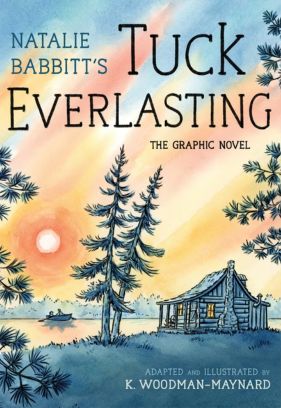
Tuck Everlasting: The Graphic Novel

Credits

Age Range

Publisher

Awards

Year Published

Reviewer

Bob Hoose

Book Review

Ten-year-old Winnie Foster wants to make a difference in the world. Instead, she’s locked away from that world in her wealthy family’s big house. But then she runs into Jesse Tuck in the woods near her home. And her beliefs on important things like living and dying are turned upside down.

Plot Summary

Jesse Tuck, the youngest of the Tuck children, is 104 years old—though he doesn’t look it. In fact, when 10-year-old Winnie Foster spies him lounging next to an ancient tree in the woods near her house, she sees nothing but a strapping, handsome fellow of 17.

And since Winnie rarely gets to meet anyone, she takes the opportunity to hide her presence behind a nearby tree and quietly watch him sipping from a spring.

Winnie, you see, is the overly protected young daughter of the Foster family. They own the wood and the large stately home next to it. And though the Fosters’ house is rather nice and well-appointed compared to many homes in and around the village of Treegap, lately, Winnie has been thinking of running away.

It’s not that Winnie hates it here, it’s just that she wants more. She’s, well, nearly 11, and she so desperately wants to make something of herself. She wants to explore the world, meet people and make a difference!

Now, Winnie isn’t sure what making a difference might entail. But she’s ready for it. So, Winifred Foster, dusts off her skirts, straightens her back and steps forward to meet this mysterious and handsomely youthful, uh, centenarian as he sips from a spring bubbling up in her woods.

Just like that, everything in Winnie’s life begins to change.

Winnie soon meets and befriends the whole Tuck family—mother Mae, father Angus and other brother Miles. And though her own mother and father would never approve, Winnie comes to realize that this family is so much kinder than her own. Not only that, but the Tucks all take care to consider her feelings on things. They listen to her. (That’s something she’s never experienced before.)

Oh, and one more thing: The Tucks have a secret. They tell Winnie that they’ve all remained the same—unaging, impervious to death or injury—for the last 87 years. And though they would never force it upon her, they’re ready to entrust the key to their immortality to Winnie—and, if she desires, welcome her in as one of their own.

Of course, suddenly becoming immortal comes with its own complications: things you must accept and things you must leave behind, new opportunities and new agonies. And this young girl who wants to make a difference must think about them all.

What would you do?

Christian Beliefs

The closest the book comes to discussing faith is Angus Tuck’s dreams of someday being in heaven with his family, something that he laments can never happen. In fact, he debates whether their immortality is a “blessing” or a curse.

Older brother Miles, for instance, was married once. But as his wife and child aged, he and the other Tucks didn’t. So the woman left, claiming that the Tucks had “sold their souls to the devil.”

Other Belief Systems

The story relies upon the fantasy that a special spring can give a drinker immortality. A man shows up believing stories about magical elves in the Foster woods. Winnie’s grandmother believes in those stories as well.

Authority Roles

Winnie’s parents and her grandmother are concerned over Winnie’s disappearance at one point. And it becomes clear that the young girl’s isolation was imposed by her family members to keep her safe. But none of the adults in Winnie’s life (before the Tucks) seem to care much about her thoughts or feelings.

On the other hand, the Tuck parents are truly interested in Winnie. (That’s partly because their immortality, ironically, forces them to isolate themselves from others for safety’s sake.) And though the Tucks live a messy and disorganized life in an unkempt little cabin, Winnie finds their warmhearted sincerity very appealing. In fact, later in the story, Mae and Angus realize that the very thoughtful young Winnie made a wise choice and dedicated her life to loving others and serving her family. And with that discovery, Angus weeps and says, “Good girl.”

A man in a yellow suit comes seeking the secrets of the Foster woods and it’s magical spring. He hopes to tap those secrets and make a fortune exploiting them—even if it means that someone might get hurt in the process.

Winnie is willing to put herself in harm’s way to protect someone she cares for.

Profanity & Violence

The closest thing to foul language in the story is the use of phrases such as, “Ding-dang it, woman,” and “Durn fool things!”

When a man threatens a child, he is hit with the stock of a rifle and crumples to the ground. Later, he dies from the blow. An older woman faces capital punishment for murder, but she is broken out of prison. On the other hand, we hear of times when Tuck family members are shot, poisoned and severely injured without any lasting effect other than small scars.

Winnie is given a bottle full of the magical spring water, but she uses it to save the life of a struggling creature.

Sexual Content

Jesse Tuck becomes fond of young Winnie (appreciating her wit and thoughtfulness). And he offers to make her immortal like him when she turns 16 and become her husband.

Discussion Topics

If you could become immortal, would you? There are definite advantages to something like that, but do you remember why Angus thought it was more of a curse than a blessing? What do you think would happen if no one ever died?

The Bible talks about Christians living a new life after death. Take a look at John 11:25-26 and John 14:2-3, as examples. What’s the difference between this story’s idea of never-ending life and that biblical promise?

Why do you think Winnie made the choice she did? Was she rewarded for her choices? How?

Sometimes we can feel like our lives are empty or uneventful. What do you think Tuck Everlasting is suggesting will give us true fulfillment? What does the Bible say will give us lasting fulfillment?

Additional Comments

This graphic novel—adapted from Natalie Babbitt’s award-winning, 1975 book—challenges readers to think about the things of greatest value in their lives. It asks us to consider how we can make a difference with the short stretch of existence we’re given.

Tuck Everlasting: The Graphic Novel also suggests that true fulfillment comes from being kind, caring and living through the challenges of life with the people we love. That said, the book also presents a fantasy-minded tale that never really explores godly faith.

You can request a review of a title you can’t find at letters@pluggedin.com.

Book reviews cover the content, themes and worldviews of fiction books, not necessarily their literary merit, and equip parents to decide whether a book is appropriate for their children. The inclusion of a book’s review does not constitute an endorsement by Focus on the Family.

Bob Hoose

After spending more than two decades touring, directing, writing and producing for Christian theater and radio (most recently for Adventures in Odyssey, which he still contributes to), Bob joined the Plugged In staff to help us focus more heavily on video games. He is also one of our primary movie reviewers.