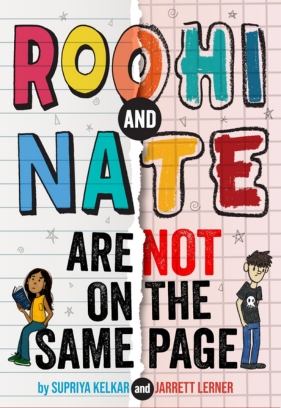
Roohi and Nate Are Not on the Same Page

roohi and nate are not on the same page

Credits

Age Range

Publisher

Awards

Year Published

Reviewer

Bob Hoose

Book Review

Roohi is bright and organized. Nate is … not. But it’s possible that these two middle schoolers might join a book club and accomplish great things. That is, if they can get over their dislike for one another.

Plot Summary

Nate is pretty sure that he’s dumb. And he’s fairly certain that his parents think so, too. They would never say that to his face, of course. But the fact that his older brother, Noah, is considered a genius and his parents can’t ever talk enough about him, sorta speaks volumes.

I mean, Nate’s grades are meh at best, and his greatest academic achievement is that he’s, well, pretty good on a skateboard. Which is to say that Nate has no academic achievements at all.

Roohi, on the other hand, is pretty high on the academic-achievement scale. She’s organized and bright, she’s at the top of her class, and she balances a full plate of extracurricular activities with style.

Problem is, Roohi recently broke her toe in a silly accident. And that has thrown everything else in her life out of whack. She can’t be on the cross-country team, for one; her team-related friendships are strained, for two; and another girl has taken her place—in a number of ways.

Roohi is so self-conscious about the teetering changes in her life that she’s not as creative as she used to be, and frankly, she can’t even eat lunch in the cafeteria anymore. So, she simply stays in the school library over lunch, nursing her throbbing toe and chatting with Mrs. Sharp, the librarian.

Mrs. Sharp is the intersection where Nate and Roohi cross paths.

OK, these two had at least met before, but it was more of a trainwreck than anything else. But both Roohi and Nate really like Mrs. Sharp. She’s positive and thoughtful. She rocks funky shoes and cool T-shirts fronting old punk bands.

Oh, and Mrs. Sharp is starting up a “Lunch Bunch” book-reading club that both Roohi and Nate are drawn to. Nate isn’t a great reader: He kind of has to read quietly out loud when he reads a book (which drives people like Roohi crazy), but he remembers loving one book in the past and would like to try again.

Of course, the Lunch Bunch draws several very different book lovers besides Roohi and Nate. There’s Dao, a tall athletic girl who’s more comfortable on the school basketball court than in a book circle. There’s Miles, a nerdy kid who’s usually playing a board game during lunch—by himself. And then you’ve got Troy, a big, thick kid in eighth grade who sports more facial hair than Nate’s dad.

The Lunch Bunch is a very odd collection of kids.

However, as mismatched and nervous as each person there may be, a good book has a way of breaking down barriers. As Mrs. Sharp once said about Roohi’s splintering friendships, “Maybe it’s all about finding your place and finding friends there.” Mrs. Sharp also makes it clear that she believes in a principle of “small change, small growth.”

You can bet there will be changes, growth and some new friendships this year. And it all starts with a first uncomfortable lunch … and a book.


Christian Beliefs

None.

Other Belief Systems

Roohi and Nate Are Not on the Same Page earnestly promotes reading and discussions about the many wise and thoughtful things to be discovered in literature.

Authority Roles

Nate’s parents are indeed very proud of Nate’s older brother, Noah. And through their comments and reactions, they accidentally reinforce Nate’s belief that he is just not up to par in any way. Eventually, however, Nate’s choices make them aware of their own past comments and actions. Nate’s dad, in particular, takes time to ask for Nate’s forgiveness; he tells his son that he loves him.

In fact, Mrs. Sharp’s book club encourages several of the Lunch Bunch members to open up and talk to their parents about the strains in their relationships. Roohi’s overworked mom and dad make efforts to lighten her load at home and show their support for her. And it’s implied that Dao’s hard-driving, sports-focused father reacts as lovingly as the other parents.

Mrs. Sharp is an excellent role model and, in a way, a solid mentor for each of the kids. So much so, in fact, that when her position is threatened because of a tight school budget, they are each able to clearly speak about her personal importance to them and the value of librarians in general. The story makes it clear that reading is an incredibly significant part of the learning experience.

Profanity & Violence

Someone is called a “jerk.” And an individual states that something is “darn right!” But there’s no foul language in the mix.

However, Nate lies to several people, primarily out of fear of how they will receive the truth about his choice to join the book club. (His skateboarding bud, Z, viscerally dislikes Roohi, for instance, and believes she looks down on people like Nate and Z.) Nate’s lies compound and eventually grow into a larger problem that hurts several different people. At one point, Nate admits the truth about a lie he’d told and thinks about the relief that flows over him when he does so.

Z breaks someone’s trust and drags Nate into someone’s public humiliation.

Other than Roohi’s thoughts about her aching broken toe and the fact that her three young brothers are constantly fighting over toys and breaking things, there’s nothing specifically violent in the story. We are told that Troy’s mom is “very, very sick” and that he selflessly dedicates a lot of his time to reading to her and caring for her needs. But we’re never told what she suffers from.

Sexual Content

Mrs. Sharp mentions that she has two dads.

Discussion Topics

Do you like reading good stories? What do you think a well-written story can give us? Are there things that you learned or thought about in this book?

Both Nate and Roohi thought others were judging them in a negative light. Do you ever secretly think people are thinking negative things about you? What’s the best way to deal with those kinds of situations? For instance, what happened when Roohi finally took the time to speak with her cross-country team friends?

Did you know that the Bible takes time to encourage us to read and discuss what we’ve read with others? Take a look at 2 Timothy 3:16-17, Hebrews 4:12 and Romans 15:4. What do these scriptures all have in common?

What was your favorite thing about Roohi and Nate’s growing friendship?

Additional Comments

Roohi and Nate Are Not on the Same Page is an interesting middle grade novel that brims with clever wordplay and nice messages about the value of books, libraries and librarians. The story also praises how reading and talking about a good book can create bridges between the most unlikely of friends.

You can request a review of a title you can’t find at letters@pluggedin.com.

Book reviews cover the content, themes and worldviews of fiction books, not necessarily their literary merit, and equip parents to decide whether a book is appropriate for their children. The inclusion of a book’s review does not constitute an endorsement by Focus on the Family.

Bob Hoose

After spending more than two decades touring, directing, writing and producing for Christian theater and radio (most recently for Adventures in Odyssey, which he still contributes to), Bob joined the Plugged In staff to help us focus more heavily on video games. He is also one of our primary movie reviewers.