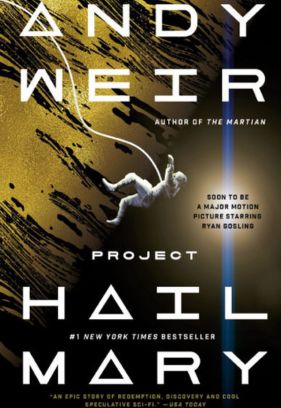
Ryland Grace is the sole survivor on a spaceship that’s hurtling through deep space. He’s on a desperate, life-and-death mission for all of humanity—and Earth itself. Problem is, he doesn’t know that. In fact, he can’t even remember his own name.
When he wakes up, he finds himself lying naked on a hammock with tubes in, and electrodes on, various parts of his body. Above him two brushed-steel armatures hang from the ceiling. And a robotic voice keeps asking him questions that his long-unused voice box and jumbled mind can’t seem to answer, no matter how hard he tries.
He can’t even remember his own name.
He finally summons the inner strength to respond that two plus two equals, “Fffoouurr.” He sits up enough to look around and realizes that he isn’t totally alone.
There are two other hammocks in this sterile-looking, round white room. And they are both occupied by … corpses: desiccated skin draped over bones.
That’s when the first memory comes back to him, unbidden. And though it’s short and specific, that flash of memory helps him realize that he (whatever his name is) is part of a special space mission.
These other two unfortunately deceased individuals were part of his crew—one the commander, the other a flight specialist—and he himself is a physicist. Yes, that’s right. A scientist of some sort at the very least.
Oh, he’s also a science guy who’s in remarkably great shape. He’s as weak as a newborn kitten but somehow beach-bod buff. It must have something to do with all the electrodes glued to his body, stimulating muscle groups.
The computer voice keeps asking for his name. Is he, uh, John, Frank, Ghalib? He still doesn’t have a clue. But when adding all the current information together, “he” comes to the conclusion that this mission must have already been in progress for a number of years. And it’s probably important. Likely important enough that he ought to get back to it.
Perhaps if he can make his way out of this hammock and climb that 10-foot ladder in the corner, up to the single hatch in the ceiling, he might be able to give himself more workable clues. Of course, at this barely-able-to-move stage of things, that will be a herculean task. The best he can do is drift back to sleep.
“Eat,” the computer tells him after he wakes a bit later. The toothpaste tube on his chest must be his first taste of sustenance that isn’t injected intravenously. And that’s a good place to start.
Eat.
Get stronger.
Climb that ladder. Then, who knows?
He might even come up with a name he can call himself.

None.
Everything here is tied to a staunch belief in human science and mathematics. In fact, the book holds some scientific theories about global warming and evolution to be indisputable fact.
The other central character here is a space alien named Rocky. He’s an intelligent, spider-like creature from the planet Erid. His species breathes ammonia and lives under extreme atmospheric pressure. Rocky is described as being about the size of a Labrador and having five legs that radiate from a rock-like carapace. He has no eyes but can “see” through an advanced sonar ability. Rocky communicates through musical, harmonic tones.
After the book’s protagonist finally realizes that his name is Ryland Grace, he has brief flashback memories that piece his backstory together for us and introduce us to important elements and people in that story.
For one thing, Ryland is indeed a scientist who was once part of the “serious science” community. But after his theories about the nature of life in the universe were soundly rejected by the larger scientific community, he stepped away. Instead, he became a very effective junior high teacher. His students loved him.
Eva Stratt is a woman who’s granted supreme authority by the United Nations to do whatever is necessary to save Earth. She’s something of a ruthless, utilitarian, determined pragmatist who brings Ryland onboard specifically because of his past theories.
We slowly discover that a unique spacefaring alien microorganism called “astrophage” is, in essence, consuming our sun’s energy. In fact, astrophage is a solar parasite that’s spreading and feeding on solar power throughout the universe.
We meet a variety of other dedicated human astronauts and specialists who are willing to set off on a one-way mission in the hope of saving Earth and its human populace.
Rocky, the alien, is a brilliant and caring engineer. He and Ryland not only work together for the benefit of both their worlds, but they become close friends. They both risk their lives for one another.
Ryland does his best to avoid using foul language, instead using less offensive exclamatory substitutes, such as “oh, fudge,” “gosh-darned” and “motherfluffer.” In some particularly stressful moments though, Ryland does slip into much coarser language. He and other people spew out f- and s-words, uses of “a–hole and “d–n” and misuses of God’s and Jesus’ name.
Ryland takes pain pills on occasion (once when badly burned), but he tries to refrain because of their mind-dulling effects. We learn that Ryland and his crewmates were all put into a drug-induced coma for the years-long space trip. In addition, without his consent, Ryland was injected with a drug that left him with amnesia.
Astronauts talk about how they would prefer to die at the end of their one-way mission. One of them requests an overdose of heroine, suggesting she’d like to experience the “pleasurable” side of the drug before finally dying.
Ryland was forced to join the space mission despite his strident protests. A huge explosion demolishes a building and kills several people. Project Hail Mary talks repeatedly of the deadly effects of a depleted sun on our planet. Eva Stratt orders the use of hundreds of nuclear weapons in a critical, large-scale operation to save humanity.
Ryland and Rocky get thrown into situations that threaten both their lives. Ryland’s spaceship is badly damaged, and he barely escapes crashing to a planet’s surface. In another instance, Ryland gets severely burned and rendered nearly blind by Rocky’s super-heated ammonia atmosphere. We are told that Rocky’s own crew was killed by radiation poisoning. Someone eats hamburgers made of meat cloned from their own muscles.
Two potential astronaut candidates have a purely physical sexual affair before the one-way mission. They talk openly and publicly about using breaktimes for 10 to 15 minutes of sex.
As mentioned, Ryland wakes from his coma totally naked. And the book describes his painful efforts to remove an inflated catheter from his genitals.
We find out that Rocky and his fellow Eridians are hermaphrodites that reproduce by laying eggs next to each other.
None.
Andy Weir’s Project Hail Mary (which is now a movie) is a compelling sci-fi tale that’s packed with scientific reasoning, mathematical equations, space alien interactions and deep space adventure. However, this book is so reliant on scientific and mathematical exposition—some of which doesn’t necessarily hold up to logical scrutiny—that readers may find the story difficult to navigate.
Evolution, global warming and aliens are all in the story mix. The book contains occasional uses of foul language and dire peril. And some characters talk about sex, too.
You can request a review of a title you can’t find at letters@pluggedin.com.
Book reviews cover the content, themes and worldviews of fiction books, not necessarily their literary merit, and equip parents to decide whether a book is appropriate for their children. The inclusion of a book’s review does not constitute an endorsement by Focus on the Family.
After spending more than two decades touring, directing, writing and producing for Christian theater and radio (most recently for Adventures in Odyssey, which he still contributes to), Bob joined the Plugged In staff to help us focus more heavily on video games. He is also one of our primary movie reviewers.