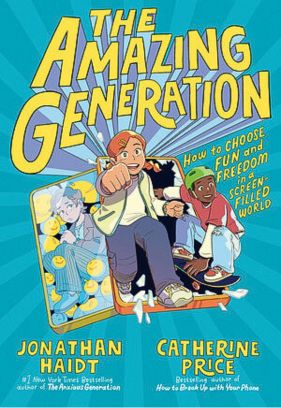
The Amazing Generation: Your Guide to Fun and Freedom in a Screen-Filled World

Credits

Age Range

Publisher

Awards

Year Published

Reviewer

Bob Hoose

Book Review

In a world filled with Greedy Wizards and Cursed Stones (a.k.a. tech companies and smartphones), some tween rebels take back their lives. And they share tips for how you can, too.


Plot Summary

Once upon a time, a group of wizards created magical, glowing stones studded with glittering gems. They promised that these stones would bring friendship, freedom and fun to anyone who picked one up. People rushed to grab them, and before long, anyone without a stone felt left out.

 Some of the wizards tried to live up to their promises, but others became greedy. Instead of making life better, they tricked people into carrying their stones with them everywhere they went—and gazing into them all day long. Why? Because these greedy wizards had figured out how to turn human energy into gold.

 Does that sound like a strangely familiar story? An allegory to tech companies and smartphones, perhaps?

Oh, it is indeed. But the outcomes are real. The “wizards” have devised twists, turns and tricks to trap everyone into their service: They promise much but take far, far more without anyone realizing.

Fear not: A rebellion is growing. Young people are sitting up and realizing that there is trickery afoot. They’re telling stories and looking at those gems in their hands, seeing them for what they are—and what they are not.

The wizards and the young rebels will determine what life will be like, not just in this generation but for generations to come.

Which side will win?

And which side will you choose?

Christian Beliefs

There are no references to religious faith in this book. …

Other Belief Systems

… That said, The Amazing Generation uses scientific evidence, quotes from young tech users and a graphic novel story arc to help illustrate why people have transformed their lives through today’s technology and the social media connections it offers. That transformation is often supported by faith that these things will deliver exactly what they promise—friendship, freedom and fun—and not the isolation and loneliness that users are often left with.

“I withdrew from my family and real-life friends, choosing to prioritize online friends over everything else. But the more I felt connected to someone across the country, the less I felt connected to the people right next to me,” says one teen testimony within the book.

Authority Roles

This is not a book featuring adults who give advice or correct young people in their choices. Rather this is a collection of materials focused on tweens and teens coming to grips with their world and the choices they need to make.

Along with the graphic novel story that runs throughout, there are a variety of informative facts and true accounts.

For instance, 18-year-old Samara Gorton reports that she got her first smartphone when she was 11. And her big tech ah-ha moment came when she went to a sleepaway camp that was phone free. During that separation she realized how much she had been missing out on the real world. When asked what she wished kids knew, she said: “It might look like teens are entranced by their phones and social media, but a lot of them are not enjoying it, and they wish they weren’t on it.”

Most of the testimonies of “young rebels” are similar. Teens often found themselves being used by tech rather than using it as the tool it was meant to be. Many felt that valuable chunks of their lives were being burned away on nothing. One page in the book illustrates this loss. It’s titled: “Screen Time Calculator That You Can Use to Freak People Out.” It reads as follows:

1 hour of screen use per day = 15 full days per year.

2 hours per day = 1 full month per year.

4 hours per day = 2 months per year.

6 hours per day = 3 months per year.

8 hours per day = 4 months per year.

10 hours per day = 5 months per year.

And studies show that today’s teens spend from 5 to 8.5 hours per day on screens.

The stories in this book also point out that smartphones and social media tend to lock kid users’ brains into “defend mode”—an anxious and fearful state of mind where their brains are on high alert for anything that might feel dangerous (like mean comments or pictures on social media). Defend mode is the opposite of “discover mode”—a confident, curious state of mind where young people have the freedom to try new things and figure out who they are.

The Amazing Generation is divided into three sections:

Part One talks about technology’s rise and the lies it permeates. Part Two focuses on the secrets of how tech and social media companies train users, hack their brains, glean information from them and make money. And Part Three discusses what it will take for teens to become “rebels” and simply use technology as a tool rather than let it use them.

Profanity & Violence

None.

Sexual Content

None.

Discussion Topics

None.

Additional Comments

The Amazing Generation is a fun, colorful and easy-to-read book that tosses the question of what to do about technology and social media into tween and teen readers’ court. So this isn’t a book for Mom and Dad.

It’s their life, the book suggests through its graphic novel story, so they need to seriously consider how they want to live it.

 The Amazing Generation talks in detail about the psychological mechanisms that tech wizards use. Then it goes on to give young readers some solid tips on how to navigate their smartphone and social media use—becoming rebels who find friendship, freedom and fun, in person and offline, while spreading the rebellion message.

You can request a review of a title you can’t find at letters@pluggedin.com.

Book reviews cover the content, themes and worldviews of fiction books, not necessarily their literary merit, and equip parents to decide whether a book is appropriate for their children. The inclusion of a book’s review does not constitute an endorsement by Focus on the Family.

Bob Hoose

After spending more than two decades touring, directing, writing and producing for Christian theater and radio (most recently for Adventures in Odyssey, which he still contributes to), Bob joined the Plugged In staff to help us focus more heavily on video games. He is also one of our primary movie reviewers.