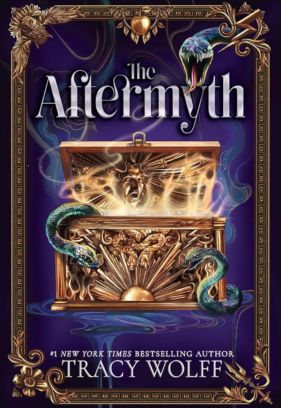
The Aftermyth

Credits

Age Range

Publisher

Awards

Year Published

Reviewer

Bob Hoose

Book Review

Anaximander’s Academy is a place where students learn about magic and the stories of Greek mythology. And Penelope Weaver knows that she is meant to embody the attributes of Athena, the goddess of wisdom and reason. But it seems that someone has other plans.

Plot Summary

It’s Penelope Weaver’s first day at Anaximander’s Academy. And you wouldn’t believe how excited she’s been about it.

As she and her family were driving to the academy that morning, Penelope was so amped up and aflutter that she could barely sit back in her seat. I mean, it kinda feels like she’s been preparing forever for this day—listening raptly to her parent’s stories, dutifully practicing her goddess attributes, reading and rereading her unabridged editions of Greek mythology.

The fact is, Penelope has known what she was going to do and be at this wonderful school from the moment her mom first told her about it. Like her parents before her, she would proudly represent Athena Hall, one of the student dormitories representing the five central Greek gods: Athena, Aphrodite, Zeus, Poseidon and Hades.

Penelope was sure of her destiny. There was no question. Like the goddess Athena, Penelope has always prided herself on being prepared. She’s been patient, wise and strategic.

However, Penelope has also been wrong.

In fact, Penelope’s entire first morning at Anaximander’s has defied every plan she’s ever made. She was accosted by scary visions and occurrences that no one else could see when she first stepped on campus. She was whisked away to strange places and had to struggle to find her way back. But far worse than any of that, Penelope wasn’t chosen by the goddess Athena.

When the sacred selecting ceremony occurred, Penelope was placed in Aphrodite Hall.

In Penelope’s opinion, the Aphrodites are the worst, most chaotic group at the school. They’re all pink hearts, shimmering glitter, neon colors and gushing sweetness. Penelope has nothing in common with a single giggling one of them.

And as the cheering Aphrodites swarm around her, passing out handfuls of sparklers and hugging one another with joy, Penelope is struck with a clear realization: This is what the next six years at Anaximander’s will be like. After all, she exists in a world where everyone’s story is fated to happen in a certain way.

However, Penelope Weaver has also just determined that she will do a very un-Athena thing: She’s going to rewrite her story.

Christian Beliefs

None.

Other Belief Systems

The Aftermyth presents a world where the Greek gods and goddesses are very real beings that dwell in a cloud palace atop Mount Olympus.

Students at Anaximander’s Academy are assigned to one of five dormitories, where the students living in that dorm represent the attributes of the god or goddess it’s named after: Residents of Athena Hall embody wisdom and strategic thinking; Zeus’ students seek unparalleled power; Poseidon’s personify shrewd protectiveness; Hades, strength and loyalty; and Aphrodites represent compassion and generosity.

In addition, students in these halls learn to bring myths to life and, with the help of a personal muse, they complete 12 “myth-based” tasks during their time at the Academy. As such, there are many tips of the hat to Greek myths woven throughout the story. For instance, early on, Penelope blows out a lantern that she believes might accidentally cause a fire. And that action plays into an encounter with a “man” named Prometheus later in the story.

Penelope finds herself tossed into several quests that she doesn’t fully understand. Some of those quests magically transport her to a new location or alter the environment around her. Sometimes the land will shift. She also sees images in shifting mosaic tiles that other people around her cannot see. There are objects, such as statues and holograms, that come to life in Penelope’s presence to communicate important messages. Some objects turn into threatening snakes. Penelope sees visions of gods and Titans.

Penelope stumbles into a pit and finds herself falling into the Underworld, then onto a train transporting the souls of the dead. Someone helps her find her way back to the land of the living. She brings the Book of Death back with her and finds that she can mysteriously understand the ancient Greek dialect it’s written in. (She refuses to read the book and hands it over to an authority figure.)

Every student gets assigned a Greek muse as a helper who will give them insight or direction. And while Penelope’s muse, Calliope, is said to be one of the “High-9,” she tends to be more interested in drinking alcohol than helping.

Authority Roles

Penelope has a twin brother (they’re both 13) who joins her at the Academy. And though she repeatedly says that he knows her better than anyone, he gets persuaded to turn his back on her.

Penelope’s parents are both concerned about and caring toward their children. But since they’re both followers of the goddess Athena, they’re also rather reserved and disinclined to emotional displays.

We meet several academy teachers. All are concerned about the welfare of the students, but their hall connections tend to shape their reactions to different situations. Dr. Themis, the school’s imposing headmaster, for instance, is a Zeus adherent who stands by the letter of the law. Whereas Dr. Dione, the Aphrodite director, is more open and kind.

Prometheus proves to be a caring individual who openly and willingly sacrifices himself for the benefit and love of mankind. (That said, most of the recounted myths here don’t cast the Greek “gods” in a very good light.)

Profanity & Violence

We see one or two uses of the word “heck” and several different people exclaim “oh my gods” or “thank the gods.”

Throughout their journeys and struggles, Penelope and her friends get thumped around and find themselves in potentially deadly situations. They’re enveloped by a fog that alters their perspective, making them despondent. They’re wrapped in choking vines and threatened by powerful lightning strikes.

Penelope gets bitten by magically appearing snakes on several occasions. And while in the Underworld, snakes slither up her legs and wrap themselves around her arms, legs and torso.

A teacher challenges his students with a scary, sharp-taloned eagle that was once charged with repeatedly eating the liver of Prometheus in Greek mythology. We hear the story of Pandora releasing the deadly evils of despair, disease, greed, conflict, envy, pride and death upon the world. Penelope asks someone to help her by kicking her brother “in the privates.”

Sexual Content

Penelope is attracted to a handsome Hades student who helps her. But she keeps those feelings at arm’s length. During a discussion with Prometheus, the Greek Titan reveals that he was in love with Pandora, his brother’s wife. And it’s implied that the two had an intimate affair. (By the end of this book, that pair seemingly become a couple in the supernatural realm they exist in.)

Penelope’s brother, Paris, falls in love with a girl in his hall. And though we don’t see their interactions, his choices are repeatedly swayed by that affection.

Discussion Topics

None.

Additional Comments

Tracy Wolff’s The Aftermyth is the first book in a magical school series with a Harry Potter-like vibe. Only instead of witches and magic wands, this tale focuses on Greek gods, quirky muses and mythical anomalies.

In that light, the book fancifully presents a world where belief in Greek gods and goddesses is the norm. And it attempts to portray those gods’ positive attributes—though frankly, their mythical stories aren’t always so uplifting.

Beyond its magical side, though, The Aftermyth asks young readers to consider the powerful and positive influence that new friendships can have on someone’s life. And it suggests that, while making plans is good, sometimes it’s the unexpected and difficult experiences of life that shape us into the good people we hope to be.

You can request a review of a title you can’t find at letters@pluggedin.com.

Book reviews cover the content, themes and worldviews of fiction books, not necessarily their literary merit, and equip parents to decide whether a book is appropriate for their children. The inclusion of a book’s review does not constitute an endorsement by Focus on the Family.

Bob Hoose

After spending more than two decades touring, directing, writing and producing for Christian theater and radio (most recently for Adventures in Odyssey, which he still contributes to), Bob joined the Plugged In staff to help us focus more heavily on video games. He is also one of our primary movie reviewers.