



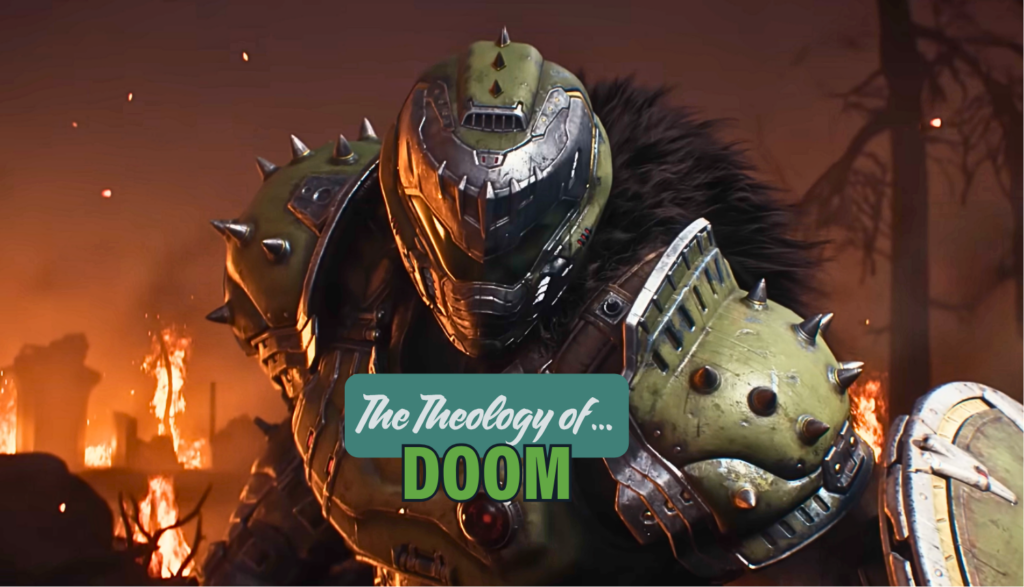
The Theology Of … is a series in which we tell parents about the overt or subtle spiritual worlds of various popular media. Each article will explain the theological landscape of a relevant series, and when appropriate, we’ll provide ways for parents to use said content as a way to teach their child about Christian theology.
Introduction to the Series
“Against all the evil that Hell can conjure, all the wickedness that mankind can produce, we will send unto them … only you. Rip and tear, until it is done.”
So opens Doom Eternal.
On its surface, the Doom video game franchise appears deceptively simple. You play as “Doomguy,” as fans have dubbed him, a one-man army who “rips and tears” his way through hordes of unholy horrors from hell. Since the series originally released in 1993, the gory gameplay has never truly progressed beyond that premise. So with every subsequent release, players have been left to rediscover what it might be like to play as the equivalent of a bipedal meat grinder for demons.
But in our Theology Of series, we don’t care much to float around on the surface. Instead, we like to dive down into the ninth circle of a franchise’s theological underpinning so that we can better understand the spiritual world as the entertainment depicts it. And boy, does Doom get complex underneath its surface.
So, without further ado, let’s rip and tear our way through these spiritual themes.
Note: While we try to go as in-depth as possible, some lore, like that of Doom, is much too detailed for us to cover in a single blog. Therefore, some items may be summarized as accurately as possible for brevity’s sake.
Overarching Spiritual Worldview
The story of Doom begins not with Doomguy but with a being called Davoth.
Davoth, the franchise posits, is the creator of all realms, as well as the life within those realms. In Doom’s beginning, Davoth created the first realm, Jekkad, and from his power came further divine existence. From Davoth came The Father, and from The Father came the angelic-like Makyrs and their realm of Urdak.
But Davoth saw that his created beings were mortal, unlike him, and he longed to discover how he might give his creatures eternal life. However, this pursuit led to a shift in power: The Makyrs, under the influence of The Father, came to see Davoth’s obsession with immortality as dangerous. They overthrew Davoth and sealed him in Jekkad with no way to escape. Davoth, furious at this betrayal, then became known as the Dark Lord, and Jekkad transformed into Hell. And for centuries, Davoth has sought to escape his prison so that he might destroy all of creation for its betrayal. Meanwhile, the Makyrs rewrote history, elevating and recontextualizing The Father—an entity tied to Davoth’s power—as the “true god,” while erasing Davoth as a Lucifer-like figure.
Unaware of this otherworldly scheming, humanity continued its own technological advances. But this all changed when the Union Aerospace Corporation, through its research into interdimensional travel, unintentionally allowed the armies of hell to break free into our realm. (This originally occurs on Phobos, but incursions later happen on Earth.) The demons wiped out every human they could find—save for Doomguy, a lone marine sent to assist in stopping the incursion.
Doomguy would near-single-handedly fight against the forces of hell for countless years and develop a burning hatred for the destruction they brought upon humanity. It would soon become his life mission to kill every demon in existence.
Throughout his battles, Doomguy would travel across many realms. He would eventually gain superhuman powers, too, transforming him into the Slayer/Doom Slayer. Doomguy would eventually do battle with the Makyrs, too, after discovering their deal with hell to refine human souls into energy that would extend the Makyrs’ lives.
Eventually, Doomguy would strike a critical blow against hell by doing battle with Davoth and killing him.
Glossary of Important Characters/Topics
Doomguy/Slayer – The main character of the Doom series, colloquially called “Doomguy,” is never given a name. Still, he’s a male human with an intense hatred for any demonic thing that attempts to crawl out of hell, as well as anyone who might attempt to assist the demons. Over time, Doomguy’s hatred and experience in slaying demons has led him to become an unstoppable killing machine—the only being hell actually fears.
After stepping into the “Divinity Machine” and receiving/unlocking immense power that enhanced his strength, speed and durability, Doomguy became known as the Slayer. The Slayer continued waging war on hell for many years, and he eventually defeated the Dark Lord (Davoth). However, because of a connection to the Dark Lord, Slayer collapsed into a sort of unconscious stasis, and he was sealed inside a sarcophagus to rest until needed again.
Davoth/Dark Lord – Davoth is the origin of all existence (in Doom’s universe), creating the various realms, mortals and the Makyrs. However, he was betrayed by the Makyrs when he sought to learn how he might gift his creation the gift of immortality: The Makyrs feared Davoth’s obsession with immortality would destroy existence itself. They sealed him in his realm of Jekkad, which was later renamed “Hell.” Davoth, furious by the betrayal, became the Dark Lord, and he has since waged war on all creation for this.
For most of the game, the Dark Lord lacks a physical body, as his “life sphere” was taken from his body long ago, which leaves him as a spiritual presence that can merely influence the world. (We are told he operates through well-planned whispers, coercing mortals into unintentionally helping him to break free from his prison.) Slayer eventually reunites the Dark Lord’s life sphere with a physical body so that he can kill the Dark Lord for good.
Life Sphere – A life sphere contains the “memory, intelligence, will, and the essential nature of a being’s consciousness, all of it contained by the mighty inventions of the Seraphs […] Only the most powerful, god-like, indomitable minds can survive the incredible stresses of having their essence fused into a life sphere, and fewer still can bear the agony of corporal resurrection” (Book of the Seraphs – Part IV).
The Father – While The Father is described as the creator of all things, he is actually revealed to be a creation of Davoth (who actually created all things). The Father, then, is an entity whom the Makyrs propped up as a god following their betrayal of Davoth. The Father—after betraying and battling with Davoth—chose to separate his own life sphere from his body, “withdraw[ing] from the physical realm to prevent Jekkad’s ever-increasing power from someday shattering Urdak and to stop Davoth from absorbing The Father’s infinite powers that he so coveted” (Book of the Seraphs – Part III).
The Slayer destroyed The Father’s life sphere (for disputed reasons, but most likely because the Slayer did not wish humanity to be at the whim of great supernatural beings any longer), leaving The Father forever unable to take physical form. Still, through reasons we do not have time to get into, a part of The Father’s essence continues to function within an artificial intelligence called “VEGA.”
The Makyrs – The Maykrs are angel-like beings created by Davoth but governed by The Father. When Davoth’s obsession with granting immortality began to threaten the existence of his creation, The Father and the Maykrs betrayed Davoth and sealed him in Hell, later rewriting history to present The Father as the ultimate creator and Davoth as a fallen, Lucifer-like figure.
The Maykrs reside in Urdak, a heavenly realm, and operate as a highly ordered theocratic society under the leadership of the Khan Maykr. Though they view themselves as gods, they are not truly divine. Instead, they possess extremely long lifespans that last eons—after which they undergo “Transfiguration,” a total biological and cognitive collapse that mutates them into monstrous, semi-sentient forms.
The Father’s presence passively sustains and stabilizes the Maykrs, delaying this decay. But when one of their own hides The Father’s life sphere, that stabilizing force is lost, leaving the Maykrs vulnerable to Transfiguration. However, they discover that Argent Energy—an energy source refined from the suffering, sentient souls in hell—can artificially prolong their existence, leading them to become dependent on hell’s demonic processes to remain stable.
Argent Energy – Argent Energy is the refined essence of suffering souls. It is created in hell, as demonic forces feed on the souls. The souls are subjected to extreme torment which destroys the consciousness and leaves behind a usable energy. Additionally, when those souls are stripped from their bodies and combined with infernal energy, they eventually morph into new demons.
Argent Energy, humans learned, also functions as a conduit to hell, allowing its demonic forces to invade other realms.
The Makyrs, meanwhile, discovered that they can use Argent Energy to stave off Transfiguration. They therefore chose to make a deal with hell: The Makyrs would provide hell with more worlds to devour in exchange for access to this soul energy. The Makyrs also found more efficient ways of torturing souls to speed up this process and obtain more Argent Energy, contributing to the creation of even more demons as a byproduct.
Samur Maykr/Samuel Hayden/Seraphim – Samur Maykr is one of the Maykrs, and his title is The Seraphim. He serves as a kind of right hand to The Father. When The Father sensed rising dangers from hell, he tasked Samur with hiding his life sphere in a place where none could find it. While this act spelled disaster for the Makyr race and branded Samur a heretic by the rest of his kind, Samur submitted to this request.
Samur later implanted his consciousness into a human body he had made for himself, taking on the name Samuel Hayden. Samuel, equipped with the mind of a Makyr, became prolific on Earth for (intentionally) guiding humanity to discover Argent Energy. The Father had informed him that humanity would have found the energy eventually, so Samuel hoped to help the humans survive the resulting catastrophe, i.e., mitigate the carnage from the forces of hell.
At some point, Samuel transferred parts of his brain into a robot body to avoid death via brain cancer. Samuel was also the one to rescue the Slayer after the man had been trapped in a magical sealed sarcophagus in hell.
The Sentinels – The Sentinels are a warrior civilization of humans who hail from the realm of Argent D’Nur. They have a very medieval look to them. They mostly follow the Makyrs, believing them to be divine guiding beings, and fight against hell. Doomguy arrives in their realm and becomes their ally, eventually using a device called Divinity Machine housed in their realm to gain power and become the Slayer.
The Sentinels ultimately learn that the Makyrs have been harvesting the souls of their lost brethren for Argent Energy, leading to a great schism in the Sentinels as some turn against the Makyrs. The Sentinels’ home world is eventually overrun by hell’s forces.
Urdak – Urdak is the celestial realm of the Makyrs. It functions as something like the “heaven” of the Doom universe.
Jekkad/Hell – Jekkad is the demonic realm where Davoth lies trapped and from which all demonic creatures come.
The UAC – The Union Aerospace Corporation is a human megacorporation whose research and antics often result in hell bursting into Earth’s dimension. They are the corporation who, led by Samuel Hayden, discover and refine Argent Energy as a renewable resource, initially unaware that it will lead to a demonic incursion.
Connecting, and Contrasting, the Gospel
- The Fall – Doom presents a universe where humanity is largely entangled in a cosmic struggle between higher powers that we had no hand in causing. As a result, humanity needs rescue from these external forces. This contrasts with Christianity, in which humanity’s deepest problem is internal. We sinned, and our rebellion deserves the wrath of a just God who hates evil. We therefore require not just rescue but redemption, too—one only possible—not through a savior who rips and tears to save us from an external threat—through Jesus, who was pierced and crushed in our place for our sins (Isaiah 53:4-6; Mark 10:45; John 10:17-18; Titus 2:13-14 and 3:7).
- Hell – In Doom, hell is a realm where demons rule and torture the souls of humans. These souls are turned into Argent Energy, and if given enough time, many of them will turn into demons, too. In Christianity, hell is not a place where demons or even Satan rules (though this is a popular misconception). Instead, hell is a place where the wicked are punished by God for their refusal to repent of their sins. The Bible describes hell as a place of “unquenchable fire” where the wicked “suffer the punishment of eternal destruction, away from the presence of the Lord and the glory of His might” (Matthew 3:12; 2 Thessalonians 1:9). It is only through faith in Jesus, who paid the price for the sins of those who would believe in Him, that we can find salvation from God’s wrath and punishment in hell (John 3:36; 2 Corinthians 5:21; Hebrews 13:11-12; 1 Peter 3:18).
- Immortality – In Doom’s creation story, Davoth searches for a way to make his creation immortal like him. His plans are foiled when his own creation rebels against him, and he seeks to destroy his creation rather than offer eternal life. In Christian belief, we, too, have rebelled against our Creator. But unlike Davoth, God nevertheless offers forgiveness and eternal life as a gift to us through the sacrifice of His Son, Jesus Christ. Those who repent of their sins and believe in Jesus as Lord and Savior will inherit everlasting life from God (John 3:16 and 10:28; Romans 6:23; 1 John 5:11-12).
Conclusion
We hope that this blog serves as a helpful primer for parents looking to understand the spirituality in Doom, so that you can be equipped with the knowledge you need to either lead a gospel conversation or to decide whether the franchise is right for you.
And be sure to check out our other Theology Of guides!
- The Theology of Lost
- The Theology of The Legend of Zelda
- The Theology of The Lord of the Rings
- The Theology of Pokémon
- The Theology of Star Wars
- The Theology of The Chronicles of Narnia
- The Theology of Halo
- The Theology of Fire Emblem
- The Theology of Final Destination
- The Theology of Warhammer 40K
- The Theology of Avatar: The Last Airbender

3 Responses
Fun fact: Comparing release windows and time frames one-to-one, Doom got massively outsold by Barbie Fashion Designer
Interesting perspective. A lot of people reduce Doom to pure violence and chaos, but there really is a deeper spiritual framework behind its worldbuilding. I appreciate that this piece looks past the surface and asks what those themes are actually saying.
Is it just me, or is this franchise different from most of the others you reviewed?
Clarifying note: I have had no interaction whatsoever with Doom. Everything I know is from this blog post, I’m just giving my observations. If I’m wrong, feel free to correct me.
I recognize that many of the other franchises you reviewed, such as The Legend of Zelda or Star Wars, have mythologies that do not align with the Christian worldview. However, it is also clear that they are largely made-up; they are not necessarily meant to give commentary on any specific religion, let alone Christianity.
Now, let’s look at Doom. Why is the being everyone assumes is the creator called “the Father,” the same name we as Christians use for our God? Why is “the Father” presented as an imposter, while the ruler of darkness and hell is presented as the true creator being? Maybe there’s something I don’t understand, but this sounds like a Satanic attack on the God of Christianity Himself.
My point is, it almost sounds like this franchise was specifically designed, not just to tell a story, but to directly attack Christianity as a whole. Maybe I misunderstand the lore, it just sounds like that’s what’s going on.