


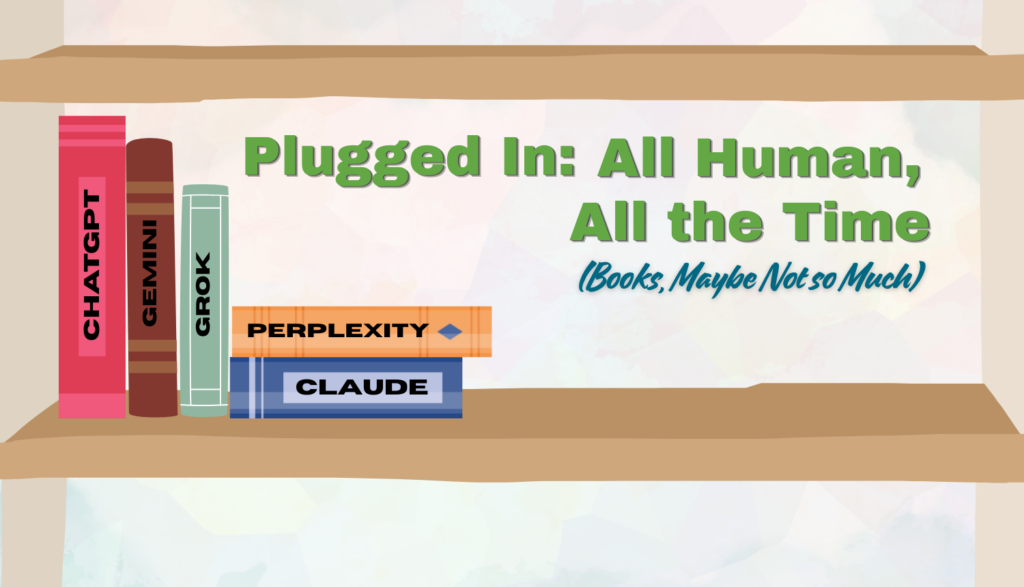
Nowadays, there’s artificial intelligence in everything.
There’s AI in your search engine.
There’s AI in your kid’s toys.
There’s AI in your fridge.
And pretty soon, there may be AI in the books at your bookstore.
OK, let’s be real. Chances are there are plenty of books at your local retailer that have snuck an AI-generated sentence or two under a publisher’s nose. And no one but the “author” is the wiser. But I’m talking about books that come with an active disclaimer, reading something like:
This book was generated by AI.
That’s something that James Daunt, the CEO of Barnes & Noble, isn’t necessarily opposed to stocking on his company’s shelves.
Wanna Read a Claude Fable?
Daunt made headlines in May when, in an interview with TODAY, he said that he had “no problem” selling AI-written books at Barnes & Noble”:
“Yes, I have actually no problem selling any book, as long as it doesn’t masquerade or pretend to be something that it isn’t, and that it has an essential quality to it, and that the customer, the reader, wants it. So as long as an AI-written book says it’s an AI-written book and doesn’t pretend to be something else and isn’t ripping off somebody else, as long as that’s clearly stated and the customer wants to buy it, then we will stock them.”
James Daunt
Yes, it very well may be that artificial intelligence will write a story so good that customer demand for it skyrockets. Perhaps it would become a bestseller. Maybe ChatGPT would figure out how to sign copies. Who knows what one would do with fair use and copyright laws?
But if we were truly honest about Daunt’s qualifications for an acceptable AI-generated novel, we would recognize that no AI book could ever achieve them. For even if such a thing were to happen, such a story would be only a shadow of its true glory.
There Are Some Strings on Thee
A marionette cannot dance. It can only give the illusion of dancing, one which is dispersed when the flash of light exposes the hand and strings manipulating its limbs. Artificial intelligence “dances” in the same way. It does not “create.” It instead looks to humanity’s work to tell it how to generate its output. AI, like a marionette, can do no more than mimic that which only humans can truly do.
In his Magnifica Humanitas (Magnificent Humanity), Pope Leo XIV speaks into this flaw within artificial intelligence.
“I invite everyone to contemplate, in the face of the Son of God, the grandeur of humanity that shines a light also on the era of AI. […] No computational system, however sophisticated, can create a heart that gives itself, or a conscience that discerns good from evil,” he writes. “Even when machines excel in efficiency, a human face that asks to be gazed upon remains the center of our history.”
Artificial intelligence may be a better writer than you or me, but this is only because it first reflects the greatest writers of humanity—those who wrote on the human experience, grappling with love, hate, goodness and evil. When AI writes a book, you read not the creative musings of a calculator, but centuries of human experience the AI has molded into a single reflected response.
The truth is that, when artificial intelligence writes a novel, the author is not the AI at all. The author is humanity itself.
The Plugged In Promise
Plugged In recognizes the value of AI—how it can make work easier or help break down complex topics. But we also recognize humanity’s unique greatness as those made in the Imago Dei, and how AI, despite its attempts, can never truly reflect that.
That is why, in an era when AI threatens even the stories we enjoy, we offer this promise to you, readers: Plugged In will never introduce AI writing into our reviews (even if it would explain how our very own Paul Asay comes up with so many puns in his posts).
Each and every one of our articles is and will continue to be personally written by a small team of human reviewers—whether it’s our main team at Focus on the Family or one of our contracted contributors. Every word written is based upon that reviewer’s time personally spent watching, reading or playing the relevant entertainment rather than some AI summary.
Yes, that may mean that, every so often, we may miss something—a muddled moment of audio may cause a crude word to slip past our radar, for instance.
But should such moments occur, let even those reflect our commitment to serving you. (If you reach out to us via email, Facebook, Instagram or YouTube, we’ll even try to correct any mistakes or missed content concerns.)
Because, unlike AI, we are simply Imago Dei humans serving Imago Dei humans to the best of our truly creative ability.

3 Responses
As a lover of books, I sincerely hope the AI books at Barnes and Noble will not sell, and that this robotic nonsense, which has overstepped its boundaries long ago, would leave our most important places.
I’m grateful PluggedIn is committed to not using A. I. to write articles. I enjoy reading the perspectives of real people concerning movies and the media and how they relate to Christianity. A.I. just condensed down an opinion based on writings it finds online without being able to evaluate them in a human way.
And the way it gets its sources (by training on other people’s content, copyrighted or no, accurate or no) has also been very problematic.