




When I was growing up, anime felt pretty niche.
Sure, I had a few friends who were diehard fans of Dragon Ball Z (thanks Toonami!), and, eventually, Pokémon—the cards, the games, the show, everything—took my school (myself included) by storm. But I still would have been hard pressed to tell you what anime actually was.
That’s not the case anymore.
Anime—a broad term for a diverse but kindred collection of animation styles and storytelling techniques originating in Japan—has become a global phenomenon which exceeds $25 billion as an industry and even influences today’s popular Western animation. (If you’d like more details, check out Kennedy Unthank’s parent’s primer to anime.)
So, anime is a big deal. But is it safe for families?
Well, as you might imagine, that’s akin to asking if animation at large is safe. The answer can be an enthusiastic yes or an emphatic no. It all depends on which movie or TV show you’re watching. Anime has a particularly broad range of possibilities, which makes it important to do some research into a piece of entertainment before watching it. (And hey, that’s what Plugged In is here for!)
There’s also the reality that Japanese culture can be very different from our own. For instance, the religions and spiritual conceptions that lay at the foundation of Japanese culture often influence anime—even if just subtly. And of course, that serves as a great segue to remind parents that the films on this list aren’t blanket recommendations: You’ll want to read our reviews in full before deciding whether to watch these titles.
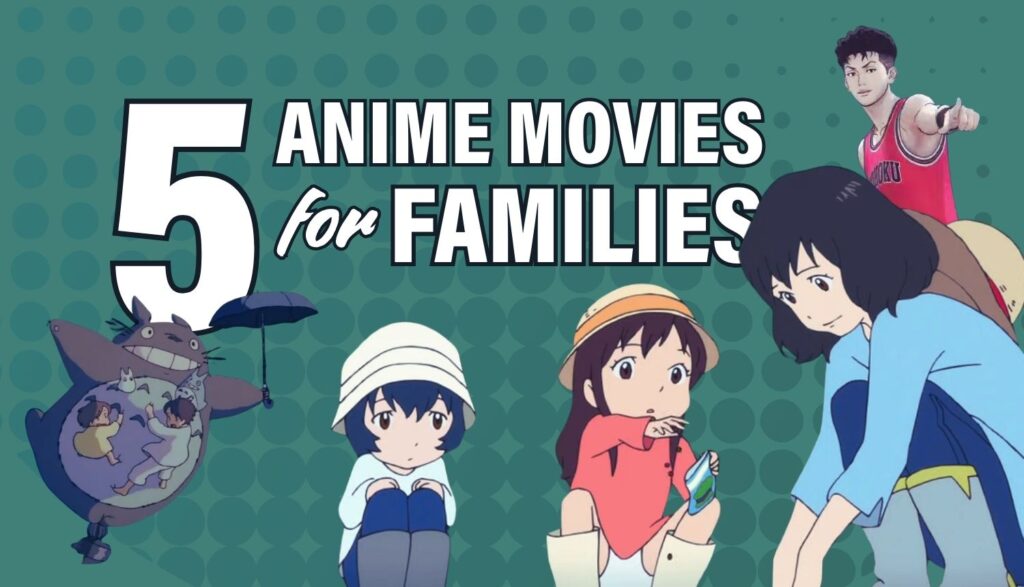
But given anime’s mass appeal, especially with younger generations, your child might be asking you to watch the latest animated export from Japan. With that in mind, here are the five best anime movies for families to enjoy together that we’ve reviewed at Plugged In.
My Neighbor Totoro (G)
One of the most well-known (and well-regarded) producers of anime in Japan is Studio Ghibli. The studio, founded in 1985 by directors Hayao Miyazaki and Isao Takahata, has produced a string of critically and commercially successful films.
While most Studio Ghibli films are generally pretty navigable for tweens on up, a few films stand above the rest when rating for “family friendliness.” One such film is 1988’s My Neighbor Totoro. As Bob Hoose noted in his review, the movie is “definitely quirky, but it’s also colorful and sweet—a kids’ movie that’s free from dark, deceptive villains, terrible adults and problematic children. Instead, we get a simple and sweet story about kids who love their parents more than anything.”
While the plot does revolve around the Japanese concept of “nature spirits,” the way things are presented wouldn’t be out of place in a Disney Golden Age flick. With a focus on familial love and strong, positive parental figures, My Neighbor Totoro is an imaginative and endearing film that the whole family can enjoy.
Wolf Children (PG)
Anime often puts a unique spin on their stories, even those that concern the mundanities of everyday life. Hence, Wolf Children—the story of a mother, Hana, learning to raise her children alone following the death of her husband. Of course, as the title implies, Hana’s children have a distinct peculiarity: They’re werewolves.
Now, that unusual premise may trip up some families, but there’s a surprisingly positive and heartfelt story to be found here. Wolf Children shows many of the trials of parenting. But in the end, it uses those difficulties to highlight Hana’s sacrificial love for her children. “Wolf Children has touched many hearts since its release in 2012,” Kennedy Unthank said in his review of the film, “and I suspect it will find many more, too. It’s the kind of film that makes you want to go thank your parents for all the trials they put up with for your sake.”
The movie contains a few notable issues that parents should know, including a realistic depiction of breastfeeding. And Hana’s marriage to a man who can transform into a wolf will give some pause. But its positive parenting messages make this pic fluffier than one might expect.
The Colors Within (PG)
InThe Colors Within, Totsuko is a young girl at a Catholic boarding school who has an odd ability: to see the color exuded by others. While she’s fascinated by the colors emanating from those around her, no one else can see what she sees, which has left her feeling like something of an outcast. Then, she meets Kimi and Rui, both exuding their own brilliant colors—and a friendship is formed.
As Kennedy Unthank put it in his review, this coming-of-age drama “is, ultimately, a story about finding love and acceptance.” Through affirmation and friendship, the trio of main characters are able to unburden themselves from the respective secrets they have been hiding for some time—leading to more honest and healthier relationships with those around them.
Additionally, the film features a generally positive depiction of Christianity—rare for a Japanese production. With few outright content concerns and a focus on finding acceptance, The Colors Within will be a fun watch for most families.
Mary and the Witch’s Flower (PG)
2017’s Mary and the Witch’s Floweris a bit of a Ghibli-adjacent production. Director Hiromasa Yonebayashi worked at Studio Ghibli for a time, so that influence can be seen in this film’s lavish and whimsical animation style.
The story, based on the British children’s book The Little Broomstick by Mary Stewart, follows a clumsy but sweet girl named Mary who discovers a mysterious “witch’s flower” that gives her magical abilities and sweeps her away on an extraordinary adventure. For those who read that description and worry that this flick makes magic and witchcraft seem like fanciful fun for kids, you might be surprised. As Bob Hoose notes in his review: “Mixed in with all the magicking in this animated flick there’s a very firm message about rejecting all that spellcasting stuff.”
And, if you don’t mind a spoiler, by movie’s end Mary—who has come to realize that there are a number of problems that come with the magic she has been given—is ready to leave all the sorcery behind and return to a normal, everyday life. That makes Mary and the Witch’s Flower, as Hoose says, “more than just another fly-by-night enchantment” for families.
The First Slam Dunk (PG-13)
Sports is one of the most popular genres in anime, and no surprise—athletic contests are rife with drama. In Japan, the visibility of the sports genre exploded following the Tokyo Summer Olympics in 1964. So, it should come as no surprise that Takehiko Inoue’s influential sports manga should make it to the screen.
The First Slam Dunk follows the Shohoku High School basketball team as they attempt to unseat the reigning high school basketball champions from Sannoh Kogyo. You don’t have to be a basketball fan to appreciate the strong redemptive themes found in this underdog anime. When he reviewed the film, Bob Hoose praised it, saying, “This is not only a great sports story, but a story of family, a tale of tenacious effort and an examination of loss and grief … involving and emotional on many levels.”
Language (whether dubbed or captioned) is the main issue here, though it’s less harsh than most of its PG-13 movie peers. For those who choose to navigate that issue, The First Slam Dunk is edge-of-your-seat entertainment that doesn’t foul out.

Recent Comments