Album Review
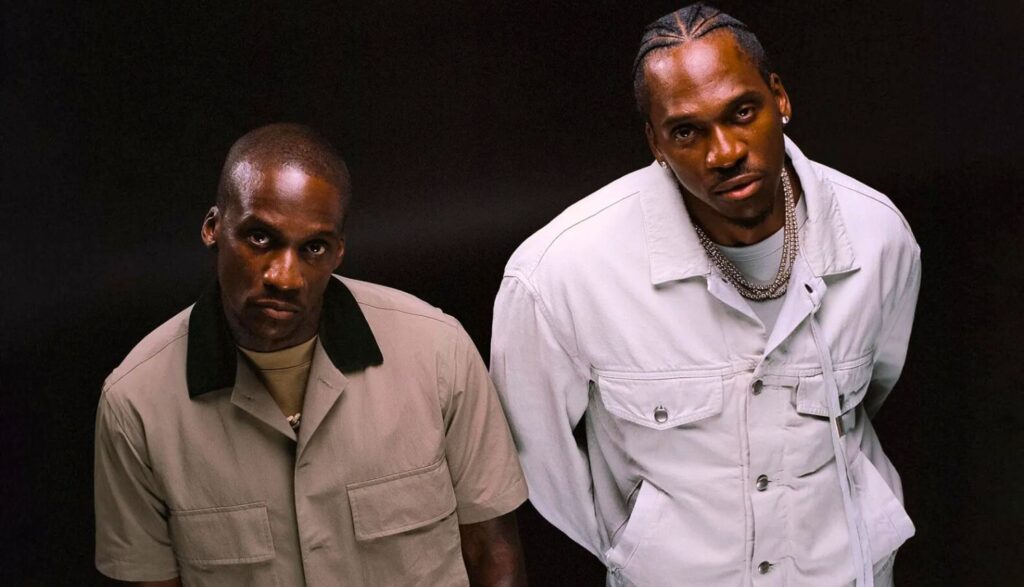
After 16 years apart, Pusha T and Malice have reunited to craft their most complex, introspective album yet.
As the rap genre continues its recent trend towards spectacle and mass appeal, Clipse feels different. Led by producer Pharell Williams, (yes that Pharell), Pusha T and Malice’s acrobatic lyrics provide a fresh entry.
Clipse’s origin story is one of contrasts. The two sides of the Clipse coin involve illegal cocaine drug deals and deep theological musings. The two brothers are as likely to drop a reference to the Apostle Paul as they are to recount a failed drug deal.
But they’re also known for their venomous diss tracks, and the duo’s clearly been storing up. Let God Sort Em Out takes aim at Drake, Travis Scott, Jim Jones, and Kanye West. Their barbed remarks overshadow an album otherwise interested in exploring death, grief, and one of the brother’s ongoing conversion to Christianity.
While it’s not uncommon for the rap genre to reckon with God, it is jarring and admirable for Clipse to do so with such honesty about the struggle of faith in a world marred by sin.
Make no mistake, Let God Sort Em Out is weighty. The heft of these lyrics reveals a careful design from Clipse. But the duo’s creativity more often slides into dark places, leaving the discerning listener sorting out if they should keep listening or not.
POSITIVE CONTENT
Clipse is often cryptic. Combing through their slippery messages can feel a bit like a high school English class where analyzing poetry is every teenager’s nightmare.
Irony abounds on Let God Sort Em Out. This leaves their positive messages difficult to decipher, but also rewarding when uncovered.
On “The Birds Don’t Sing,” Clipse reckons with the loss of loved ones saying, “The birds don’t sing/they screech in pain,” and “you owe it to the world, let your mess become the message.”
“Chains and Whips” carries a reference to John 10:10, a key thematic verse focused on thieves coming to steal, kill, and destroy. Clipse advocates for justice for victims and how to overcome thieves in our own lives.
“By The Grace of God” emphasizes how the duo wouldn’t have escaped their pasts if it wasn’t for God. They reflect on their unfortunate situations involving drugs in the past and how they “dodged crazy strays” but “escaped the odds by the grace of God.”
“All Things Considered” carries a mention of overcoming the grief from a miscarriage and how they learned to “stick wit’ it” and find hope despite the pain. Later on in the song, Malice alludes to his conversion saying, “All things considered, I been forgiven.”
CONTENT CONCERNS
No song is exempt from profane language. Their constant use of profanity hangs over the pockets of resonant messages. Across the album, there are more than two dozen uses of “d—,” “n—–,” “b—-” and the f-word.
“Ace Trumpets” describes a night at the strip club in vulgar and demeaning detail. The duo recounts the night, “You had to see it/Strippers shakin a– and watchin’ the dough blow.”
“So Be It” exists as a pithy proclamation of Clipse’s ability to impress women then cast them aside. The duo says, “If I had her, then you had her, then she never mattered,” while they’re also “twirling your b—- like spaghetti.”
Clipse enlists an assortment of rap talent to support the album. These features often contribute the most inappropriate lines
Kendrick Lamar appears on “Chains and Whips” with an explosive rant against the current government. He says, “I don’t f—” with that kumbaya s—” when speaking of the administration.
Tyler the Creator appears on “P.O.V.” to add his braggadocious attempt to impress the audience to be like, “white b—– the way [he] pop s—.”
“P.O.V.” also features ongoing descriptions of drug deals as symbols of status and wealth. Clipse raps, “P.O.V kilos in the Maybach…I just hit 6 mil behind Tyvek.”
A trio of songs carry explicit or ironic abbreviations: “M.T.B.T.T.F.” “E.B.I.T.D.A.” and “F.I.C.O.”
The first, “M.T.B.T.T.F”, translates to “Mike Tyson blow to the face.” The phrase carries a double entendre for physical harm to a woman and a drug with a high so powerful it feels like a punch from the former heavyweight champion. Clipse uses a crude reference to drug dealing in saying, “selling dope is a religion.”
“E.B.I.T.D.A.” is a financial term for valuation before taxes. The song meditates on material wealth, quantity over quality, and the irony of how chasing money will never be enough.
“F.I.C.O.” uses another financial term as a symbol of street credit because of past situations involving drugs, guns, and a shootout. The duo remembers a harrowing moment in their past and eulogizes a drug deal gone wrong in vulgar detail.
“Inglorious B——” loudly proclaims the duo’s status in their own words as people not to be “f—– with.” They unfortunately emphasize they can be found in two places: cooking drugs and having sex without consent.
ALBUM SUMMARY
There’s no questioning the depth and intention behind Clipse’s comeback effort. For these brothers, the years apart yielded a creative masterwork lauded by secular critics and fans as one of the best recent rap albums.
And Clipse’s memories haunting the album are encapsulated in a lone repeated phrase.
Pusha T and Malice keep whispering, shouting, and proclaiming: “This is culturally inappropriate.”
At times the phrase plays both ways depending on the audience. It’s culturally inappropriate to sell drugs, brag about wealth, and flaunt trips to the strip club. It’s just as, if not more, culturally inappropriate to find redemption in religion, seek forgiveness, and reconcile with enemies.
For Clipse, the two paths are inseparable. There is no redemption without heartbreak. There is no dependency without previous independence. There is no need for grace without sin.
These are hopefully universal truths to followers of Jesus.
Yet, this conclusion is not easily found. As Pusha T and Malice share themselves, it takes failure to realize the need for salvation.
On Let God Sort Em Out, unfortunately, the true gift of salvation is too often masked by a package of temporal pleasure and empty promises. It’s a pattern Clipse knows too well and is more than happy to share with listeners.