
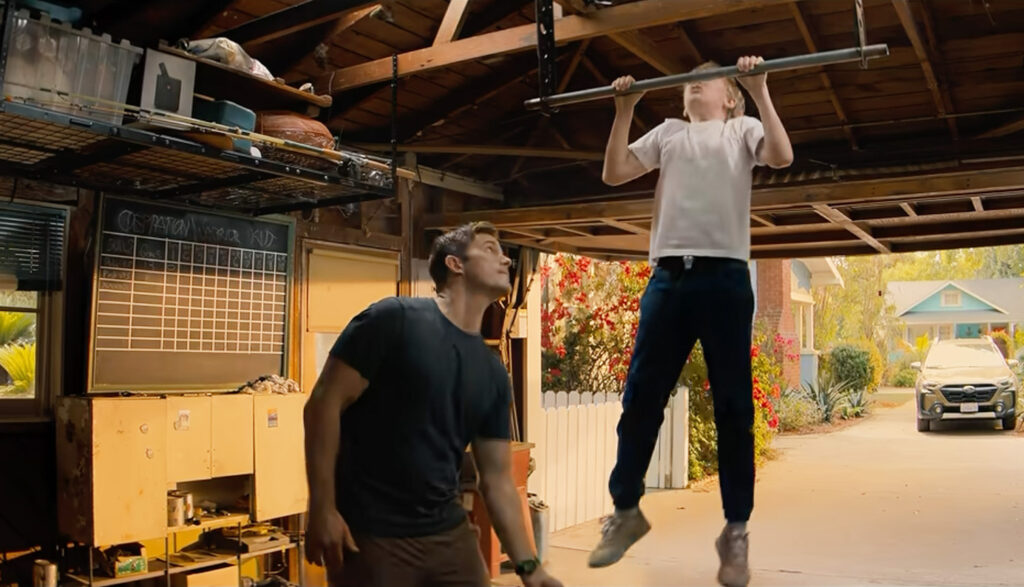
A Navy SEAL visits his sister’s house for some much-needed R&R, and he discovers that his nephew could use a little help himself. While Way of the Warrior Kid contains violence, peril, a bit of profanity and some sexual asides, the film also encourages us to engage in the hard work of self-improvement. And that makes this a surprisingly inspirational film.
Marc Lee is not one of the cool kids. He’s not even one of the average kids. Marc knows it. Everyone in school knows it. Worst of all, Kenny knows it.
Kenny. He’s a foot taller than Marc and clearly never had a pimple in his life. He mocks Marc relentlessly on social media. He nicknamed Marc the “GLOAT,” or “Greatest Loser of All Time.”
But hey, Kenny’s just saying what everybody’s thinking, right? So Marc believes, anyway. Yep, the only person who thinks Marc’s any better than a month-old turnip is his mom, Sarah. And when you’re 13 years old, that’s cold comfort.
Marc’s just about to head to ninth grade, too. And while everyone talks about new beginnings and fresh starts and blah blah blah, Marc knows it’ll be the same ol’, same ol’. Kenny will be there, along with his loyal band of tormenters. And he’ll make sure that everyone in high school knows what a loser Marc is.
Ordinarily, Marc would at least have the summer to look forward to, but even that’s not gonna happen this year. See, his uncle Jake is going to be living with them for a couple months. Jake—the Navy SEAL, the guy who has muscles on top of his muscles, the guy who doesn’t just laugh in the face of danger but takes danger out for coffee and makes it drink a frothy cappuccino with sprinkles.
When Sarah sees Marc’s face fall when she tells him about Uncle Jake’s stay, she asks why.
“I don’t want him to see that I’m …”
“What?” Sarah asks.
“That I’m weird.”
Marc doesn’t know it, but back in the day, Jake was a little weird, too. And Sarah wonders whether her brother might be the mentor that Marc could use—a father figure who can help her son not just grow older, but grow up. Grow into the sort of man that Sarah knows Marc can be.
And who knows? Maybe Marc can even teach Jake a thing or two as well.
Jake isn’t in town just for a visit. The Navy SEAL needs some serious recuperation, both physically and mentally. His last mission—one that he led—ended with the death of a close friend and a debilitating injury to his own hand. But even though Jake’s there to rest, his sister, Sarah, asks if Jake might still have time to help Marc a little bit. As a mother, she does what she can, but Sarah knows there are limits.
“What 13-year-old wants to listen to their mom?” Sarah tells Jake. “He needs, like a teacher or a friend or a mentor or something.”
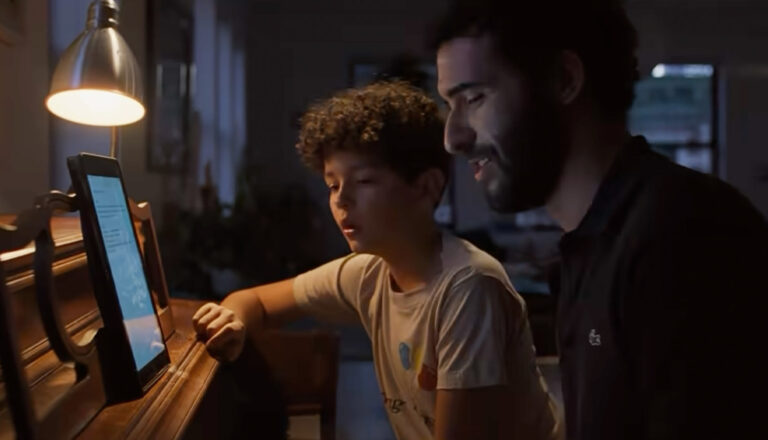
Jake becomes that something. He institutes, essentially, a summer-long boot camp that he calls “Operation Warrior Kid,” and he and Marc settle on some challenging goals, including doing 13 pull-ups.
“Thirteen pull-ups isn’t a goal!” Marc protests. “It’s a mythological quest!”
But while those goals are important benchmarks of Marc’s progress (just as our own goals are), the real victories come in finding the mental and emotional will to truly pursue those goals.
“Discipline equals freedom,” Jake writes on the board. “It means if you want to be able to do all the things that you want to do, first you have to take control of your life,” Jake tells him. That control manifests itself in, of course, a challenging physical regimen, but it doesn’t end there. It’s about mental toughness, too: Jake pushes Marc to study harder in school and memorize the names of the U.S. presidents in order. Jake asks Marc to help his mother in the ice cream shop she owns.
But the training is hard, and Marc wants to bail at first. He pushes back hard, and Jake walks away: You can’t change people who don’t want to be changed—or put the work into it. “You want to be a warrior?” Jake asks him. “I suggest you find out what that means.” And so Marc does, reading the Navy SEAL ethos in the library. “I will never quit,” the creed reads in part. “I persevere and thrive on adversity. I get knocked down, I get back up, every time.” From then on, Marc is fully committed to following Jake’s leadership.
Initially, the end goal in Marc’s eyes is to get tough enough to beat up the bully Kenny. And Jake indeed helps Marc learn how to fight, enrolling him in a Jiu Jitsu class. But Jake insists that the goal isn’t to beat somebody up: “You’re gonna learn how to fight so you don’t have to fight,” Jake tells him. And Jake repeatedly says that fighting is rarely the answer to anything.
In due time, Marc sees that Jake is right about that. Marc discovers that Kenny is dealing with some serious issues of his own, and Marc does his best to avoid a physical confrontation—not out of fear, but empathy.
In a grave crisis, Marc has an opportunity to put all of his training to the test, and he winds up saving not just Kenny, but a bunch of other people, too.
While Jake gives Marc a lot of help, Marc finds an opportunity to return the favor.
As mentioned, Jake is recuperating from a failed mission and its tragic end. But he hasn’t told anybody about how he feels about what happened. Marc tells Jake that Native American warriors would often tell stories after a big battle. “They talked about the heroic parts,” Marc says. “They talked about the hard parts, too. That way, one warrior didn’t have to carry it.” Marc tells Jake that he’d be happy to listen to Jake’s story if he wants—and Jake takes him up on his offer.
During a reconnaissance mission, Marc tells Jake over a walkie-talkie that he’s “advancing to target for God and country.” When Marc reaches one of his goals, he quips, “god-mode unlocked.”
Marc meets—and is quickly smitten by—a girl named Nora. That smiting is physical as well as romantic; the two hit it off in Marc’s Jiu Jitsu class, and when they spar and wrestle, Nora knocks the inexperienced Marc around quite a bit. But Marc gets better, and soon he’s asking Jake about how to ask Nora out: Not on a date, of course, but, y’know, to just hang out.
At first, Jake thinks that Marc wants to talk about puberty and “the changes going on in your body.”
“Gross!” Marc says. “It’s not that!”
Jake coaches Marc a bit—coaching that turns out to be unnecessary, as Nora ultimately asks Marc to go to the local fair with her. The day of the, um, not-a-date, Jake drives Marc to the fair and asks the kid what he knows about the “birds and the bees.”
“I got you something,” Jake tells Marc. “It’s better to have it and not need it than need it and not have it.” While we’re set up to believe Jake’s going to hand the 13-year-old a condom, he instead hands him a container of breath mints.
Nora and Marc hold hands while riding a roller coaster, and they nearly kiss on a Ferris wheel before they’re interrupted.
Both Jake and Marc spend some time shirtless. Marc makes a joke about the importance of not dropping soap in a shower—a curious reference to same-sex encounters in communal bathrooms. Sarah and Jake take Marc clothes-shopping for his big not-a-date. One of the outfits that he tries on looks like a dress but is, in fact, a kilt. “Very Timothée Chalamet,” the clerk says.
Jake’s failed mission involved the attempted rescue of children from their kidnappers. We see parts of that mission, including when a missile hits the tail of the helicopter Jake is riding in, sending him and his men to the jungle floor below. We see them engage in a firefight with some hostiles, and Jake’s friend, Kyle, is mortally wounded. The camera doesn’t reveal anything particularly gory, but we do see some blood and know that Kyle is done for. Jake’s right hand also was temporarily paralyzed in the mission: He undoes the cast protecting the bloody wound at Sarah’s house.
Kenny’s bullying can take on a physical dimension. Early in the film, Kenny and his pals chase Marc while all are on bikes. Kenny jams a baseball bat into the spokes of Marc’s bicycle wheel, sending Marc and his bike flipping end-over-end. Kenny then threatens to throw Marc off a bridge into the water below—but Marc says he can’t swim, so Kenny tosses Marc’s bike off the bridge instead. Kenny pushes Marc to the ground once or twice, too, and he often threatens to exact more physical violence.
We see a bunch of kids spar, wrestle and throw each other around in Jiu Jitsu class—sometimes twisting and bending arms painfully in order to get their opponent to tap out. Outside of class, one kid administers a choke hold on another, forcing the victim to tap out as well.
Marc doesn’t know how to swim at the movie’s open. It stems from a bit of childhood trauma when some other kids pushed him under the water and he sank: “If my father hadn’t pulled me out by the hair on my head, I would’ve drowned.” Marc says that his dad had planned to teach him how to swim, but he died before he had the chance.
Marc’s fear of water remains, though. It might not help that Jake wants Marc to jump off a bridge that’s suspended about 70 feet above a local river. “River drowning is like the third leading cause of child mortality,” Marc gravely says.
A man shoves his son and throws empty beer cans at him. A dog chases a snooper. There’s a reference to the serial killer Jeffrey Dahmer. Marc plays a violent video game. An angry, hurting Marc pummels Jake on the chest.
[Spoiler warning] A forest fire, exacerbated by high winds, breaks out during a bus-borne school outing. The bus is knocked over by a falling tree and rolls several times as it tumbles down an embankment. The accident leaves the driver incapacitated, and the principal suffers a broken leg. Marc runs across another kid unable to move. The fire threatens pretty much everyone on the bus, and it becomes a particularly challenging moment for Marc. He’s nearly killed before summoning the courage to jump off a huge ledge and into the water below.
We hear one use of the word “a–” and two each of “b–ch” and “h—.” The word “fudge” is used as an f-word stand-in.
Sarah drinks wine at dinnertime. When Marc goes shopping for clothes, one outfit makes him look like a “Miami drug lord,” according to Jake.
While Marc is working at his mother’s ice cream parlor, Kenny and his friends walk in and force Marc to make them “three of your finest chocolate sundaes”—without paying for them, of course. “What are you gonna do about it, cry to you mommy?” Kenny taunts. Later, Kenny dumps popcorn on Marc and Nora, and, still later, he demands that Marc hand over the ice cream that Marc’s eating. Marc gives it to him—by shoving it in his face.
Jake tells Marc that he had his own share of problems when he was young: “Do you know I got arrested when I was your age?”
“See? Even that sounds cool!” Marc tells him.
“It wasn’t cool. I acted out. Failed in school. I was angry all the time. No one wanted to be around me.”
Jake tries to mislead his commanding officers that his hand and arm are fine in order to return to the field and finish the mission he started.
“I don’t think I’m ever gonna change,” Marc laments early on in Way of the Warrior Kid. And that might’ve well been true—had it not been for Jake’s not-so-gentle prodding and Marc’s own will.
Change hurts. Sometimes it hurts physically, like when Jake tells Marc to keep trying to do pull-ups until his arms fall off. But it can hurt mentally and emotionally and even spiritually, too. Most of us are creatures of comfort. We like our comfy couches and pieces of pie and rote routines that never alter. But, as Jake says, “Comfort’s a curse.” And while I don’t think that’s always true, it often is.
Way of the Warrior Kid offers some outstanding lessons to children growing up in our age of comfort, where we see more screens than people, where we can be a Madden NFL star with a bowl of Cheetos hunkered at arm’s reach. For those of us who think that life is a little too easy these days, and that our kids might be growing up a little soft and sheltered, Way of the Warrior Kid provides a gentle prod for kids to get off their keesters, sweat a little and challenge themselves.
But I don’t think that kids are the only ones who could use that lesson. We adults are often just as guilty of loving our own comforts. We watch more football than we play. We scroll through other people’s memories instead of making our own.
I think one of the secrets to Marc’s transformation was having Jake in his corner—a guy who not only could push and encourage him, but who walked the walk. It’s a good lesson for us moms and dads, too. We can tell our kids to do a lot of stuff. But to make a lesson truly stick, we need to show them. Want your daughter to exercise? Exercise with her. Want your son to put down his phone? Put down your own.
Movies like this can inspire us. They can be catalysts that can make their viewers want to change. But real change? Yeah, it’s hard—as Jake and Marc both know. And for that, you need help that sticks with you beyond when the credits roll.
Way of the Warrior Kid comes with some content concerns, too: Some violence, profanity and strangely sexual asides will mar this film for many.
But this Apple TV film is also a welcome rarity in the movie world these days. It’s boldly and unapologetically aspirational. Rather than telling us we’re just fine just the way we are (which does contain an element of truth to it), it suggests that we could be even better. It encourages us to engage in that hard work of change. It reminds us that we can all be heroes—not just in our own stories, but in other people’s as well.
But to do so requires work. And that work begins once the movie’s done.

Paul Asay has been part of the Plugged In staff since 2007, watching and reviewing roughly 15 quintillion movies and television shows. He’s written for a number of other publications, too, including Time, The Washington Post and Christianity Today. The author of several books, Paul loves to find spirituality in unexpected places, including popular entertainment, and he loves all things superhero. His vices include James Bond films, Mountain Dew and terrible B-grade movies. He’s married, has two children and a neurotic dog, runs marathons on occasion and hopes to someday own his own tuxedo. Feel free to follow him on Twitter @AsayPaul.